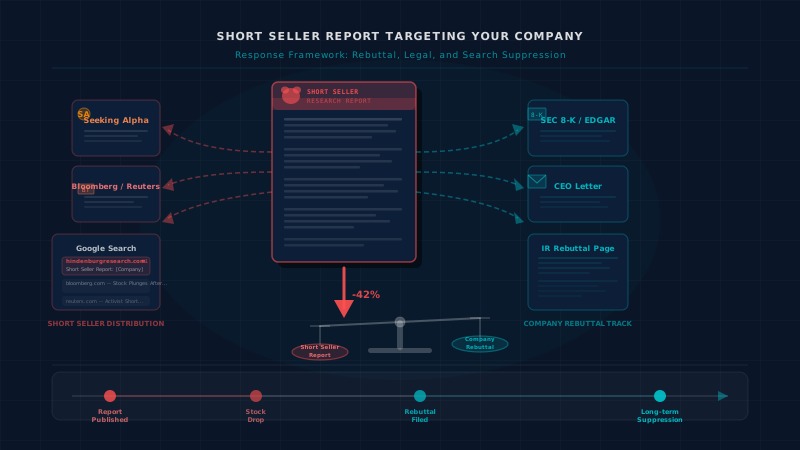
A Short Seller Published a Report on Your Company. Here Is What You Can Actually Do.
A short seller research report is one of the most damaging and most difficult reputation problems a public company can face: the report is written by professionals who know exactly how to make allegations sound credible, it is distributed to financial media and published on platforms that rank very highly in Google, and the short seller has a financial incentive to maximize the reputational damage because their position profits from the stock decline. Unlike a news article, a short seller report is not subject to journalistic ethics standards -- it is a financial document and an advocacy piece simultaneously. But the company has more options than it might appear.
By Anthony WillFounder & CEO, Reputation Resolutions · Removing articles since 2013
Updated June 30, 2026Published May 12, 2026 · 9 min read
Key Takeaways
Short seller reports are not news articles -- they are financial advocacy documents published by parties with a direct financial interest in damaging the company's reputation; this affects what legal and reputational responses are available.
The report itself has very limited removal options -- but the news articles covering the report are standard editorial targets that respond to the same removal and correction frameworks as any other news article.
A rapid, substantive factual rebuttal published within 48-72 hours is the most effective single response to a short seller report -- companies that respond with specifics outperform those that issue general denials in both stock recovery and search presence outcomes.
Over time (2+ years after the short position is covered and the report is stale), Google de-indexing and counter-content strategies become viable for managing the residual search presence for company name searches.
What Short Seller Reports Are and Why They Are Uniquely Hard to Address
Professional short sellers -- firms like Hindenburg Research, Muddy Waters Capital, Citron Research, Gotham City Research, and Grizzly Research -- publish detailed research reports alleging accounting fraud, misleading disclosures, undisclosed related-party transactions, channel stuffing, or other financial misconduct. These are not opinion pieces dashed off by individual investors. They are often lengthy, heavily footnoted documents that cite public filings, interview former employees, reference satellite imagery of manufacturing facilities, and present financial modeling designed to show that the company's reported numbers do not add up.
The distribution structure of a short seller report is designed for maximum reach and minimum delay. The report is typically published simultaneously on the short seller's own website -- which, for established firms, carries significant domain authority built up over years of high-traffic financial research -- and on Seeking Alpha, which has very high domain authority specifically for financial content. Short seller attacks that trigger company bankruptcy news coverage or wire service press releases from plaintiffs' firms create additional removal challenges that require separate strategies. Simultaneously, the report is emailed directly to institutional investors and financial journalists at Bloomberg, Reuters, CNBC, the Wall Street Journal, and the Financial Times. Coverage from these outlets follows within hours, not days.
The short seller holds a financial position that profits if the stock price declines. This is legal under US securities law. The SEC on short selling explains investor protections and the regulatory framework. Short sellers are also protected by the same First Amendment considerations that protect financial commentary broadly -- a point documented in the EFF defamation guide. The fact that the publisher profits from the damage is not, in itself, a legal defect in the report.
This structure creates several compounding problems for the company trying to respond:
1
The short seller has no incentive to remove the report. Their position benefits from continued circulation. Every day the report ranks in Google is a day the short thesis is reinforced for investors doing diligence.
2
The report typically mixes accurate and inaccurate allegations. Short sellers are skilled at identifying real operational or disclosure weaknesses and amplifying them. A company that tries to issue a blanket denial encounters credibility problems when some of the allegations are technically accurate, even if the conclusions drawn from them are not.
3
The financial press treats short seller reports as newsworthy regardless of accuracy. The secondary news coverage is editorially independent -- Bloomberg is not republishing the short seller's document, it is covering it as a news event. That coverage requires its own response strategy.
We help manage the reputational damage from enforcement actions — suppression, de-indexing & reputation control.
No upfront payment No retainer A+ BBB Rated 5,000+ clients helped In business since 2013 Reputation Control Experts True Removal Experts
A short seller research report is one of the most damaging and most difficult reputation problems a public company can face: the report is written by professionals who know exactly how to make allegat
Section 02
The Immediate Response Window (First 72 Hours)
The first 72 hours after a short seller report is published determine the shape of the recovery. Companies that respond poorly or slowly in this window create a narrative vacuum that the short seller's report fills by default. Companies that respond well create the foundation for both stock price recovery and long-term search presence management.
Issue a factual rebuttal, not a general denial. A statement that the report is false and misleading is not a rebuttal -- it is a talking point that financial media ignores and institutional investors distrust. The rebuttal must be specific. Identify the specific false claims paragraph by paragraph. Respond to each with documentation: the actual financial figures, the actual disclosure language, the actual contract terms. Companies that issue specific, documented rebuttals within 72 hours see faster stock price recovery and generate counter-content that ranks alongside the short seller report in Google searches for the company's name.
File an 8-K if the allegations are material. If the short seller report contains material allegations, an 8-K filing that includes a point-by-point rebuttal becomes a permanent SEC record published on EDGAR -- one of the few platforms with domain authority comparable to the short seller's own site. An EDGAR-hosted 8-K rebuttal can rank on page one of a company name search within days of filing. It is also a document that institutional investors and analysts are required to read, making it the most authoritative counter-narrative available.
Do not threaten legal action in the public rebuttal. Legal threats against short sellers in the initial rebuttal almost universally backfire. Financial media covers those threats with the framing that the company is attempting to silence critics rather than address the substance of the allegations. The legal threat becomes the story, displacing the factual rebuttal. Pursue legal remedies separately and quietly through counsel.
Brief institutional investors directly within the first 24 hours. Investor relations outreach to your top 20 institutional holders before the market opens on the day after the report is published prevents the narrative vacuum that short sellers rely on. Analysts who receive a direct briefing with supporting documentation can publish their own responses -- which become independently indexed counter-content.
Practitioner Perspective
"The companies that recover fastest from short seller attacks are the ones that treat the rebuttal as a content problem, not just a legal problem. A detailed 8-K, a CEO letter to shareholders, a point-by-point webpage, and a series of interviews with financial media all create indexed content that competes with the short seller report in Google. The legal path takes years; the content path starts working in weeks."
Section 03
Can the Short Seller Report Be Removed?
This is the question most companies ask first, and it deserves a direct answer. The short answer is: removal of the report itself is rarely achievable. Removal of the secondary news coverage is more actionable but still difficult. Here is the honest breakdown by platform.
From the short seller's own website: almost never. The report is the short seller's intellectual property and their financial instrument. They will not remove it voluntarily -- the report continues to drive traffic and reinforce the thesis for as long as the short position or the short seller's reputation benefits from its circulation. Courts have generally protected short seller reports as financial commentary protected by the First Amendment. Some reports have been quietly withdrawn when the short seller covered their position and moved on, but this is the short seller's decision, not the company's. It cannot be compelled in most circumstances.
From Seeking Alpha: hard, rarely achieving full removal. Seeking Alpha publishes short seller reports as third-party contributor content from verified investors. Its content policies permit this category of research. Removal requests based on alleged inaccuracy go through Seeking Alpha's editorial review process, which is slow and infrequently results in full removal. Corrections or clarifying notes are sometimes appended following a documented company rebuttal. The practical expectation is correction, not removal.
From Google search results: limited while the report is live, more viable for older secondary coverage. The short seller report itself, if still live and actively maintained, is difficult to de-index from Google -- it is current content on a legitimate domain with high authority. However, news articles covering the report that are two or more years old, and where the underlying allegations have been addressed without SEC action or regulatory findings, may qualify for outdated content removal requests through Google outdated content removal. You can also deindex the article on Google through other pathways where applicable. This is the more productive Google-layer strategy.
Legal route -- defamation claims: high bar, limited success rate. Companies have pursued defamation claims against short sellers. The results have been mixed at best. Courts apply a high standard to defamation claims against financial commentary, particularly when the target is a public company. The most successful legal strategies have focused narrowly on specific, demonstrably false factual claims -- not opinions, not financial interpretations, not forward-looking allegations -- that can be proven false with documentary evidence. Consult a news article removal attorney to assess whether your case meets the defamation lawsuit threshold. The SPJ ethics code also provides useful context on what constitutes responsible financial reporting versus advocacy.
Critical Caution
Do not file a legal action against a short seller primarily as a PR strategy to signal confidence. Courts are experienced with this tactic and financial media covers these lawsuits extensively -- often with the framing that the company is trying to silence critics rather than address the underlying allegations. Pursue legal remedies only when the factual case is strong and the goal is actual legal relief, not press coverage of the lawsuit.
Section 04
The News Coverage Track -- A More Actionable Target
While the short seller report itself is a difficult removal target, the news coverage it generates is a different matter. News articles published by Bloomberg, Reuters, CNBC, the Wall Street Journal, and trade press outlets are editorial content -- and editorial content follows the standard frameworks for correction, update, and, in some cases, removal.
The most important characteristic of short seller news coverage is that it is often never updated. A reporter covers the short seller report as breaking news on the day it is published. If the company subsequently files a detailed 8-K rebuttal, analysts upgrade the stock, and the SEC closes its books without taking action, the original article frequently never receives a follow-up. The article continues to rank in Google describing allegations that have effectively been addressed, with no indication that the situation evolved.
This creates several actionable paths:
1
Rebuttal as grounds for correction request. A factual rebuttal filed with the SEC gives companies specific, documented grounds to contact the original reporter and request that the article be updated to reflect the company's response. Many outlets will append a paragraph noting that the company filed a rebuttal -- this is not removal, but it changes the framing of the article and improves what readers find when they follow up on the original coverage.
2
Follow-up coverage as counter-content. When analysts publish research notes defending the company's fundamentals, those notes are often covered by the same financial press that covered the short seller attack. A Bloomberg or Reuters article reporting that major institutional holders have added to their positions following the rebuttal ranks for the company's name and provides the counter-narrative Google needs to balance the search results.
3
Outdated content removal for resolved allegations. Articles from 2+ years ago describing pending investigations or allegations that have since been resolved -- no SEC enforcement action, no fraud determination, no regulatory finding -- are strong candidates for outdated content removal requests. Google's outdated content removal tool is available for exactly this category: information that was accurate when published but has been superseded by subsequent developments.
4
Major outlets rarely remove but do append. Bloomberg and Reuters have removal thresholds that are extremely high. The realistic outcome for major outlet coverage is a correction, an update that adds the company's response, or a follow-up article that provides context. Trade press and smaller financial outlets have more varied policies and in some cases do remove articles where the underlying allegations have been definitively resolved.
For companies where the acute crisis has passed -- the short position has been covered, no regulatory action was taken, and the company has returned to normal operations -- the residual search presence problem is the one that persists longest. A report published three years ago by a short seller who has long since moved on can still rank on page one of a company name search, coloring every analyst introduction, every partnership conversation, and every executive hire.
The rebuttal materials published during the crisis continue to rank as positive signals if properly maintained. A detailed 8-K rebuttal on EDGAR does not expire. A point-by-point response page on the company's investor relations site continues to be indexed. These materials, if kept current and properly structured for search, provide a long-duration counter-narrative.
Third-party validation content ranks well and carries persuasive weight. Independent auditor reports confirming the company's financial statements, regulatory clearance letters where applicable, sell-side analyst upgrades published after the rebuttal, and industry association recognitions all create indexed content that provides the counter-narrative Google needs to balance search results for the company's name. This content ranks particularly well because it comes from sources with no financial interest in the company's stock price -- which is precisely the credibility the short seller's report lacked.
Earned media coverage of company performance since the report is the strongest long-term signal. A company that has grown revenue, completed acquisitions, signed major contracts, or received analyst coverage upgrades in the two years following a short seller attack has a body of positive, independently indexed content that Google can weight against the original report. The goal of the long-term content strategy is to give Google enough high-authority positive content that the short seller report is displaced from the top results for the company's name.
The company's Wikipedia article should reflect the full timeline and outcome. Wikipedia pages for public companies often describe short seller attacks without noting subsequent rebuttals, regulatory clearances, or stock recovery. An accurately maintained Wikipedia article that documents the full timeline -- report published, company responded with specific rebuttal, no regulatory findings, stock recovered -- provides an important counter-narrative on a platform with very high domain authority.
The Investor Relations page should prominently surface any regulatory clearances. If the SEC reviewed the allegations and took no action, if the auditor reaffirmed the financial statements, or if any formal regulatory process resulted in no findings, that outcome should be prominently featured on the IR site with appropriate documentation. Investors doing diligence will check the IR site, and the clearance information needs to be findable without extensive navigation.
Short Seller Report Removal: Difficulty and Realistic Outcomes by Content Type
Content Type
Removal Difficulty
Best Approach
Realistic Outcome
Short seller report (own website)
Extremely Hard
Legal action (defamation) if specifically false; otherwise suppression via counter-content
Report typically stays live; suppress via counter-content over 12-24 months
Seeking Alpha copy
Hard
Editorial review complaint; submit documented rebuttal to Seeking Alpha
Correction appended; rarely full removal
News articles (Bloomberg, Reuters, WSJ)
Hard
Rebuttal request to reporter; follow-up coverage pitch; formal correction request
Correction or follow-up article; rarely removal
News articles (trade press, 2+ years old)
Moderate
Outdated content removal (post-resolution, no SEC action taken)
De-indexing viable if allegations unsubstantiated and matter resolved
SEC 8-K filings (company's own rebuttal)
N/A -- Keep Live
Use as counter-content; EDGAR-hosted documents rank with high authority
Company rebuttal ranks alongside short report within days of filing
Google search results (aggregated)
Hard to Moderate
Counter-content strategy plus outdated content removal for older articles
12-24 months to see meaningful shift in page-one composition
Section 06
The 6-Step Response Plan
1
Within 24 hours -- brief the board, legal counsel, and investor relations team. Do not respond publicly yet. Gather the specific allegations from the report and identify, allegation by allegation, which claims are factually false versus which are matters of interpretation or financial modeling disagreement. The distinction matters significantly for the rebuttal strategy and any subsequent legal action.
2
Within 72 hours -- publish a specific, documented rebuttal. File an 8-K if the allegations are material under SEC guidance. Post a point-by-point response page on the company's investor relations site. Do not issue a general denial. Every allegation in the short seller report that is demonstrably false should be addressed with the specific documentation that establishes the falsity.
3
Brief institutional investors and sell-side analysts directly. Investor relations outreach to the top institutional holders with the rebuttal documentation prevents the narrative vacuum and gives analysts the information they need to publish their own assessments. Analyst notes defending the company's fundamentals rank in financial databases and Bloomberg terminals, providing third-party validation that institutional investors rely on.
4
Pursue legal remedies separately if the factual case is strong. If the report contains specifically false factual statements -- not interpretations, not opinions, but demonstrably false factual claims -- engage securities litigation counsel to assess defamation and market manipulation claims. Do not announce this publicly in the initial rebuttal. Pursue it as a parallel track, and only if the facts genuinely support it.
5
Monitor and address news coverage through the standard editorial framework. Identify the articles covering the short seller report. Contact reporters to request follow-up coverage or corrections where the rebuttal has addressed specific false claims. Document every interaction. For articles at major outlets, the realistic target is a correction or a follow-up piece, not removal.
6
12-24 months out -- assess the residual search presence. If no regulatory action has resulted from the short seller's allegations and the short position has been covered, pursue outdated content removal for news articles where the underlying allegations have been addressed and time has passed. Publish updated IR content with third-party validation -- auditor sign-offs, regulatory clearances, analyst upgrades -- to provide Google with positive, high-authority content to rank alongside the original report.
If Removal Fails
When Short-Seller Report Removal Isn't Achievable: What We Can Do
Short-seller reports occupy a protected space in securities law: they are typically framed as investment opinions, they are published by firms with First Amendment and market commentary protections, and defamation claims against them face a high legal bar because financial forecasts and investment views are generally treated as opinion rather than fact. Legal challenges to short-seller reports have a poor track record -- most are dismissed, and filing a claim can generate additional negative press coverage ("company sues short seller") that compounds the original damage. The more practical approach for most issuers is a search suppression campaign paired with proactive investor relations content: audit confirmations, regulatory clearances, analyst upgrades, and management rebuttals that give institutional investors and retail searchers substantive counter-information to weigh against the short seller's allegations.
Our team assesses each short-seller situation individually -- including the specific allegations, the publisher's profile, and the regulatory environment -- and provides a direct answer about whether any removal pathway exists and what a suppression campaign would realistically accomplish. For cases where individual news articles covering the report can be addressed, we work on a pay-for-results basis. Reputation Resolutions has 13+ years of experience and has worked with 5,000+ clients. A free consultation gives you a direct answer within one business day.
Not Sure What's Possible?
Our team reviews every situation individually and gives you a direct answer -- what's removable, what can be suppressed, and what a realistic timeline looks like. Schedule a free consultation and hear back within one business day. No pressure, no obligation.
Free Consultation
Is your article removable? Find out -- free.
Tell us about your situation and a removal specialist will personally review it and respond within one business day. No pressure, no obligation.
No upfront payment -- you only pay if we succeed
A+ BBB Rated · 5,000+ Clients Helped · Since 2013
100% Confidential · Response within 1 business day
Frequently Asked Questions
Short Seller Report FAQ
Can a public company force a short seller to remove their research report?
Almost never through direct compulsion. Short seller reports are the intellectual property of the firm that published them and are protected under the same First Amendment considerations that apply to financial commentary. Courts have generally declined to order removal of short seller reports absent specific, demonstrably false factual claims that meet a high defamation threshold. The practical path is not removal of the report itself but management of what ranks alongside it in search results -- through counter-content, rebuttal filings, and, over time, outdated content removal for secondary news coverage where the underlying allegations have not been sustained.
How do we respond to a short seller attack on our company?
The most effective response combines a specific, documented factual rebuttal published within 72 hours with an 8-K filing if the allegations are material, direct outreach to institutional investors and sell-side analysts, and a point-by-point response page on the company's investor relations site. General denials -- statements that the report is false and misleading without specifics -- are largely ineffective and are treated by financial media as confirmation that the company is rattled. Companies that respond with documented specifics recover faster in both stock price and search presence than those that issue general statements.
Can a short seller report be removed from Seeking Alpha?
Rarely in full. Seeking Alpha publishes short seller reports as third-party contributor content under its editorial policies, which permit verified investors to publish research. Removal requests based on alleged inaccuracy go through Seeking Alpha's editorial review process. This process moves slowly and infrequently results in full removal. Corrections or clarifying notes are sometimes appended following a documented company rebuttal. The more productive path for most companies is building indexed counter-content that ranks alongside the Seeking Alpha page rather than pursuing removal directly.
Does filing a lawsuit against a short seller help remove the report from Google?
Filing a lawsuit does not remove the report from Google and typically makes the search presence problem worse in the short term. Lawsuits against short sellers are covered extensively by financial media, often with the framing that the company is attempting to silence critics rather than address the substance of the allegations. This coverage generates additional indexed content that ranks for the company's name. Legal remedies should be pursued only when the factual case for defamation is strong, and separately from the public communications strategy.
How long do short seller reports stay in Google search results?
A short seller report that remains live on the publisher's website will continue to rank as long as it is accessible and the firm maintains its domain authority -- which for established firms like Hindenburg Research and Muddy Waters Capital can be indefinitely. Secondary news articles covering the report have a more variable lifespan. Articles 2+ years old where the underlying allegations have not resulted in SEC action, regulatory findings, or fraud determinations are viable candidates for outdated content removal from Google. The report itself is a harder target; the strategy for most companies is suppression through counter-content rather than removal of the source document.
What is the best counter-content strategy after a short seller attack?
The most effective counter-content strategy combines several content types published across high-authority platforms: the 8-K rebuttal filed with the SEC (published on EDGAR, which has very high domain authority), a point-by-point response page on the company's investor relations site, CEO or CFO interviews with financial media outlets, analyst research notes from sell-side firms that have reviewed the rebuttal, and ongoing earned media coverage of company performance. Third-party validation content -- auditor reports, regulatory clearances, analyst upgrades -- ranks well for company name searches and provides the counter-narrative that Google needs to balance search results over the 12-24 month horizon.
Short Seller Report Still Ranking. Let's Map Your Options.
We work with public companies, investor relations teams, and communications professionals dealing with the search presence fallout from short seller attacks. We can't always remove the report -- but we can show you what is actually possible.
CEO & Co-Founder, RemoveNews.ai · Reputation Resolutions
Anthony has spent 13+ years studying what makes negative news content stick — and how to remove it. He co-founded Reputation Resolutions and has helped 5,000+ clients remove and suppress damaging press coverage. He holds Corporate & Crisis Communications and Brand Management certifications from Cornell, a Digital Marketing certificate from NYU, and is a member of the Forbes Agency Council and Fast Company Executive Board.