-
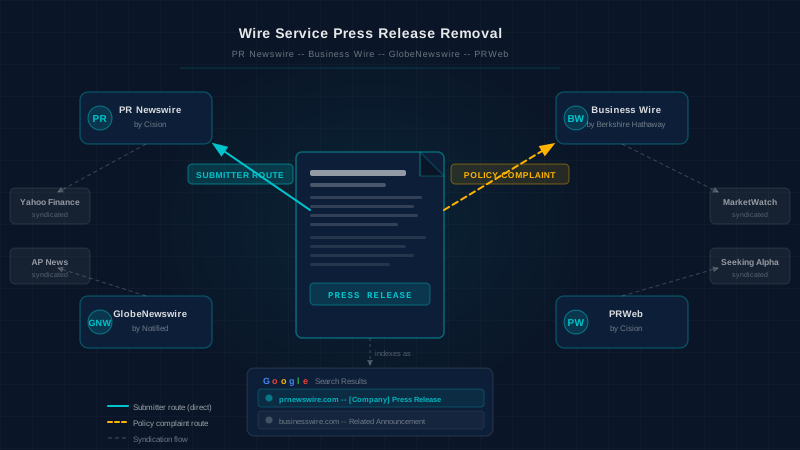
Wire services are distribution platforms, not publishers. PR Newswire, Business Wire, and GlobeNewswire publish what their clients submit, which means removal requests go through the original submitter -- not an editorial team.
-
If you submitted the press release yourself, removal is straightforward. Contact the wire service's customer service with your account information and request removal or correction.
-
If someone else submitted the press release, removal requires either convincing the submitter to retract or demonstrating a policy violation. Law firms, competitors, and regulators are the most common third-party submitters.
-
Google de-indexing of the wire service URL is often faster and more practical than attempting wire service removal. Both paths should be pursued simultaneously -- do not wait for one to complete before starting the other.
How Wire Services Work -- and Why That Matters for Removal
PR Newswire, Business Wire, and GlobeNewswire are paid distribution services. A client pays to submit a press release, which is then distributed to newsrooms, indexed on the wire service's own website, and syndicated to aggregator sites across the financial and general news ecosystem. The wire service does not fact-check or editorially review content beyond basic policy compliance. Their relationship is with the submitter -- the company or PR firm that paid for the distribution.
This matters for removal because the wire service will almost always defer to the submitter on questions of content modification or removal. If you are the submitter, you have leverage. If you are not, your leverage is limited to demonstrating a clear policy violation -- false or misleading statements, defamatory content, or a violation of third-party rights that the wire service's published policies explicitly prohibit.
Understanding ownership also matters for knowing where to direct a request. The major wire services and their parent companies:
PR Newswire: owned by Cision, one of the largest PR software and distribution companies globally. Customer service and content policy complaints route through Cision.
Business Wire: owned by Berkshire Hathaway. Business Wire operates independently with its own dedicated customer service and technical team.
GlobeNewswire: owned by Notified, formerly part of Intrado. Notified handles submitter support and content policy matters.
PRWeb: owned by Cision alongside PR Newswire. Lower tier than PR Newswire, with a self-service submitter dashboard. Widely used for lower-cost distributions, including litigation press releases from smaller law firms.
AccessWire: independent, mid-tier service used by investor relations professionals and smaller companies. Has its own support team for submitter removal requests.
EIN Presswire: lower-tier service heavily used by legal firms for litigation announcements, regulatory enforcement releases, and class action notices. Limited syndication reach compared to the major services.
For related guidance on removing class action press releases specifically, or on addressing government and regulatory press releases, see those dedicated guides. For scenarios involving data breach press release removal or SEC enforcement press release removal, those articles cover the specific challenges of each context. This article focuses on the wire service removal process itself across all scenarios.
Scenario 1 -- You Submitted the Press Release and Want It Removed
This is the simplest case. As the submitter of record, you have the clearest path to removal. The process varies slightly by service:
PR Newswire
Contact Cision client services directly -- either through your account portal or via their support contact form. As the submitter of record, you can request either a full takedown (complete removal of the press release from PR Newswire's website) or a correction (an updated version replaces the original, with a note that the release has been revised). Cision typically processes submitter removal requests within 5 to 10 business days.
Important: after removal from PR Newswire's own website, the press release will almost certainly persist on syndication partners -- Yahoo Finance, MarketWatch, AP News, and hundreds of regional aggregators. Those are separate indexed URLs and require separate requests. Do not assume wire service removal equals complete removal from the internet.
Business Wire
Contact Business Wire customer service with your account information and the wire number (the unique identifier assigned to each press release at distribution). Submitters have full rights to request removal or revision. Business Wire's technical team can also add a noindex meta tag to the press release URL if full removal is not desired -- this instructs Google to drop the URL from its index without deleting the page entirely, which can be useful when you need to preserve the page for internal record-keeping but want to eliminate its search presence. Timeline is similar to PR Newswire: 5 to 10 business days.
GlobeNewswire
Contact Notified support with your submitter credentials. Submitter removal rights are identical to the major services -- you can request full removal or correction. GlobeNewswire press releases also syndicate broadly across financial news aggregators. Address the wire service first, then identify and separately handle any aggregator copies that remain indexed.
PRWeb
PRWeb, owned by Cision alongside PR Newswire, has a distinct advantage for submitters: a self-service portal where you can log in to your account dashboard and unpublish press releases directly without contacting support. This is the fastest self-service removal option available on any major wire service, and it can be completed in minutes rather than days. If you no longer have access to the PRWeb account used for the original submission, contact PRWeb support directly with proof of submitter identity.
Scenario 2 -- A Law Firm, Competitor, or Third Party Submitted It
This is the harder case. You are not the submitter, so you have no direct removal rights with the wire service. Your options are to work through the submitter or to make a policy violation argument directly to the wire service's content team.
Contact the Submitter First
The most direct path is to contact the law firm, company, or individual who submitted the press release and request that they ask the wire service to remove or correct it. For law firm litigation press releases, this often means requesting that the firm add a case resolution note -- such as a settlement or dismissal -- or retract the original. Law firms are not obligated to do this, but some will, particularly after a favorable settlement for the defendant or when the underlying litigation is fully resolved. Approach this as a professional business request, ideally through legal counsel, rather than a confrontational demand.
Policy Violation Argument
Review the wire service's published content policy carefully. Most major wire services prohibit: false or demonstrably misleading statements of fact, defamatory content, content that violates third-party intellectual property rights, and content designed to manipulate markets or harm identifiable individuals. If the press release contains statements you can demonstrate are factually false -- not just unflattering or one-sided, but verifiably incorrect -- a policy violation complaint submitted to the wire service with supporting documentation may result in removal or correction.
The distinction between false and merely unflattering is critical. Wire services will not remove accurate press releases simply because they are damaging to the subject. The policy violation argument requires specific, documented factual errors -- dates that are wrong, settlements that are described incorrectly, outcomes that are misstated. Generic reputational harm arguments without factual specificity are unlikely to succeed.
Wire Service Content Teams
PR Newswire and Business Wire each maintain content review teams that handle policy complaints. Submit a detailed written complaint that identifies specific statements in the press release, explains why each statement violates the wire service's content policy, and provides documentation supporting your position. Do not submit a complaint that is simply a statement of disagreement -- frame it around the policy language and provide evidence. GlobeNewswire and PRWeb have similar processes, though their content review teams are smaller.
"The fastest path is almost always parallel: contact the submitter to request removal while simultaneously submitting a Google de-indexing request for the wire service URL. The Google removal can happen in weeks; the submitter negotiation may take months. Running both tracks simultaneously means you can get the search result addressed quickly while the underlying removal is being worked out."
The Syndication Problem -- Wire Copies on Yahoo Finance, MarketWatch, and Aggregators
A press release submitted to PR Newswire is automatically syndicated to dozens of financial and news aggregator sites as part of the distribution package. Yahoo Finance, MarketWatch, Seeking Alpha, AP News, and hundreds of regional news sites and financial portals all receive and index wire service content. Each syndicated copy is a separate indexed URL in Google's search index. Removing the press release from the wire service's own website does not touch any of these copies.
After securing wire service removal, the aggregator cleanup process follows the same general logic: demonstrate that the source has been removed or corrected, and request that the aggregator follow suit.
Yahoo Finance: submit a content removal request via Yahoo's content reporting tool. Yahoo Finance is generally responsive to removal requests for press releases that have been retracted or corrected at the originating wire service. The argument is straightforward -- the source content has been removed, and the syndicated copy should follow.
MarketWatch: owned by Dow Jones. Contact their editorial and content team with documentation of the wire service removal. MarketWatch's process is less standardized than Yahoo Finance's and may require follow-up, but removal of the source wire content is typically the strongest argument available.
AP News: the Associated Press syndicates press releases via its AP Content Services product. Contact AP Content Services directly with your wire service removal documentation. AP is generally receptive to correcting or removing syndicated content when the source has been officially retracted.
Google de-indexing for aggregator copies: after wire service removal, use Google's Outdated Content Removal tool to submit each aggregator URL individually. When the wire service URL returns a 404 or redirect and the aggregator copy also reflects removed or retracted content, the Outdated Content Removal request is typically processed within a few weeks. This is often faster than waiting for each aggregator's individual content team to act.
For a broader overview of how syndicated content spreads and how to address it across multiple platforms, see our guide on removing syndicated news articles.
Do not submit a new, corrective press release to the same wire service in response to the damaging one. This creates a second indexed URL that keeps the story alive in search results. A corrective press release that says "In response to the press release of [date]..." tells Google that the original press release exists and is being disputed -- and may cause the original to rank even more prominently by reinforcing its topical relevance. Address the original directly through the removal process rather than layering a response on top of it.
Google De-Indexing of Wire Service URLs
Google de-indexing is often the most practical first step for addressing a wire service press release in search results, particularly when the submitter is uncooperative or when full wire service removal will take time to complete. The two primary tools are Google's Outdated Content Removal tool and the Personal Information Removal tool, depending on the nature of the press release content.
Outdated Content Removal: this tool asks Google to update or remove search results that reference content that has materially changed since it was originally indexed. It is most effective when the press release describes a situation that no longer accurately reflects reality -- a lawsuit that has settled, a regulatory investigation that has been closed, a company that has been acquired or ceased to exist, or an executive who is no longer in the role described. The key is documenting the change: a settlement agreement, a court dismissal order, a regulatory closure letter, or other authoritative evidence of the changed situation strengthens the removal request significantly.
After wire service removal: once a wire service removes a press release and the URL begins returning a 404 error or redirect, submit the URL to Google's removal tool immediately. A dead URL is the strongest possible basis for a de-indexing request -- Google has no reason to keep a 404 in its index, and the removal tool accelerates the update of its index to reflect the changed state. Do not wait weeks for Google to discover the 404 on its own through its normal crawl cycle; the removal tool shortens that process substantially.
Personal information removal: if the press release contains personal information -- a home address, personal email address, personal phone number, or similar identifying information -- Google's personal information removal tool may apply independently of whether the press release has been removed at the source. This is particularly relevant for litigation press releases that include the names and addresses of individual defendants alongside corporate defendants.
Submit de-indexing requests for the wire service's primary URL and for every aggregator copy you can identify. Each URL is treated as a separate request. Do not submit a single request and assume it covers all versions of the content.
Wire Service Removal Comparison
| Wire Service | Submitter Removal | Third-Party Removal | Syndication Reach | Google De-Index Path |
|---|---|---|---|---|
| PR Newswire | Easy -- 5 to 10 days via Cision client services | Hard -- policy violation or submitter cooperation required | Very broad -- Yahoo Finance, AP News, 1,000+ partners | Outdated Content Removal tool; URL removal after 404 |
| Business Wire | Easy -- 5 to 10 days via Business Wire support; noindex option available | Hard -- same policy complaint route applies | Very broad -- MarketWatch, Reuters, AP News | Outdated Content Removal tool; noindex tag as alternative |
| GlobeNewswire | Easy -- contact Notified support with submitter credentials | Hard -- policy complaint route; limited editorial review team | Broad -- strong financial news syndication footprint | Outdated Content Removal tool |
| PRWeb | Easy -- self-service portal; unpublish directly without contacting support | Moderate -- policy complaint route; smaller content team but same process | Moderate -- smaller than major services | Outdated Content Removal tool |
| AccessWire | Easy -- contact AccessWire support; responsive to submitter requests | Moderate -- smaller team; policy complaint approach applies | Moderate -- IR-focused distribution network | Outdated Content Removal tool |
| EIN Presswire | Easy -- contact EIN support; account-based removal process | Moderate -- policy complaint route; widely used by law firms for litigation | Limited -- narrower distribution than major services | Outdated Content Removal tool |
The 5-Step Wire Service Press Release Removal Plan
-
1Identify all wire service copies ranking for your name or company. Run an incognito Google search for your name and company name. Note every wire service URL appearing in the results -- prnewswire.com, businesswire.com, globenewswire.com, prweb.com, accesswire.com, einpresswire.com. Also check Yahoo Finance, MarketWatch, and AP News directly. Build a complete URL inventory before taking any action.
-
2Determine who submitted each press release. The press release itself typically identifies the submitting company or PR contact in the boilerplate or distribution note. For your own press releases, proceed directly to contact the wire service. For third-party press releases, identify the submitter -- law firm name, company name, or PR contact -- and assess both the submitter cooperation path and the policy violation argument simultaneously.
-
3Contact the wire service (submitter route or policy complaint route) and document everything in writing. Send written requests -- not phone calls -- so you have a record of what was requested, when, and by whom. Keep copies of all correspondence, confirmation numbers, and any responses received. If the wire service acknowledges a removal timeline, follow up in writing if the deadline passes without action.
-
4Simultaneously submit Google de-indexing requests for each wire service URL. Use Google's Outdated Content Removal tool. Do not wait for wire service removal to complete before submitting these requests. The de-indexing process runs on its own timeline and starting it early means the search result may disappear from Google before the wire service even completes its removal process. If the press release describes a materially changed situation, document that change in your de-indexing request.
-
5After wire service removal, verify that syndication copies on Yahoo Finance, MarketWatch, and other aggregators are also removed or de-indexed. Search for the press release headline in quotes to surface any surviving copies. For each surviving aggregator URL, submit a separate Google Outdated Content Removal request and contact the aggregator's content team directly with documentation of the wire service removal. This cleanup phase is often the longest part of the process.
Wire service press release ranking for your name? We know the process for every major platform. Start with the URL.
Get a Free AssessmentPRWeb -- The Lower-Tier Service With a Self-Service Removal Option
PRWeb deserves its own section because it occupies a distinct position in the wire service landscape. Owned by Cision alongside PR Newswire, PRWeb is a lower-cost service widely used for litigation announcements, regulatory filings, and local business communications. Its lower barrier to entry means it is frequently used by law firms distributing class action notices, regulatory agencies announcing enforcement actions, and smaller companies making announcements that would not meet PR Newswire's minimum standards for distribution.
The key advantage for submitters is PRWeb's self-service portal. Submitters can log in to their PRWeb account dashboard and unpublish press releases directly -- no customer service contact required, no waiting 5 to 10 business days for a support team to process the request. This makes PRWeb the fastest self-service removal option of any major wire service. If you submitted a PRWeb press release and need it removed, logging into your account and unpublishing it is the most direct path.
If someone else submitted the PRWeb press release -- a law firm, a competitor, or a regulatory agency -- the self-service advantage disappears. The same policy complaint route applies as with the major services: identify specific false or policy-violating statements, document your position, and submit a formal complaint to PRWeb's content team. PRWeb's content review team is smaller than PR Newswire's, which can mean both faster processing (fewer cases in queue) and less predictable outcomes. Be specific, be documented, and follow up in writing.
PRWeb's syndication footprint is more limited than PR Newswire or Business Wire -- it syndicates primarily to regional news aggregators and smaller financial portals rather than Yahoo Finance or AP News at the same scale. This means the aggregator cleanup phase after PRWeb removal is typically less extensive, though it still requires individual attention to any copies that appear in Google search results.
Common Questions About Wire Service Press Release Removal
Stop the Wire Service Result. Control What Ranks for Your Name.
A press release on PR Newswire or Business Wire can rank for years without the right intervention. Our team handles the wire service removal process, the Google de-indexing requests, and the aggregator cleanup -- all simultaneously.
Free assessment. Confidential. No obligation.