GDPR Right to Be Forgotten Request Template (2026)
Most GDPR erasure requests fail not because the requester lacks a qualifying ground, but because the submission does not articulate that ground in the language Google's reviewers are trained to evaluate. This guide provides complete, fillable templates for three common scenarios, explains the anatomy of a request that gets reviewed rather than discarded, and tells you exactly what not to write.
By Anthony WillFounder & CEO, Reputation Resolutions · Removing articles since 2013
Updated June 30, 2026Published May 12, 2026 · 10 min read
Key Takeaways
The grounds statement is the entire request. Everything else supports it. A request without a specific Article 17 ground cited will be rejected before a reviewer reads the second paragraph.
Google's RTBF process applies only to EU search domains, not google.com. Requests targeting google.com will be rejected on geographic scope alone, regardless of their legal merit.
Emotional appeals actively harm your request. They signal to reviewers that no qualifying legal ground exists. Save the personal narrative for your own records and keep the submission clinical.
A rejection is not the end. Most DPAs, including the ICO and CNIL, accept complaints after a Google rejection and have successfully directed Google to comply. The escalation letter uses a different format and audience than the original form submission.
Google processes hundreds of thousands of right to be forgotten requests each year. The review is not performed by a court or a regulator. It is performed by trained content reviewers working through a high volume of submissions, applying a structured framework derived from Article 17 of the GDPR and the guidelines issued by the European Data Protection Board (EDPB).
Those reviewers are looking for a specific legal argument, not a personal story. The moment a submission identifies a qualifying ground under Article 17(1), the reviewer's job shifts from gatekeeping to evaluation. Until that moment, the reviewer's job is simply to categorize the request as qualifying or non-qualifying. A request that does not state a ground is automatically non-qualifying.
Article 17(1) of the GDPR sets out the conditions under which a data subject has the right to obtain erasure of personal data. There are six subsections. The most commonly applicable in news article contexts are:
a
Article 17(1)(a): The personal data is no longer necessary in relation to the purposes for which it was collected or otherwise processed. This is the most frequently cited ground for old news articles about private individuals whose circumstances have changed since publication.
c
Article 17(1)(c): The data subject objects to processing under Article 21(1) and there are no overriding legitimate grounds for the processing. This ground requires a separate objection statement and is more complex to argue successfully.
d
Article 17(1)(d): The personal data has been unlawfully processed. This applies where the original publication of the data, or its continued indexing, lacks a lawful basis under Article 6. It is the most powerful ground when applicable but requires a clear showing of unlawfulness.
e
Article 17(1)(e): The personal data has to be erased for compliance with a legal obligation. This most commonly applies in the context of court-ordered suppression, spent convictions under national rehabilitation law, or specific regulatory directives requiring removal.
Identifying the correct subsection is not optional. It is the foundational element of the request. Every other component, the specific URLs, the proportionality argument, the supporting documentation, exists to support the grounds statement. Without the grounds statement, those components are irrelevant to the reviewer.
How Reviewers Evaluate Requests
Google has published transparency data showing that it approves approximately 49% of URLs reviewed under the RTBF process. The approval rate varies significantly by content type and grounds stated. Requests citing specific legal grounds with supporting documentation approve at materially higher rates than requests citing general privacy preferences. The grounds statement is the single largest determinant of outcome. For a broader overview of what RTBF covers and does not cover, see our complete right to be forgotten guide.
We help remove content using your legal rights — you only pay after it’s gone.
No upfront payment No retainer A+ BBB Rated 5,000+ clients helped In business since 2013 Only Pay For Results True Removal Experts
Most GDPR erasure requests fail not because the requester lacks a qualifying ground, but because the submission does not articulate that ground in the language Google's reviewers are trained to evalua
Section 02
The Anatomy of a Successful RTBF Request
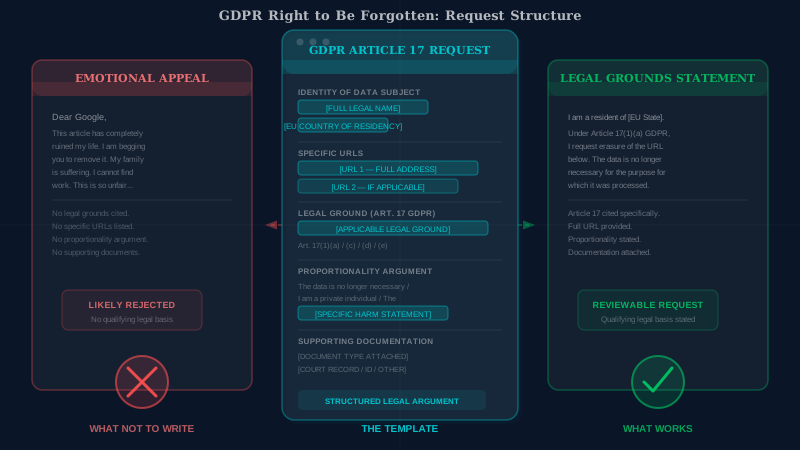
A well-structured GDPR erasure request directed at Google has five components. Each must be present. The absence of any one component weakens the request materially, and the absence of the grounds statement makes the request non-reviewable.
1. Identity of the Data Subject
You must identify yourself as the person whose data appears in the indexed content. This means your full legal name, your country of EU residence (establishing GDPR jurisdiction), and, if your name has changed since the article was published, your name at the time of publication. Google's form asks for this information directly. Do not conflate this with a general description of the content; state who you are and why the article pertains to you specifically.
2. Specific URLs
The request must list each URL you are seeking to have delisted, not the publication name, not a general description of the content. Each URL should be the exact address of the indexed page as it appears in Google search results for your name. Copy the URL directly from the address bar after clicking through from search results. Requests submitted with approximate or partial URLs cannot be acted upon.
If the same article appears on multiple domains or has been republished by aggregators, each URL must be listed separately. A single request can include multiple URLs, but each must be individually specified. Google delist decisions are URL-specific, not publication-wide.
3. The Legal Ground Under Article 17
Name the specific subsection. Write "Article 17(1)(a) of the GDPR" or the applicable variant. Then explain in two to three sentences why that ground applies to your circumstances. Do not list multiple grounds hoping one will stick; identify the strongest applicable ground and argue it specifically. Citing multiple subsections without explaining why each applies signals to reviewers that you do not have confident grounds for the request.
4. The Proportionality Argument
Even where a qualifying ground exists, Google must balance your privacy interest against the public's interest in accessing the information. The RTBF is not absolute; Article 17(3) carves out exceptions for freedom of expression, public interest, and journalism. Your proportionality argument is your rebuttal to those carve-outs. It should establish that you are a private individual rather than a public figure, that the information is no longer current or relevant, that the passage of time has reduced any legitimate public interest, and that the harm to you from continued indexing is concrete and ongoing.
5. Supporting Documentation
Documentation is not required by Google's form, but it substantially improves outcomes. The most effective supporting documents are those that corroborate the legal ground being cited: court orders, acquittal certificates, rehabilitation certificates, regulatory clearance letters, or official records showing that the underlying matter has been resolved. For identity verification, a government-issued ID is typically sufficient. Redact any information in supporting documents that is not directly relevant to the request before submission.
Section 03
The Templates: Three Scenarios
The following templates are designed to be copied into Google's RTBF form or into a formal written request. Replace all [PLACEHOLDER] fields with your specific information. Do not leave placeholder text in the submission. Each template is calibrated to a specific scenario; use the one that most closely matches your circumstances.
Template 1: Old News Article About a Private Individual
Use this template when the article was published about you as a private person, the events described are no longer current, and you have not voluntarily entered public life in the intervening period.
I am writing to request the delisting of the following URL(s) from Google search results on European search domains, pursuant to Article 17(1)(a) of the General Data Protection Regulation (EU) 2016/679.
Data Subject: [YOUR FULL LEGAL NAME]
Country of EU Residence: [EU MEMBER STATE OR UK]
Name as it appears in the article (if different): [NAME AT TIME OF PUBLICATION]
URL(s) Requested for Delisting:
1. [FULL URL OF INDEXED PAGE]
2. [FULL URL OF SECOND PAGE, IF APPLICABLE]
Legal Ground:
The personal data processed via the indexing of the above URL(s) is no longer necessary in relation to the purposes for which it was originally processed, within the meaning of Article 17(1)(a) GDPR. The article was published [APPROXIMATE DATE OR YEAR] and describes circumstances that no longer reflect my current situation. I am a private individual who has not voluntarily entered public life. The events described were [BRIEF FACTUAL DESCRIPTION: e.g., "a civil dispute that was settled and resolved in [YEAR]" / "a personal matter that received local press attention at the time"]. No ongoing public interest justifies the continued indexing of this personal data against my name.
Proportionality:
The continued indexing of this URL causes concrete harm to my [EMPLOYMENT / PROFESSIONAL / PERSONAL] interests. I am a private individual. The article does not concern my conduct in a public role. The passage of [X YEARS] since publication has eliminated any legitimate public interest purpose the article may have originally served. Continued indexing under my name is disproportionate to any residual public interest and constitutes unnecessary processing of my personal data under current circumstances.
Supporting Documentation Attached: [LIST DOCUMENT TYPES: e.g., "Government-issued ID confirming identity" / "Settlement agreement dated [DATE]" / "No further action letter from [AUTHORITY]"]
Note: Submit this text in the "Additional details" field of Google's official RTBF form at myaccount.google.com/delete-services-or-account. Attach documentation separately where the form permits.
Template 2: Resolved Criminal Matter (Spent Conviction or Acquittal)
Use this template when you were charged with or convicted of a criminal offence that has since been resolved through acquittal, dismissal, or by reaching spent status under your national rehabilitation law. The grounds shift to Article 17(1)(a) for acquittals and Article 17(1)(e) where national law creates a specific legal obligation of erasure for spent convictions.
I am writing to request the delisting of the following URL(s) from Google search results on European search domains, pursuant to Article 17(1)(a) and/or Article 17(1)(e) of the General Data Protection Regulation (EU) 2016/679.
Data Subject: [YOUR FULL LEGAL NAME]
Country of EU Residence: [EU MEMBER STATE OR UK]
URL(s) Requested for Delisting:
1. [FULL URL OF INDEXED PAGE]
2. [FULL URL OF SECOND PAGE, IF APPLICABLE]
Legal Ground:
The URL(s) above index personal data concerning a criminal matter that has been fully resolved. Specifically: [CHOOSE THE APPLICABLE STATEMENT BELOW AND DELETE THE OTHERS]
OPTION A (Acquittal / Charges Dropped):
I was acquitted of all charges / the charges were dismissed by [COURT NAME] on [DATE]. The indexing of this data therefore pertains to a criminal allegation that resulted in no finding of guilt. Continued processing of this personal data is no longer necessary for the purpose for which it was collected and constitutes processing of inaccurate personal data, in that it presents unresolved allegations as if they remain live matters (Article 17(1)(a) GDPR).
OPTION B (Spent Conviction):
The conviction referenced in the above URL became a spent conviction under [APPLICABLE NATIONAL LAW: e.g., "the Rehabilitation of Offenders Act 1974 (UK)" / "the relevant provisions of [MEMBER STATE] criminal rehabilitation law"] on approximately [DATE OR YEAR]. Under Article 17(1)(e) GDPR, personal data must be erased where necessary for compliance with a legal obligation to which the controller is subject. The continued indexing of a spent conviction under my name is incompatible with the legislative purpose of rehabilitation law and constitutes processing that my member state's law was specifically designed to prevent.
Proportionality:
I am a private individual. I have not held, and do not seek to hold, any public office or position of trust that would make my criminal history a matter of legitimate public concern. The [X YEARS] elapsed since the matter was resolved means that the information no longer reflects my current circumstances. The harm from continued indexing to my employment, professional reputation, and personal life is concrete and ongoing. No public interest purpose proportionate to that harm justifies continued indexing.
Supporting Documentation Attached: [e.g., "Certificate of acquittal / court dismissal order dated [DATE]" / "Rehabilitation of Offenders Act certificate or equivalent" / "Government-issued ID"]
Note: If your spent conviction involves a sensitive category of personal data (e.g., relates to a health condition or sexuality), note this explicitly, as Article 9 GDPR imposes heightened obligations on controllers processing such data.
Template 3: Outdated Business or Professional Coverage
Use this template when the article concerns your professional conduct or a business matter, the underlying issue has been resolved, and you are not a current public figure whose conduct in a professional role is a matter of ongoing legitimate public concern. This is a harder case than the private individual template because public interest arguments are stronger for professional conduct, so the proportionality argument must be correspondingly more detailed.
Template 3: Outdated Business / Professional Coverage
I am writing to request the delisting of the following URL(s) from Google search results on European search domains, pursuant to Article 17(1)(a) of the General Data Protection Regulation (EU) 2016/679.
Data Subject: [YOUR FULL LEGAL NAME]
Country of EU Residence: [EU MEMBER STATE OR UK]
Professional context at time of article: [BRIEF DESCRIPTION: e.g., "I operated a small retail business in [CITY] which ceased trading in [YEAR]"]
URL(s) Requested for Delisting:
1. [FULL URL OF INDEXED PAGE]
Legal Ground:
I invoke Article 17(1)(a) GDPR on the basis that the personal data processed via the indexing of the above URL is no longer necessary in relation to the purposes for which it was collected. The article was published approximately [X YEARS] ago and concerns a [DISPUTE / REGULATORY MATTER / BUSINESS FAILURE / COMPLAINT] that has since been fully resolved. Specifically: [TWO TO THREE SENTENCES DESCRIBING THE RESOLUTION, e.g., "The regulatory matter was closed by [AUTHORITY] in [YEAR] with no finding of misconduct" / "The civil claim was settled and discontinued by consent order dated [DATE]" / "The business closed and all outstanding obligations were discharged as of [YEAR]"].
Proportionality:
I acknowledge that individuals acting in professional and commercial capacities carry a reduced expectation of privacy with respect to conduct in those roles. However, the public interest justification for retaining indexed access to this information must be proportionate to the privacy cost and must serve a current, identifiable public interest purpose.
In this case: (1) I am no longer active in the sector or role to which the article relates; (2) the underlying matter has been formally resolved with no adverse finding; (3) [X YEARS] have elapsed since publication, reducing any legitimate public interest in current accessibility; (4) I currently occupy [DESCRIBE CURRENT ROLE OR STATUS: e.g., "an employed position in an unrelated field" / "a role as a private individual without public-facing responsibilities"], and the continued indexing of this article against my name misleads users about my current circumstances.
The data processed by ongoing indexing is therefore no longer necessary for the original journalistic purpose and is disproportionate to any residual public interest. I respectfully request delisting from EU search results.
Supporting Documentation Attached: [e.g., "Regulatory closure letter dated [DATE]" / "Consent order / settlement agreement" / "Companies House / official registry record showing dissolution or change of directorship" / "Government-issued ID"]
Note: This template is appropriate for former business owners, ex-directors, and professionals whose articles relate to resolved company-level matters. If the article concerns your conduct as a current public official or person of significant public influence, the proportionality argument requires substantially more detailed development.
Section 04
What NOT to Write
Certain types of content in a GDPR erasure request do not merely fail to help; they actively harm the submission by signaling to reviewers that no qualifying legal ground underlies the request. The following categories appear frequently in rejected submissions and should be avoided entirely.
Emotional Appeals and Personal Narratives
Do Not Write Anything Like This
"This article has completely ruined my life. I cannot find a job. My family has suffered enormously. Every time someone searches my name they find this and judge me. I am begging you to remove it. I have been trying for years and no one will listen. Please, this is destroying me."
An emotional appeal communicates to a reviewer that you are aware of no legal argument for removal. The reviewer's evaluation criteria are entirely legal. Personal suffering is not a ground under Article 17. Writing about emotional impact does not establish necessity, lawfulness, proportionality, or any other evaluative criterion the reviewer is applying. It also increases the risk that the reviewer categorizes the request as one where the requester "simply disagrees with the content," a category that is explicitly non-qualifying under RTBF guidelines.
Threats and Legal Ultimatums Directed at Google
Do not threaten Google with litigation, data protection complaints, or regulatory action in the body of the RTBF request. Threats do not accelerate review or improve outcomes. If you intend to file a DPA complaint, do so after receiving a rejection, as a separate formal step with the appropriate authority. A threat in a submission signals adversarial intent without providing any legal basis that the reviewer can act on.
Vague or Incorrect Legal Citations
Citing "GDPR" generally without identifying a specific article and subsection is insufficient. Citing GDPR Article 17 without the applicable subsection is insufficient. Citing ECHR Article 8 (right to private life) without connecting it to a GDPR ground is legally irrelevant to the form submission, which is not a court filing. Citing the US right to be forgotten (which does not exist as a legal doctrine) or California's CCPA in a request about EU search domains is a grounds mismatch that results in automatic rejection.
Requests Directed at Google.com
Google's RTBF mechanism operates on EU and EEA search domains: google.co.uk, google.fr, google.de, google.it, google.es, and equivalent country-specific domains. The GDPR applies to data subjects who are resident in the EU or UK. Requests submitted about google.com results fall outside the geographic and legal scope of the mechanism. If you are concerned about google.com results, the applicable pathway is a separate deindexing request or a suppression strategy. For more on the distinction, see our guide on how to file a Google right to be forgotten request.
Arguments That the Article Is Unfair Without Arguing It Is Inaccurate or Outdated
"Unfairness" is not a legal ground under Article 17. An article that you consider biased, one-sided, or contextually incomplete does not thereby become unlawfully processed data. If the article contains specific, documentable factual inaccuracies, that is a stronger argument under Article 17(1)(d), but it requires identifying the inaccuracy specifically and providing evidence of the correct facts. A general complaint about editorial framing does not establish any legal ground for erasure.
Section 05
Key Phrases That Carry Weight in Google's Review
Google's RTBF reviewers work from guidelines published by the European Data Protection Board and informed by the Court of Justice of the European Union's decisions in cases including Google Spain (C-131/12) and GC and Others (C-136/17). Certain phrases appear in those guidelines as relevant factors in the balancing exercise. Using them deliberately and accurately in your proportionality argument signals to reviewers that you understand the legal framework and are engaging with it seriously.
High-Weight Phrases for the Proportionality Argument
"I am a private individual who has not voluntarily entered public life" directly invokes the public/private distinction central to RTBF eligibility. Public figures have a reduced right to erasure for conduct in their public role; private individuals have a stronger claim.
"The data is no longer necessary in relation to the purposes for which it was originally collected" is the exact language of Article 17(1)(a). Using the statutory language rather than a paraphrase leaves no ambiguity about which ground is being invoked.
"The passage of [X] years since publication has reduced any legitimate public interest to a residual level disproportionate to the ongoing harm to my privacy" engages directly with the temporal dimension the EDPB guidelines identify as a key factor in the balancing test.
"The underlying matter has been formally resolved with [no adverse finding / acquittal / settlement / regulatory closure]" establishes the factual predicate for arguing that the article's original subject matter no longer exists in its original form.
"Continued indexing presents outdated information as if it reflects current circumstances, misleading users about my present situation" argues both harm and inaccuracy, engaging Article 5(1)(d) GDPR's accuracy principle alongside Article 17(1)(a).
These phrases should appear in your request in the context of facts that make them accurate, not as boilerplate without supporting substance. A reviewer who reads "I am a private individual" immediately after identifying you as a prominent politician will discount the submission. Use the language because it describes your situation, not because it sounds like it should work.
Section 06
Google RTBF Form vs. DPA Complaint Letter
There are two distinct channels for pursuing the right to be forgotten against Google's EU search results, and they require different documents, different formats, and different audiences. Confusing them leads to submissions that are filed in the wrong place or that use the wrong register for their intended recipient.
The Google RTBF form submission is a request directed at Google LLC as a data controller, asking it to voluntarily delist URLs from EU search results. It is filed through Google's Right to Be Forgotten form at myaccount.google.com/delete-services-or-account. The audience is Google's content review team. The tone should be factual and legal but not adversarial. The templates above are calibrated for this channel. Google is required to respond within one month under Article 12 GDPR.
The DPA complaint letter is a formal filing with your national data protection authority, alleging that Google has failed to comply with its obligations under the GDPR by rejecting a legitimate erasure request. It is filed with the ICO (UK), CNIL (France), DPC (Ireland), or your national data protection authority after receiving a rejection from Google. The audience is the regulator, not Google. The tone is formal and reads as a complaint, not a request. It references Google's rejection letter, explains why the rejection is incorrect in law, and asks the DPA to investigate and direct Google to comply.
Most data protection authorities will not accept an RTBF complaint unless the requester has first submitted to Google and received a rejection. The rejection letter from Google serves as a prerequisite for DPA filing. Keep a copy of every communication with Google, including the submission confirmation, the rejection letter, and the specific rejection language Google uses, because the DPA complaint must respond to that language specifically. For more on what to do after a rejection, see our guide on how to appeal a Google RTBF rejection.
Google rejected your RTBF request? Our team has helped clients successfully escalate to the ICO, CNIL, and other European DPAs. The rejection language tells us exactly what the resubmission or complaint needs to address.
Template: DPA Complaint Letter After Google Rejection
The following template is for a complaint to a data protection authority after Google has rejected your RTBF request. Adapt the authority name, your member state, and the specific rejection language you received. This is a formal complaint letter, not a web form submission.
DPA Complaint Template: Post-Google Rejection
[YOUR FULL NAME] [YOUR ADDRESS] [DATE]
The Information Commissioner's Office [or: Commission Nationale de l'Informatique et des Libertes / relevant DPA name] [DPA ADDRESS]
Re: Complaint against Google LLC / Google Ireland Limited
Failure to comply with Article 17 GDPR erasure request
Reference: [GOOGLE'S CASE REFERENCE NUMBER FROM REJECTION EMAIL]
Dear Officer,
I write to file a formal complaint against Google LLC (operating in the EU through Google Ireland Limited) for its failure to comply with a right to erasure request I submitted pursuant to Article 17(1) of the General Data Protection Regulation (EU) 2016/679.
Background:
I am a resident of [EU MEMBER STATE / UK]. On [DATE], I submitted a request to Google asking it to delist the following URL(s) from its EU search results:
1. [URL]
I invoked Article 17(1)([APPLICABLE SUBSECTION]) GDPR on the basis that [BRIEF RESTATEMENT OF YOUR LEGAL GROUND]. I provided supporting documentation in the form of [DOCUMENTS ATTACHED TO ORIGINAL REQUEST].
Google's Rejection:
On [DATE], Google rejected my request. Its stated reason was: "[QUOTE GOOGLE'S REJECTION LANGUAGE EXACTLY]."
Why the Rejection Is Incorrect:
Google's rejection is incorrect in law for the following reasons: [TWO TO THREE SPECIFIC PARAGRAPHS RESPONDING TO GOOGLE'S STATED REASON, e.g., "Google states that the content relates to my professional conduct. However, the CJEU held in GC and Others (C-136/17) that even professional conduct may qualify for delisting where the data subject is no longer active in the relevant role and the passage of time has reduced the public interest. I ceased to be active in [ROLE] in [YEAR], a fact confirmed by the attached [DOCUMENT]." ]
Relief Requested:
I respectfully request that this Authority investigate Google's rejection of my request and, if it determines that the rejection was unjustified under the GDPR, direct Google to delist the URL(s) listed above from its EU search results.
Enclosed:
1. Copy of my original RTBF submission to Google
2. Google's rejection communication dated [DATE]
3. [SUPPORTING DOCUMENTS]
Yours faithfully, [YOUR NAME]
Note: The ICO accepts complaints online at ico.org.uk/make-a-complaint. The CNIL accepts complaints at cnil.fr/fr/plaintes. The DPC (Ireland) accepts complaints at dataprotection.ie. Check your DPA's specific submission requirements before filing, as some require their own form rather than a letter.
Section 08
After Submitting: What to Expect
Google is legally required to respond to an Article 17 erasure request within one month of receipt. In practice, acknowledgment emails typically arrive within a few days. The substantive decision, whether approval or rejection, typically arrives within three to six weeks. For complex requests, Google may extend the response period by a further two months, but it must notify you of the extension within the initial one-month window. For step-by-step filing guidance, see our article on how to file a Google right to be forgotten request. For context on what Google actually approves, see GDPR right to erasure for news articles. If you have criminal records involved, our guide oncovers additional considerations.
If Google approves the request, the delisted URLs will stop appearing in search results for searches of your name on EU search domains. The delisting applies to results surfaced by name searches; it does not remove the article from the publisher's website or from search results on non-EU domains. Other people searching for the article directly, rather than searching for your name, may still be able to find it. The article itself remains published; only its indexation under your name in EU search results is affected.
Reading a Rejection
Google's rejection language is formulaic, but it is informative. Common rejection reasons and what they typically mean:
1
"The content appears to be about your professional life or business conduct." Google has determined that the public interest in professional accountability outweighs your privacy interest at this time. This does not mean the request fails permanently. A resubmission that demonstrates you are no longer active in the relevant role, or that provides documentation of resolution, can overcome this rejection reason.
2
"The content appears to relate to a public figure." Google has categorized you as a public figure. If this categorization is incorrect (you were a private individual who received unusual coverage), the resubmission should address this directly with evidence of your private status, including absence of ongoing public role, absence of voluntary public engagement, and the involuntary nature of the original coverage.
3
"We were unable to identify sufficient grounds under the applicable legal framework." This is Google's generic rejection for submissions that do not identify a qualifying Article 17 ground. A resubmission using one of the templates above, with a specific Article 17 subsection cited, is the appropriate response. This rejection does not indicate that the content is ineligible; it indicates that the submission did not establish eligibility.
4
"The content relates to criminal convictions." For requests about criminal records, Google applies heightened scrutiny because of the sensitivity and the ongoing public interest in criminal accountability. This rejection is best challenged at the DPA level, where the DPA can evaluate whether national rehabilitation law creates a legal obligation that overrides Google's balancing decision. See our detailed guide on.
For articles that relate specifically to news coverage rather than general search results, our guide on GDPR right to be forgotten for news articles covers the specific considerations that apply when the content you are seeking to delist was published by a news organization claiming journalistic purpose.
When the RTBF Request Is Denied or Ignored
A Google rejection is not the end of the road. If your request is denied, the first escalation path is a formal complaint with your national data protection authority -- the ICO for UK residents, the CNIL for France, the BfDI for Germany, or the relevant DPA for your EU member state. These authorities have binding enforcement powers over Google and have successfully directed Google to reverse rejections they found unjustified. The DPA complaint process takes longer (typically three to twelve months) but carries regulatory weight that a self-filed form submission does not.
The second path -- and in many cases the more effective one -- is to contact the publisher directly with a structured editorial removal request. This is separate from the RTBF process entirely. A publisher-facing request that is supported by documentation of case resolution, evidence of private individual status, or demonstration of elapsed time and diminished public interest gives publishers a principled basis to act. RemoveNews.ai handles this editorial outreach professionally, combining documented legal outcomes, established publisher relationships, and privacy arguments to achieve removal where a self-serve contact would be ignored or refused.
⚠ The AI Search Gap
Even a successful RTBF request does not prevent ChatGPT, Perplexity, Google AI Overviews, or Gemini from surfacing the content in AI-generated answers. AI systems maintain their own indexes and training data independent of Google's search index. A de-indexed article can still appear prominently when someone queries these tools about you. Editorial removal -- getting the publisher to actually take down the article -- is the only solution that addresses all discovery vectors at once.
For a complete removal strategy that goes beyond RTBF -- including editorial publisher outreach and AI search management -- RemoveNews.ai provides professional news article removal services that handle every step.
Risk Comparison
Approach Comparison: Success Probability by Request Type
Approach
Google's Likely Response
Success Probability
What to Do Instead
Generic emotional appeal with no legal grounds cited
Rejection, typically within 2-3 weeks. Reviewer codes as "insufficient grounds."
Very Low
Resubmit using Template 1, 2, or 3 with specific Article 17 subsection cited and proportionality argument included.
Correct Article 17 ground cited without proportionality argument
Possible rejection, particularly if the content concerns professional conduct or a matter of any residual public interest.
Low to Moderate
Add a proportionality section to the submission. Explain specifically why your privacy interest outweighs the public interest, using the key phrases from Section 05.
Vague proportionality argument ("it's old and I'm a private person")
Often rejected, particularly for professional or business coverage, where Google applies a higher proportionality threshold.
Moderate
Quantify the passage of time, document resolution of the underlying matter, and specify the current harm with concrete detail rather than general assertions.
Strong specific grounds, documented resolution, full proportionality argument, supporting documentation attached
Review and frequently approval for private individuals; approval less certain for content about professional conduct absent a strong resolution showing.
High (Private Individual)
This is the target approach. Use the templates above and ensure all placeholder fields are completed with accurate, specific information before submission.
DPA complaint after Google rejection, with specific rebuttal of Google's stated reasons
DPA investigates and may direct Google to comply; Google then typically complies with DPA directions. The ICO, CNIL, and other DPAs have established track records of directing Google to delist.
High (Private Individual) / Moderate (Professional)
Use the DPA template from Section 07. Reference Google's rejection language explicitly and explain why the rejection is legally incorrect. Attach all original submission materials.
Resubmission after rejection with same content, no changes to grounds or documentation
Rejection on the same grounds as the original. Identical resubmissions are processed against the same evaluation criteria and produce the same result.
Very Low
Analyze the rejection language to identify what Google found insufficient. Resubmit only after correcting the specific deficiency identified, or escalate to the DPA rather than resubmitting to Google.
Free Consultation
Is your article removable? Find out -- free.
Tell us about your situation and a removal specialist will personally review it and respond within one business day. No pressure, no obligation.
No upfront payment -- you only pay if we succeed
A+ BBB Rated · 5,000+ Clients Helped · Since 2013
100% Confidential · Response within 1 business day
Frequently Asked Questions
Common Questions About GDPR Erasure Requests
What is the most important part of a GDPR right to be forgotten request?
The legal grounds statement is the single most important element. Google's reviewers are trained to evaluate whether a request identifies a qualifying ground under Article 17 of the GDPR. A request that relies on emotional appeal rather than a specific legal ground will almost always be rejected. The grounds statement must identify which subsection of Article 17(1) applies, explain why that ground fits your circumstances, and support the claim with a proportionality argument showing why your privacy interest outweighs any public interest in the information remaining accessible.
Can I submit a GDPR erasure request about content on google.com?
No. Google's GDPR right to be forgotten process applies only to its European search domains: google.co.uk, google.fr, google.de, google.it, google.es, and other EU and EEA country domains. Requests must target the specific EU domain search results where the content appears. Requests directed at google.com are outside the geographic scope of the GDPR right to be forgotten mechanism, because Google.com serves users globally rather than specifically European residents. If the content appears on google.com, a separate deindexing request or suppression strategy may be more appropriate.
What happens after Google rejects a right to be forgotten request?
After a rejection, you have two main options. First, you can resubmit with corrected or stronger legal grounds, additional supporting documentation, or a more precisely targeted proportionality argument. Many rejections are the result of incomplete submissions rather than ineligible content. Second, you can file a complaint with the data protection authority in your EU member state. In the UK that is the ICO; in France it is the CNIL; in Ireland it is the DPC; in Germany it is the relevant state DPA. The DPA can investigate your complaint and direct Google to comply if it finds the rejection unjustified.
What documents should I attach to a GDPR right to be forgotten request?
The most effective supporting documents depend on the grounds being claimed. For resolved criminal matters, attach the court dismissal order, acquittal certificate, or certificate of rehabilitation. For outdated personal information, a government-issued ID showing current name or address can establish that old data is inaccurate. For spent convictions, the Rehabilitation of Offenders Act certificate or equivalent national document is essential. For professional matters, a regulatory clearance letter or settlement agreement can support the proportionality argument. Never attach documents that contain more sensitive personal information than necessary; redact unrelated personal details before submission.
What is the difference between submitting a Google RTBF form and filing a DPA complaint?
A Google RTBF form submission is a direct request to Google asking it to voluntarily delist specific URLs from EU search results. It is reviewed by Google's internal content review team. A DPA complaint is a formal legal filing with your national data protection authority alleging that Google has failed to comply with its obligations under the GDPR. The DPA has investigative powers and can require Google to take action. The two processes are sequential: you must first submit to Google and receive a rejection before most DPAs will accept a complaint. The DPA complaint letter is addressed to the regulator, not to Google, and uses a different format and tone.
How long does a GDPR right to be forgotten request take?
Google is required under Article 12 of the GDPR to respond to an erasure request within one month of receipt. That period can be extended by a further two months for complex or numerous requests, provided Google notifies you of the extension within the initial one-month window. If Google approves the request, delisting typically takes effect within a few days of the decision. If you escalate to a DPA, the investigation timeline varies by authority and caseload; the ICO and CNIL typically complete initial assessments within three to six months, though complex cases can take longer.
Need Help With Your RTBF Request?
Our team has submitted and successfully resolved GDPR erasure requests across the EU and UK, including DPA escalations. We know what Google's reviewers look for and how to respond when they reject.
CEO & Co-Founder, RemoveNews.ai · Reputation Resolutions
Anthony has spent 13+ years studying what makes negative news content stick — and how to remove it. He co-founded Reputation Resolutions and has helped 5,000+ clients remove and suppress damaging press coverage. He holds Corporate & Crisis Communications and Brand Management certifications from Cornell, a Digital Marketing certificate from NYU, and is a member of the Forbes Agency Council and Fast Company Executive Board.