-
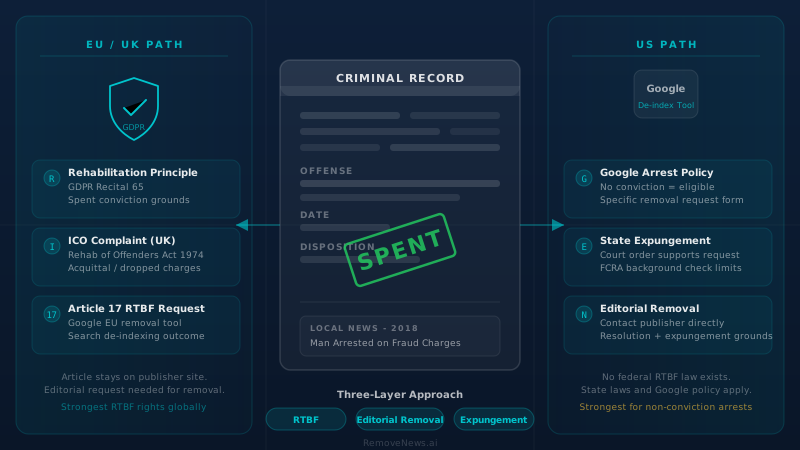
Criminal records are the strongest RTBF use case in EU and UK law. GDPR Recital 65 specifically names rehabilitation as grounds for erasure, and regulators consistently rule in favor of individuals with spent or rehabilitated convictions.
-
US residents have no federal RTBF right, but Google has a specific arrest record policy. If your arrest did not result in a conviction, Google will consider de-indexing the arrest record and related content under its own removal guidelines.
-
RTBF de-indexes search results; it does not delete the article. The news article stays on the publisher's website. Removing it entirely requires a separate editorial removal request to the publication.
-
The three-layer approach produces the best outcomes. Combining RTBF or Google de-indexing with an editorial removal request and, where available, a state court expungement order addresses all three channels through which criminal record information reaches the public.
Why Criminal Records Are the Strongest RTBF Use Case
The right to be forgotten was not designed with any single category of information in mind, but courts and data protection authorities in the EU and UK have consistently applied it most favorably to one type of personal data: old criminal records. The reason is rooted in the foundational legal concept underlying RTBF, which is proportionality. For a search engine to keep indexing a piece of personal information, the public interest in that information must be proportionate to the privacy harm it causes the individual.
Criminal records, particularly older ones, fail this proportionality test in the most straightforward way possible. Society has already made a formal determination through the criminal justice system about what happens to that record over time. The law sets rehabilitation periods, defines when convictions become spent, and in some cases provides for their complete expungement. When data protection law then asks whether continued public access to information about that conviction is proportionate, the answer is often no, because the legal system itself has said the record should fade.
GDPR Recital 65 makes this explicit. It states that data subjects should have the right to have personal data erased and no longer processed where the data are no longer necessary in relation to the purposes for which they were collected or otherwise processed. It gives as a specific example the situation where a data subject has withdrawn consent, but it also references the case where a data subject objects to the processing and there is no overriding legitimate ground for the processing. Importantly, Recital 65 specifically mentions that the right to erasure should be interpreted in light of the fundamental right to rehabilitation.
The practical effect is that a person seeking RTBF removal of a news article about a minor criminal matter from fifteen years ago, who has not reoffended and holds no public position, is presenting one of the strongest possible cases for approval. The legal framework was written with exactly this situation in mind.
The European Court of Human Rights has long recognized that rehabilitation is a legitimate aim that may justify restrictions on the flow of personal information. The Grand Chamber ruling in M.L. and W.W. v. Germany (2018) confirmed that even accurate historical reporting about criminal proceedings must be weighed against the individual's right to rehabilitation and reintegration into society. This principle flows directly into GDPR Article 17 RTBF claims and is why criminal record cases receive particularly sympathetic treatment from data protection authorities across the EU and UK.
EU and UK RTBF for Criminal Records: The Four Strongest Grounds
Not every criminal record RTBF request is equal. Regulators and search engines evaluating requests apply a consistent framework that weighs the nature of the offense, the individual's role in public life, the time elapsed, and whether the legal system has already made a determination about the record's continued relevance. Four grounds consistently produce the strongest outcomes.
1. Spent or Rehabilitated Conviction Under National Law
In the United Kingdom, the Rehabilitation of Offenders Act 1974 creates a legal framework under which convictions become "spent" after a prescribed rehabilitation period. Once a conviction is spent, the convicted person is legally treated as if the conviction never occurred for most purposes, including employment, insurance, and civil proceedings. The rehabilitation period varies by sentence: a community order spent after one year, a sentence of up to 12 months in custody spent after four years, and so on.
A spent conviction under the 1974 Act is one of the clearest grounds for a RTBF request to the ICO and to Google's UK de-indexing tool. The argument is simple: Parliament has already determined that this conviction should be treated as if it did not occur. A news article that continues to surface it in Google search results directly undermines that legal determination. Data protection authorities have accepted this reasoning in multiple published decisions, and Google's own guidelines recognize the spent conviction framework as a relevant factor in evaluating UK removal requests.
EU member states have their own rehabilitation frameworks under their national criminal laws and their implementations of GDPR. Germany, France, the Netherlands, and most other member states provide for some form of criminal record rehabilitation that operates similarly to the UK spent conviction regime, and the same logic applies in those jurisdictions.
2. Charges Dropped or Acquittal
An acquittal or a dropped charge represents the justice system's conclusion that the alleged conduct either did not occur or cannot be proved to the required standard. Yet news articles about the original arrest or charge often remain online for years, surfacing every time someone searches the individual's name, with no follow-up coverage of the acquittal or dismissal.
This situation is among the most persuasive for RTBF. The individual was not convicted of anything. The public interest in the original allegation has been conclusively resolved in the individual's favor. Continued indexing of the article serves no legitimate informational purpose proportionate to the ongoing reputational harm. Both Google's EU removal process and the ICO complaint pathway explicitly recognize acquittal and charge dismissal as strong grounds for de-indexing requests, and approval rates in this category are among the highest.
3. Minor Offense, Private Individual, No Continuing Public Interest
For matters where a conviction stands but the offense was minor, the individual holds no public role, and no continuing public safety or accountability interest exists, RTBF claims are typically strong. A first-time offense for which the individual received a small fine or short community sentence, reported in a local paper a decade ago, involving someone who is not a politician, executive, public official, or otherwise accountable to the public, presents an almost textbook RTBF scenario.
Regulators apply what is sometimes called the "public figure test" in reverse: the less public the individual's role, the weaker the public interest justification for ongoing access to their criminal record, and the stronger the privacy claim. The passage of time strengthens the claim further. A ten-year-old article about a minor offense involving a private person who has not reoffended is very different from a recent article about a serious offense involving someone in a position of public trust.
4. Significant Time Elapsed, No Reoffending
Time is an independent factor in the proportionality analysis even when none of the above grounds apply fully. Data protection regulators and courts have consistently held that the passage of time reduces the legitimate public interest in information about an individual's past conduct. A conviction from twenty years ago, for a person who has not reoffended and has rebuilt their life, carries less legitimate ongoing public interest than a conviction from two years ago, even if the offense was identical.
Google's own transparency report data on RTBF requests shows that requests involving older information are approved at higher rates than those involving recent events, across all categories of content. For criminal matters, the time dimension compounds with the rehabilitation principle: the longer ago the offense occurred without reoffending, the more the individual's current identity diverges from the conduct described in the article, and the weaker the argument that continued indexing serves the public.
Criminal record appearing in Google search results? Our team assesses your RTBF eligibility, coordinates EU/UK removal requests, and handles editorial outreach to news publishers. Free confidential consultation.
Get a Free AssessmentThe US Path: Google's Arrest Record Policy and the Arrest vs. Conviction Distinction
The United States has no federal right to be forgotten equivalent. The First Amendment and the strong tradition of public access to court records create a legal environment that is fundamentally different from the EU and UK frameworks. A US resident cannot file a RTBF complaint with a federal regulator and compel Google to de-index content about their criminal history the way a UK resident can file with the ICO.
What does exist for US residents is a specific Google policy on arrest records, along with state-level expungement laws and FCRA protections that create different but overlapping tools for addressing criminal record information online. Understanding the distinction between an arrest and a conviction is essential to knowing which tools apply.
Google's Arrest Record De-indexing Policy
Google has a specific policy that allows removal requests for arrest or booking records where no conviction resulted. This policy is available to US residents and covers situations where an individual was arrested, charged, or detained, but the matter was resolved without a conviction. This includes cases where charges were never filed, where charges were dismissed, where the individual was acquitted at trial, or where the case was otherwise resolved in a way that did not result in a finding of guilt.
The removal request is submitted through Google's legal troubleshooter tool. Google evaluates each request individually and does not guarantee removal in every case, but the non-conviction category is one of the more consistently approved categories in Google's US content removal framework. The request should include documentation of the disposition, such as court records showing dismissal, an acquittal order, or a certificate of disposition indicating no conviction.
It is important to understand what this policy covers and what it does not. It covers arrest records, booking records, and related content such as mugshot listings and database entries. Whether it covers a news article about the arrest is fact-specific: if the article primarily describes the arrest and the charges rather than a conviction, and if no conviction resulted, the article may fall within the scope of the request. But news articles from established publications involve editorial judgment and press freedom considerations that Google weighs separately from raw records and database content.
Google's arrest record policy applies to arrests without conviction. If you were arrested and later convicted, this policy does not provide a basis for removal of the conviction information, even if you have since served your sentence. For US residents with a conviction, the relevant tools are state expungement (which supports but does not guarantee de-indexing) and editorial removal from the publication. The EU/UK RTBF framework is the primary route for conviction information de-indexing, and it applies only to individuals within those jurisdictions.
FCRA Protections and Background Check Limits
The Fair Credit Reporting Act limits how long certain negative information can be reported in consumer background checks prepared by consumer reporting agencies (CRAs). For criminal convictions, the FCRA allows CRAs to report convictions indefinitely. For arrest records without conviction, CRAs are limited to seven years of reporting. These limits apply specifically to formal background check reports, not to newspaper articles or public web content. A news article on a newspaper's website is not governed by the FCRA regardless of what it describes.
FCRA rights are relevant in the criminal record online presence context because they provide a parallel route for addressing background check results that are distinct from the news article problem. If a background check service is pulling up old criminal information beyond the FCRA reporting period, an FCRA complaint or dispute is the appropriate mechanism. If a newspaper article is appearing in a Google search of your name, the FCRA has no bearing and the routes described in this article apply instead.
State Expungement Laws and Their Effect on Online Content
Expungement is a court order that seals, destroys, or otherwise neutralizes a criminal record under state law. The specific procedures and eligibility requirements vary substantially by state: some states allow expungement of misdemeanors after a waiting period, others allow felony expungement under certain conditions, and a few states have no meaningful expungement framework at all. First-time offenders, juvenile records, and charges that did not result in conviction are the most commonly expungeable categories across jurisdictions.
An expungement order does not automatically remove news articles or web content. Courts have consistently held that expungement orders govern official government records, not the free press. A newspaper that covered your arrest and conviction is not required to take down its article because you later obtained an expungement, and compelling it to do so would raise serious First Amendment concerns. However, expungement is one of the most powerful supporting documents for a voluntary editorial removal request, because it demonstrates that the legal system has treated the matter as if it did not occur.
Expungement also strengthens a Google de-indexing request for US residents. While Google's arrest record policy applies specifically to non-convictions, Google's broader content removal guidelines allow consideration of context when evaluating requests. A conviction that has been expunged by court order, combined with a well-documented request explaining the expungement and its legal effect, is meaningfully more persuasive than the same request without that documentation. Our guide on why expunged records still show online explains in detail why expungement does not automatically clear web content and what additional steps are required.
What RTBF Does Not Do: The Article Stays on the Publisher's Site
One of the most important misunderstandings about the right to be forgotten is what a successful outcome actually achieves. Many people assume that winning a RTBF request means the article disappears from the internet. It does not. A successful RTBF request results in de-indexing: Google removes the URL from its search index in the applicable jurisdiction, so the article no longer appears in Google search results when someone searches the individual's name. The article itself remains on the publisher's website exactly as published.
Anyone who has the direct URL can still access the article. It may remain indexed in other search engines such as Bing or DuckDuckGo unless separate requests are filed with each. And in the EU, de-indexing applies to the European version of Google search; the article may still surface through Google.com for users outside the EU. Our complete guide to GDPR RTBF for news articles covers these geographic and technical limits in detail.
The only way to remove the article itself from the publisher's website is through a successful editorial removal request to the publication. This is a separate process from RTBF and requires engaging directly with the journalists, editors, or legal team at the publication. Editorial removal requests succeed when the article is factually inaccurate, when the underlying matter has been formally resolved in a way that changes the article's accuracy, or when the publication has a policy of removing outdated criminal record coverage under specific circumstances.
The practical implication is that RTBF and editorial removal are complementary rather than competing strategies. A successful RTBF de-indexing removes the article from view for the vast majority of users who rely on Google search. A successful editorial removal request eliminates the underlying URL entirely. Doing both provides comprehensive coverage. For most individuals dealing with criminal record news articles, the complete strategy involves pursuing both simultaneously, along with expungement where available. This is the three-layer approach covered in the next section.
For a deeper examination of the full RTBF process for news articles from start to finish, see our complete right to be forgotten guide, which covers eligibility assessment, how to submit requests, what to do when requests are rejected, and how to appeal.
The Three-Layer Approach: RTBF + Editorial Removal + Expungement
Individuals dealing with criminal record news articles have access to three distinct tools that operate through different channels and achieve different outcomes. Using all three in a coordinated sequence produces significantly better results than relying on any single approach. The three layers are the right to be forgotten request (or Google's arrest record policy for US residents), the editorial removal request to the publisher, and state court expungement where available.
-
1Assess your RTBF or Google removal eligibility. If you are in the EU or UK, identify which of the four grounds applies to your situation: spent conviction, acquittal or dismissed charges, minor offense as a private individual, or significant time elapsed. If you are in the US, determine whether your matter resulted in no conviction and therefore falls within Google's arrest record policy. Gather all relevant court documents, disposition records, and sentencing information before filing any request. Our GDPR RTBF guide explains the EU/UK process step by step.
-
2File the RTBF or Google removal request with full documentation. Submit through Google's legal troubleshooter for UK de-indexing, through the national data protection authority for an EU complaint, or through Google's specific arrest record removal form for US non-conviction matters. Include your legal name, the specific URLs, a clear explanation of the applicable ground, and supporting documentation. Incomplete requests are the most common reason for avoidable denials. If your initial request is denied, see our guide on how to appeal a Google RTBF rejection.
-
3File for expungement with the appropriate state court if eligible. Do this in parallel with or immediately before the editorial removal step, because the expungement order is your strongest evidence for both the publisher and for any follow-up requests to Google. An attorney who handles expungement in your state can advise on eligibility and timing. Once the order is granted, obtain certified copies for use in subsequent removal requests. Our article on expunged records still showing online explains how to use the order in content removal requests.
-
4Send a structured editorial removal request to the publication. This is a formal communication to the publication, ideally handled by a reputation specialist or attorney, that explains the grounds for removal and provides documentation. The strongest requests include the court disposition or expungement order, a factual explanation of why continued publication is no longer accurate or proportionate, and, where applicable, reference to the successful RTBF or Google de-indexing outcome as evidence that the relevant authority has already found the privacy interest to outweigh the public interest. Do not contact journalists directly or via social media without professional guidance, as missteps here can result in defensive republication or new coverage.
-
5Monitor and address residual content. After successful de-indexing and editorial removal, conduct regular searches to identify any syndicated copies, aggregator reproductions, or cached versions that have surfaced. Mugshot websites require a separate removal process distinct from news articles; see our mugshot website removal guide. Set up Google Alerts for your name to catch any new indexing of old content. Old news articles sometimes get re-indexed after website migrations or when archiving services update their crawls.
-
6Build positive indexed content to protect against future surfacing. Even after successful removal and de-indexing, a proactive presence of authoritative content in your name reduces the risk that any residual or future negative content ranks prominently. This includes a personal or professional website, profiles on authoritative platforms, and, where appropriate, authored content in reputable publications. This step is particularly important for individuals who, despite having resolved their criminal matter, may face continued professional and social scrutiny.
The order in which you pursue these three layers matters. Filing for expungement before approaching the publisher gives you documentation that transforms a subjective appeal into a legally grounded request. Filing the RTBF or Google request before contacting the publisher means you can demonstrate that the relevant authority has already made a proportionality finding in your favor. The most effective sequence is: RTBF request, then expungement (if applicable), then editorial removal request, using each prior outcome to strengthen the next.
Mugshot Websites: A Separate Problem Requiring a Different Process
Mugshot websites are a distinct category of online criminal record content that differs from news articles in important ways and requires a different removal strategy. Understanding this distinction prevents wasted effort and misdirected requests.
Mugshot websites are for-profit platforms that aggregate arrest records and booking photographs from public court records and law enforcement databases. They do not employ journalists, they do not exercise editorial judgment, and they do not operate under journalistic norms about accuracy, fairness, or the public interest. Their content is typically generated automatically from public records, and the individuals listed have not necessarily been convicted of anything.
Most major mugshot websites have their own removal processes, though these vary considerably. Some sites have free opt-out mechanisms that process removal within a specified period. Others have historically charged removal fees, a practice that has been banned or restricted in California, Utah, Colorado, and several other states under laws specifically targeting mugshot websites. A small number of sites ignore removal requests entirely, in which case the approach shifts to requesting de-indexing from Google directly.
The RTBF framework applies to mugshot websites in the same way it applies to news articles for EU and UK residents. A successful RTBF de-indexing request will remove the mugshot site URL from Google search results in the applicable jurisdiction regardless of whether the site itself removes the content. For US residents without a formal RTBF right, the combination of Google's arrest record policy (where applicable) and direct site removal requests is the primary mechanism. See our complete guide to mugshot website removal for the specific process by site type.
One important note: mugshot website removal and news article removal must be pursued separately. A successful editorial removal request to a newspaper has no effect on a mugshot website, and a successful mugshot site removal has no effect on the newspaper article. Each requires its own request directed to the appropriate party through the appropriate channel.
Old Arrest Articles in Google: What Works and What Does Not
Beyond the formal frameworks, there are several practical realities about how old arrest articles behave in Google search that affect which removal strategy is most likely to succeed.
First, the age of the article matters in two different ways. An older article is more likely to succeed in a RTBF proportionality argument, but it may also be harder to remove from the publication because the original journalist may have moved on, the publication may have changed ownership, or the article may have been migrated to an archive platform that operates under different editorial policies. Our article on removing old arrest articles from Google covers these publication-specific factors in detail.
Second, whether the article was the original source or a syndicated copy affects which removal approach applies. Many local news articles are republished by wire services, aggregators, or regional publications as part of syndication agreements. Removing the original article from the originating publication does not automatically remove the syndicated copies, each of which may require a separate request. Identifying all instances of the content before beginning removal efforts prevents the situation where an article appears removed only to resurface through a syndicated copy you did not address.
Third, AI-generated search features are creating new challenges for individuals who have successfully de-indexed old arrest articles. Google's AI Overviews and similar features can surface information about a person from sources that are technically de-indexed from standard search results but still accessible to crawlers. This is an emerging area where the law and technical practice are still developing, and it represents one reason why editorial removal from the source publication remains important even after successful RTBF de-indexing.
- What was the outcome of the criminal matter? Acquittal, dismissed charges, and non-prosecution are the strongest grounds across all jurisdictions. A conviction is addressed differently depending on whether you are in the EU/UK or the US and whether the conviction is spent or has been expunged.
- Are you in the EU or UK, or are you a US resident? The applicable framework is entirely different. EU and UK residents have formal RTBF rights through data protection law. US residents rely on Google's voluntary policies and state expungement frameworks.
- How many articles or URLs are involved? A single local newspaper article requires a different strategy from a matter covered by multiple outlets including wire services and national publications. Identify all URLs before beginning any removal effort.
- Is the article accurate? Factual inaccuracies create additional grounds for editorial removal that do not depend on RTBF eligibility. If the article misstates the charges, the outcome, or key facts, a correction request supported by documentation is a separate and potentially faster path to resolution.
- Are you eligible for expungement in your state? Even if you do not know the answer to this question, consulting a criminal defense attorney about expungement eligibility is worth doing early in the process. An expungement order significantly strengthens every subsequent removal request.
Removal Options by Situation: What Works for Each Scenario
The table below summarizes the removal landscape across seven common criminal record scenarios. Each column reflects what is realistically achievable, not what is guaranteed, since outcomes depend on jurisdiction, publication type, and individual facts.
| Situation | RTBF Applicable? | Google De-index? | Editorial Removal Grounds | Best Combined Strategy |
|---|---|---|---|---|
| Spent or rehabilitated conviction (EU/UK) | Strong Yes | High approval rate | Strong: legal rehabilitation determination supports removal argument; conviction legally treated as if it did not occur | File RTBF with spent conviction documentation; use outcome as leverage for editorial removal; highest combined success rate of any scenario |
| Acquittal or dropped charges | Yes (EU/UK) | Yes (US + EU/UK) | Very strong: continued publication implies guilt after a not-guilty determination; factual accuracy argument often available | Parallel RTBF and Google arrest policy request with court disposition; editorial removal citing factual inaccuracy by omission; update article at minimum to reflect outcome |
| Minor offense, private individual, no public interest | Yes (EU/UK) | Likely if EU/UK; limited in US | Moderate to strong: public interest argument is weak; passage of time strengthens proportionality case; depends on publication policy | RTBF request emphasizing private individual status and time elapsed; editorial removal citing lack of ongoing public interest; expungement if US-based |
| Conviction of a public figure or official | Weak or No | Low approval rate | Very weak: public accountability interest overrides privacy; courts consistently uphold continued access for public officials | Suppression strategy (building positive counter-content) rather than removal; focus on accurate framing of resolution rather than removal of original coverage |
| Recent serious conviction | No | Not eligible | None at this stage: public interest in recent serious criminal conduct is at its highest and outweighs privacy considerations | Monitor for errors in coverage; respond via attorney to any factual inaccuracies; revisit RTBF and editorial options after significant time and rehabilitation have occurred |
| US arrest without conviction | No federal right; Google policy applies | Yes via Google arrest record policy | Strong: ongoing publication of arrest allegation after non-conviction outcome raises fairness concerns; many publications will update or remove | Google removal request with court disposition documentation; editorial removal citing non-conviction outcome; FCRA dispute if background check services are involved |
| US conviction (expunged by court order) | No federal right; limited Google options | Possible with strong supporting documentation | Moderate: expungement order is strong supporting documentation; no legal obligation on publisher to remove, but many will on request with order | Provide certified expungement order with Google request and editorial removal request; frame as legal system's determination that record should not persist; manage expectations that result is not guaranteed |
Common Questions About Criminal Records and the Right to Be Forgotten
Your Past Conviction Should Not Define Your Future Search Results.
Our team has navigated criminal record news article removal across EU, UK, and US jurisdictions since 2013. We know what works, what does not, and how to sequence the three layers for the best possible outcome.
Free assessment. Confidential. No obligation.