-
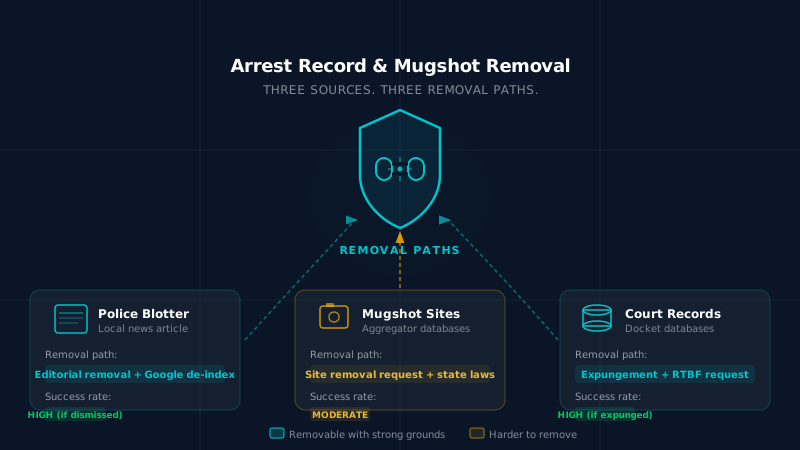
Three distinct sources publish arrest records online, and each requires a different removal strategy. Police blotter articles, mugshot aggregator sites, and court docket databases all have separate editors, operators, and legal frameworks governing what can be removed and how.
-
Dismissed or dropped charges are the strongest grounds for removal. Google's policy explicitly allows de-indexing of arrest content when the charges did not result in conviction, and most news publications will consider removal when presented with documentation of dismissal.
-
Expungement does not automatically remove online content. A court order expunging your record seals government files. It does not reach private websites, news archives, or Google's index. Separate action is always required after expungement.
-
EU and UK residents have strong GDPR-based rights for spent convictions. GDPR Article 17 and rehabilitation of offenders legislation provide meaningful legal leverage for removing old criminal record content from Google and from the sites that host it.
Why Arrest Records Appear Online: Three Distinct Sources
Before pursuing removal, it is essential to understand where arrest record content comes from. Most people assume it is a single system. In reality, there are three independent publishing pipelines that can put your arrest record in front of anyone who searches your name -- and each requires a completely different removal approach.
(a) Police Blotter Articles Written by Local News Outlets
Local newspapers and regional news websites have published "police blotter" columns for generations. Arrests are public records, and reporters routinely scan court filings, jail logs, and police reports to produce daily or weekly roundups of local arrests. These articles are written quickly, typically contain minimal context, and almost never include the outcome of the case -- whether charges were dropped, the defendant was acquitted, or the matter was resolved in any other way.
Once published on a news website, these articles are indexed by Google and can rank prominently for the arrested person's name, sometimes for years after the underlying legal matter concluded. The publication owns the content, and the decision about whether to update or remove it rests with the publication's editorial staff.
The removal path for police blotter articles is editorial. You must contact the publication, present your case, and persuade the editors that removal or updating the article is warranted. The strongest grounds are a documented dismissal or acquittal. Expungement also provides legal leverage in jurisdictions where state law creates a right to request removal of expunged record content.
(b) Mugshot Aggregator Websites
Mugshot aggregator sites are a distinctly modern problem. These are private websites -- not government agencies -- that automatically scrape booking records and arrest photographs from county jails, court dockets, and other public record databases. They repackage this information into searchable profiles that rank prominently in Google because the sites are designed specifically to appear in searches for a person's name.
Many of these sites historically charged individuals money to have their listings removed -- a practice that generated significant controversy and prompted legislative action in several states. Today, dozens of states have laws limiting or prohibiting fee-based mugshot removal, but the sites themselves continue to operate, and new ones appear regularly.
Removal from mugshot sites is site-specific. Each aggregator has its own removal request process. Some comply readily; others resist even when state law requires them to remove content. Google's policies on mugshot sites provide a secondary path: even if a site refuses to take down your listing, a successful Google de-indexing request can remove the page from search results, drastically reducing its real-world impact.
(c) Court Docket Databases and Public Records Sites
The third source is court docket databases -- both official government portals and third-party commercial sites that aggregate public records data. PACER (the federal court records system), state court portals, and services such as CourtListener or Justia publish case records that include charges, booking information, and case outcomes. Private background check aggregators like Spokeo, BeenVerified, and similar sites pull from these databases and republish the information in consumer-facing profiles.
Removal from court databases is the most complex path. Official government court records are generally not subject to editorial removal requests -- they are public records maintained by government entities. The path to removal from these sources typically runs through the court itself via an expungement or sealing order, followed by a request to Google and to any private sites that republished the data to update their indexes. Even then, the government portal may continue to maintain the record, requiring a Google de-indexing request specifically for the official court URL.
Identifying the source of your arrest record content before taking action is not a formality -- it determines which strategy to use. Sending a removal request to a news publication when the problem is a mugshot site wastes time and reveals your concern to a third party unnecessarily. Map every URL where your arrest record appears before contacting anyone. Search your full name in an incognito browser, note every domain, and categorize each result by source type. That audit shapes every step that follows.
Charges That Were Dropped, Dismissed, or Expunged: Your Strongest Case for Removal
Not all arrest records are equal in terms of removal prospects. The single most important factor determining how successfully you can remove arrest content from Google and the internet is whether the charges resulted in a conviction. When charges were dropped, dismissed, or the defendant was acquitted, the legal and editorial case for removal is significantly stronger than it is for records where a conviction occurred.
When Charges Were Dismissed or Dropped
A police blotter article that reports your arrest but never reports that the charges were dismissed is, in a meaningful sense, factually incomplete. It presents one half of the story -- the arrest -- without the conclusion. Many editorial policies at responsible news organizations recognize that publishing only the arrest without the outcome can cause undue reputational harm, and removal or update requests framed around this incompleteness are often received more sympathetically than general reputation complaints.
Google explicitly addresses this scenario in its content removal policies. Google's guidelines for personal information and sensitive content state that it will consider removing content about an individual where charges related to an arrest did not result in conviction. This makes dismissed charges one of the cleaner use cases for Google's legal removal request tool -- more so than requests based purely on age or embarrassment.
When presenting a removal case based on dismissed charges, documentation is essential. A copy of the order of dismissal, a letter from your attorney confirming the outcome, or a certified copy of the court docket showing the case resolution all strengthen the request. Vague assertions without documentation are rarely effective.
Expungement: What It Does and Does Not Do
Expungement is a court-ordered process that seals, destroys, or otherwise removes a criminal record from official government files. Eligibility for expungement varies dramatically by state. In some states, first-time offenders can expunge arrests that did not lead to conviction relatively easily. In others, expungement is available only for a narrow category of offenses, requires a waiting period, or is not available for certain charge types at all.
What expungement definitively does: it removes the record from official government databases, which means it generally will not appear on most background checks run through official channels. Law enforcement and certain government agencies may still be able to access expunged records in specific circumstances, but for employment background checks and most other consumer-facing uses, an expunged record is effectively invisible in official systems.
What expungement does not do: it does not automatically remove content from the internet. Private websites -- including news sites and mugshot aggregators -- are not bound by state expungement orders. They received the information when it was public record, published it lawfully at that time, and have no automatic legal obligation to remove it when a court later orders the record sealed. This is one of the most painful and poorly understood gaps in the expungement system, and it catches many people off guard after they have gone through the effort and expense of obtaining an expungement order.
What expungement does provide, however, is powerful legal leverage in removal requests. Many news publications have editorial policies that support removing or updating coverage of events that have been expunged. An expungement order is objective, court-certified evidence that the legal system has determined the arrest should not follow the person -- a compelling argument even for editors who would otherwise decline a general removal request. Some states have enacted laws that go further, explicitly creating a private right of action against websites that continue to publish expunged record content after receiving notice.
Expungement removes a record from government systems. It does not reach Google, news websites, or mugshot databases. People who obtain an expungement and take no further action often remain fully visible in online searches. The steps required to clear your online record after expungement are separate from the legal expungement process, involve different parties, and usually require professional assistance to execute effectively. Expungement is the beginning of the process for your online record, not the end of it.
Police Blotter Articles: Contacting the Editor and Making the Case for Removal
The original arrest article published by a local newspaper or news website is often the highest-ranking and most damaging piece of online arrest record content. Because these articles are on credible, established news domains, Google gives them strong ranking authority. A single article on a local news site can rank on page one of a name search for years.
The good news is that these articles have a specific, identifiable decision-maker: the publication's editor or digital content manager. Unlike a mugshot site operated anonymously or a government court database with no editorial discretion, a news publication has editors who can make the decision to update, correct, or remove an article. That gives you a lever to pull that does not exist with other sources.
Editorial Removal Grounds
The strongest grounds for requesting editorial removal or update of a police blotter article are:
-
1Charges were dismissed, dropped, or you were acquitted. This is the most compelling argument. The article is factually incomplete: it reported an arrest but not the outcome. Most reputable editors acknowledge this creates an unfair public record and will at minimum add an update to the article noting the outcome. Many will remove the article entirely when the charges were dropped.
-
2The record was expunged. In many states, expungement provides direct legal leverage. Some state statutes explicitly require websites to remove expunged record content upon request. Even in states without such statutes, an expungement order is powerful editorial persuasion -- it represents a court's determination that the arrest should not follow you.
-
3The article contains factual errors. Errors in police blotter articles are common. If the article misstates the charge, the date, the circumstances, or any other material fact, a correction request is grounded in basic journalistic ethics and is difficult for any editor to refuse in good faith.
-
4The outdated content argument. Even for articles that are technically accurate and involve a conviction, there is an argument based on proportionality: a minor charge from years ago, which the person has fully served their time for, continues to cause disproportionate ongoing harm relative to any public interest served by its continued prominent display in search results. This argument is less reliable than dismissal or expungement grounds, but some publications respond to it, particularly for older content.
For a detailed walkthrough of how to contact editors and what to say, see our dedicated guide: How to Remove a Police Blotter Article From Google.
Arrest article ranking in your name search? Our team has direct relationships with editors at hundreds of publications and has handled 1,000+ police blotter removal requests. We can assess your situation confidentially.
Get a Free ConsultationMugshot Websites: How They Work and How to Get Your Listing Removed
Mugshot aggregator websites operate in a legal gray area that has shrunk considerably in recent years as states have passed legislation targeting their business model. Understanding how these sites work is the first step toward getting off them.
The Mugshot Business Model
Most mugshot sites work as follows: automated scrapers pull booking records and arrest photographs from county sheriff websites, court systems, and other sources that publish this information as public records. The data is reformatted into individual profile pages -- one per person arrested -- optimized for search engines so that the page ranks prominently when someone searches the individual's name. Many sites historically monetized by charging the subject of the record a fee to have their listing removed, sometimes ranging from dozens to hundreds of dollars per site, with new sites appearing continuously to recapture individuals who had already paid for removal from earlier sites.
This fee-for-removal model attracted significant regulatory attention. Starting around 2013, states began passing laws specifically targeting mugshot sites. Today, states including California, Georgia, Illinois, Oregon, Utah, Virginia, and Wyoming (among others) have statutes making it illegal to charge for mugshot removal. The legal landscape continues to evolve, and the specific protections available depend heavily on where you live and where the site is based.
How to Submit Removal Requests
The removal process for mugshot sites is site-specific and often tedious. Each site has its own form, email address, or process. Most require you to provide identifying information confirming the listing is yours, and some require documentation such as a court order or expungement record. Steps include:
-
1Identify every site that hosts your listing. Search your full name plus "arrest," "mugshot," and "booking." Compile the complete list of URLs before contacting anyone. New requests to individual sites are more efficient when you know the full scope of the problem upfront.
-
2Check whether your state's anti-mugshot law applies. If your state has a statute prohibiting fee-based removal, reference it explicitly in your removal request. Sites that are knowingly violating state law have additional incentive to comply when you demonstrate awareness of the legal framework.
-
3Submit removal requests to each site individually. Use the site's designated removal process if one exists. Document every request with a screenshot and timestamp. If the site does not respond within a reasonable period (typically 30 days), a follow-up attorney demand letter can accelerate compliance.
-
4For non-compliant sites, submit a Google de-indexing request. If a mugshot site refuses to remove your listing, you can still address the search visibility problem by requesting that Google de-index the specific page. Google has policies that address mugshot sites specifically and has removed many such pages upon request even when the underlying site did not take the page down.
For complete details on mugshot site removal, state law coverage, and which sites respond to removal requests, see: How to Remove Your Mugshot from Aggregator Websites.
Google's Policy on Mugshot Sites
Google has specifically acknowledged the problem of mugshot sites in its content removal documentation. The company's stance is that mugshot content -- particularly on sites that charge for removal -- can be a form of harmful content that may be eligible for removal under its personal information policies, especially when the arrest did not result in a conviction. Even without a de-indexing request, Google's quality raters have downgraded many mugshot sites in search rankings over the years, reducing their visibility -- though individual pages from these sites can still rank prominently for specific name searches.
Google De-Indexing for Arrest Records: Policy, Tools, and the Legal Removal Path
Even when you cannot get a news publication or mugshot site to remove their content, Google's own removal tools offer a meaningful second path. Removing a page from Google's index does not delete the page from the internet, but it removes it from search results -- which, for most practical purposes, is where the reputational damage actually occurs. A page that does not appear in Google search results is effectively invisible to most people.
Google's Arrest and Conviction Record Policy
Google's personal information removal policies explicitly address arrest and conviction records. The key provision states that Google will evaluate requests to remove content about individuals where the content involves an arrest or charge that did not result in conviction. This is a direct policy acknowledgment that non-conviction arrest records are a category of personal information that warrants special treatment under Google's framework.
The policy does not guarantee removal. Google evaluates each request, considers the public interest in the content, and weighs that against the individual's privacy interests. For arrest content on news sites that serves a documented public interest -- a high-profile case, a public figure, content from a major investigation -- Google may decline to remove even non-conviction content. For routine police blotter entries, particularly older ones, the balance tips more readily toward removal.
The Outdated Content Removal Tool
Google's outdated content removal tool is a separate mechanism from the legal removal request. It is designed for cases where a page has been deleted or significantly updated by the source website, but Google's index still shows the old version. If a news publication has removed or unpublished an arrest article, you can use the outdated content tool to accelerate the removal of the stale Google listing before Googlebot's next regular crawl catches up. This tool alone cannot remove content from Google when the underlying page still exists -- it requires the source to have already removed or altered the content.
The Legal Removal Request Pathway
For arrest record content that still exists on the source website, the relevant mechanism is Google's legal removal request form. This form is used to request de-indexing based on specific legal grounds, including Google's policies on non-conviction arrest records, personal information policies, and applicable local law. Requests made through this pathway are reviewed by Google's legal and policy teams. Approval rates are higher when requests are well-documented, cite specific policy grounds, and include supporting evidence such as court dismissal orders.
See our full guide on Google's removal process: How to Remove an Old Arrest Article from Google.
Expunged and Sealed Records Still Appearing Online
One of the most frustrating situations a person can face is completing the expungement process, learning that their record has been legally sealed or destroyed, and then Googling their own name to find the arrest article still sitting on page one of search results. This is not a glitch or an error -- it is a structural gap between the legal expungement system and the private information ecosystem of the internet.
Expungement operates on government-maintained records. The court issues an order, the clerk of court updates the official record, and the sealed or destroyed designation is noted in whatever record-keeping system the court uses. Criminal background check vendors that pull from official court databases will update their records when they re-query the court system. But private websites that scraped and published the information before the expungement have no automated notification system. They have no legal obligation in most states to monitor court expungement orders and remove matching content proactively.
The steps required after expungement to clean up your online record are entirely separate from the expungement process itself:
-
1Obtain certified documentation of the expungement. A certified copy of the expungement order is your primary instrument for requesting removal from private websites and from Google. Many sites will not process removal requests without it.
-
2Contact news publications that ran the original arrest article. Present the expungement order and request removal or, at minimum, a prominent update noting the outcome. Many publications have policies that treat expungement as sufficient grounds for removal.
-
3Submit removal requests to mugshot sites. Include the expungement order with your removal request. In states with anti-mugshot statutes that specifically address expunged records, cite the applicable statute.
-
4Submit a Google de-indexing request for any pages that remain. Reference the expungement in your request and attach supporting documentation. Google's policies treat expunged record content as eligible for removal consideration.
-
5Contact commercial background check aggregators. Sites like Spokeo, Intelius, BeenVerified, and similar services maintain data derived from public records. After expungement, you can submit opt-out requests to these sites, which most honor because they update their databases from official records and the expunged status will eventually propagate -- but opt-out requests accelerate the process.
For more detail on the expungement gap and the steps to close it, see: Expunged Records Still Showing Online: What to Do. If your matter involved a sealing order rather than full expungement, our guide on sealed court records appearing in Google covers the additional considerations for sealed versus expunged content.
Juvenile Records: Special Considerations
Juvenile arrest records occupy a different legal space than adult criminal records in most U.S. jurisdictions. The juvenile justice system was designed with rehabilitation as a primary goal, and most states provide much stronger confidentiality protections for juvenile records than for adult records. In theory, juvenile records are sealed automatically in many states at the age of majority or upon completion of the juvenile justice disposition. In practice, the gap between legal protection and internet reality is just as wide as it is for adult records -- and in some cases wider.
State-by-state variation in juvenile record confidentiality is significant. Some states seal juvenile records entirely, making them inaccessible even to law enforcement for most purposes. Others allow public access to juvenile records for serious offenses, particularly those where a juvenile was tried as an adult. A handful of states have relatively limited automatic sealing provisions, requiring the individual to petition the court for sealing even for juvenile records.
The online content problem for juvenile records typically arises in one of two ways:
First, local news coverage of a juvenile arrest, particularly for a serious or unusual offense, may have been published when the individual was a minor. This coverage remains indexed by Google long after the individual reaches adulthood and the court record has been sealed. News publications are generally not prohibited from publishing information about juvenile arrests that was public at the time of reporting, even when court records are later sealed. Editorial removal requests -- framed around the juvenile nature of the offense, the individual's rehabilitation, and the disproportionate ongoing harm -- are the primary avenue.
Second, mugshot aggregator sites sometimes capture juvenile booking records from county systems that briefly make such records public before sealing occurs. These listings can persist even when the underlying court record has been sealed for years.
For state-specific guidance on juvenile record removal, see: Juvenile Arrest Records Appearing Online: Your Options by State.
RTBF for Criminal Records: EU and UK Residents
EU and UK residents have substantially stronger legal tools for removing old criminal record content from Google than their counterparts in the United States. The General Data Protection Regulation (GDPR), which applies across the EU, and the UK GDPR (retained as domestic law following Brexit), both provide a right to erasure under Article 17 that is directly applicable to criminal record content in many circumstances.
The Legal Grounds Under GDPR Article 17
GDPR Article 17 -- commonly called the right to be forgotten -- allows individuals to request that data controllers (including search engines and news publishers) erase personal data when any of several grounds apply. The most relevant grounds for criminal record content are:
-
1The data is no longer necessary for the purpose for which it was collected. A criminal record article published years ago for the purpose of informing the public about a local arrest may no longer serve a legitimate current purpose, particularly if the individual has completed any sentence and rehabilitated.
-
2The individual objects to processing and there are no overriding legitimate grounds. A data subject can object to the continued processing of their personal data. For old criminal record content, the individual's interest in moving past the matter typically outweighs the public interest in continued indexing, particularly for minor offenses many years later.
-
3The data relates to a spent conviction under rehabilitation of offenders legislation. This is the most powerful ground for criminal record removal in the EU and UK. The UK's Rehabilitation of Offenders Act 1974 (and its 2014 reforms) provides that after a specified period following the completion of a sentence, a conviction becomes "spent" and the individual is treated as if they were never convicted. EU member states have analogous legislation under their national implementation of rehabilitation principles. Once a conviction is spent, continued publication of the criminal record information is difficult to justify under GDPR proportionality analysis.
Google has accepted a substantial proportion of RTBF requests relating to spent convictions and old criminal records in the EU and UK. The European Court of Justice's 2019 ruling in Google v. CNIL clarified that RTBF applies to Google's European search results, and the court has consistently upheld the right in the criminal record context when convictions are spent and the individual is not a public figure.
For a complete guide to using RTBF for criminal record removal, including how to structure the request and what documentation to include, see: Right to Be Forgotten for Criminal Records and Arrest History.
Under the UK ROA 1974 (as amended), rehabilitation periods vary by sentence length. A sentence of up to six months has a rehabilitation period of two years after the sentence end date; up to 30 months, four years; up to four years, seven years. Sentences of over four years do not become spent under UK law, though GDPR proportionality arguments may still apply depending on elapsed time and individual circumstances. Spent conviction status is among the strongest grounds for a Google de-indexing request in the UK context and should always be cited when applicable.
Arrest Records Appearing in AI Search Results
A growing number of people are discovering their arrest records not through a Google search but through AI-powered search tools. When someone types a name into ChatGPT, Perplexity, or uses Google's AI Overviews feature, the AI's responses can surface arrest information sourced from news articles and public records in its training data or live web retrieval.
This creates a new dimension of the arrest record problem that is in some ways more difficult to address than traditional search results. AI search tools do not work from a static index in the same way that Google's traditional search does. Perplexity and similar tools perform live web searches and synthesize results in real time. Google's AI Overviews draws on Google's own index but presents information in generated summaries rather than direct links. ChatGPT's responses may draw on training data, browsed web content, or both, depending on the version and settings in use.
The only reliable fix for arrest records appearing in AI search is source removal. AI tools surface content from the underlying web. If the original news article, mugshot site listing, or court database entry is still accessible on the internet, AI systems will continue to find and cite it. There is no AI-specific removal form that addresses the underlying data -- the content must be removed or de-indexed at the source to prevent AI systems from surfacing it.
This reinforces the importance of pursuing editorial removal and Google de-indexing as primary strategies, not just secondary ones. An article that has been de-indexed by Google may still be accessible directly and may still be surfaced by AI tools that retrieve content directly from the web. Full removal from the source website is always the cleanest and most durable outcome.
For a detailed look at how arrest records surface in AI search and what options exist, see: Arrest Records in AI Search: ChatGPT, Perplexity, and Google AI Overviews.
Arrest Record Types: Removal Paths at a Glance
| Record Type | Removal Path | Google Policy | Typical Timeline | Success Rate | Notes |
|---|---|---|---|---|---|
| Police Blotter Article (charges dismissed) | Editorial removal request + Google de-index | Favorable -- non-conviction policy applies | 1 -- 4 months | High | Dismissal documentation is essential. Most publications respond to outcome-based requests. |
| Police Blotter Article (conviction) | Editorial removal or suppression; legal channels if defamatory | Neutral -- removal less likely | 3 -- 12 months for suppression | Moderate | Outdated content, proportionality, and rehabilitation arguments may apply for older articles. |
| Mugshot Aggregator Site | Site removal request; state law demand; Google de-index | Favorable -- mugshot site policy | 2 -- 8 weeks per site | Moderate | New sites appear regularly. Monitor for re-listing after removal. |
| Expunged Record Still Online | Expungement order + editorial/site removal + Google de-index | Favorable -- expungement strengthens request | 1 -- 5 months | High | Must pursue separately from the legal expungement. Expungement alone does not clear online content. |
| Court Database / Background Check Site | Opt-out request; expungement propagation; Google de-index of specific URLs | Varies -- depends on content and grounds | 1 -- 3 months | Moderate | Commercial aggregators typically honor opt-out requests. Official government portals may not. |
| EU/UK Resident -- Spent Conviction | GDPR Article 17 / RTBF request to Google and source publishers | Strong -- RTBF / rehabilitation grounds | 4 -- 16 weeks | High | Strongest legal framework available. Spent conviction status significantly increases approval rate. |
When to Work With a Professional Removal Firm
Not every arrest record situation requires professional intervention. A single, clearly outdated article on a small local publication about charges that were plainly dismissed can sometimes be resolved with a well-written email and a copy of the court order. But in most situations involving multiple sources, major publications, resistant operators, or records that are several years old and deeply embedded in Google's index, the complexity and the stakes both argue for professional help.
Where professionals add the most value:
-
1Publication relationships. Firms that specialize in news article removal often have established relationships with editors and content managers at hundreds of publications. A removal request from a known professional contact is processed differently than an unsolicited email from the subject of the article.
-
2Google request expertise. Google's removal tools are not self-explanatory, and poorly constructed requests are frequently denied. Experienced practitioners know how to frame requests, cite the right policy grounds, and document the supporting evidence in the format Google's review teams respond to.
-
3Monitoring and persistence. Mugshot sites re-list removed content. Google re-indexes de-indexed pages. New articles can appear. Ongoing monitoring and prompt re-removal of re-appearing content requires systematic effort that most individuals cannot sustain while managing other aspects of their lives.
-
4Legal coordination. When removal strategy intersects with ongoing legal proceedings -- such as an active expungement petition or a defamation claim -- professional coordination between the reputation management strategy and the legal strategy is important. Missteps in public-facing requests can have unintended legal consequences. See also: Working With a News Article Removal Attorney.
Ready to address your arrest record online? RemoveNews.ai works on a pay-for-results basis. If we cannot achieve removal, you do not pay. Get a confidential assessment with no obligation.
Start Your Free AssessmentArrest Record Removal: Common Questions Answered
Your Past Doesn't Have to Define Your Search Results.
Our team has helped 1,000+ people remove arrest records, mugshot listings, and police blotter articles from Google. We work on a pay-for-results basis. If we cannot achieve removal, you do not pay.
Free assessment. Confidential. No obligation.