Right to Be Forgotten vs. Right to Erasure: What Is the Difference?
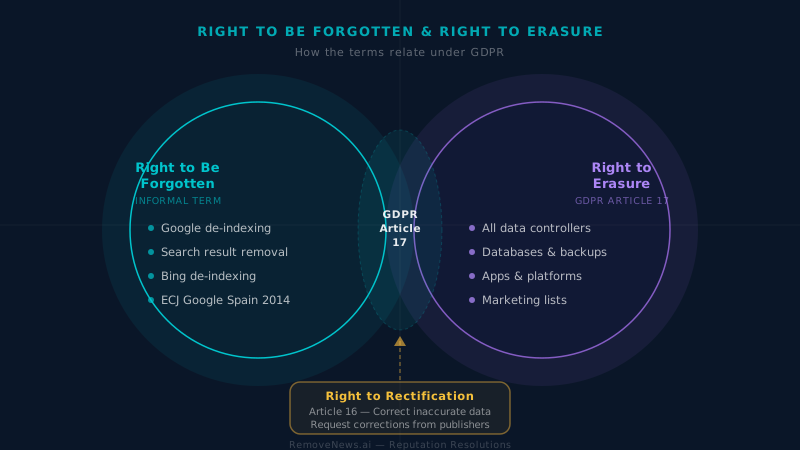
Most people use these two phrases as if they mean the same thing. They do not. The right to be forgotten is an informal term that emerged from a 2014 court ruling and refers specifically to search engine de-indexing. The right to erasure is a formal legal right under GDPR Article 17 that covers a much wider universe of data processing. The distinction is not just semantic: it determines who you make your request to, what grounds you invoke, and how likely you are to succeed. This article explains both rights precisely, introduces the overlooked right to rectification under Article 16, and provides a clear decision framework for which right to use in your situation.
By Anthony WillFounder & CEO, Reputation Resolutions · Removing articles since 2013
Updated June 30, 2026Published May 12, 2026 · 12 min read
Key Takeaways
"Right to be forgotten" is informal; "right to erasure" is the statutory term. GDPR Article 17 codified the right to erasure. The right to be forgotten is the colloquial name for the search-engine de-indexing version of that right, born from a 2014 court ruling that predates GDPR.
For news articles, the correct target is the search engine, not the publisher. Publishers are typically protected by the freedom of expression exemption under Article 17(3)(a). Requesting de-indexing from Google or Bing is the practical route.
Right t
o rectification (Article 16) is often overlooked and frequently more powerful. If a news article contains factual errors, rectification bypasses the freedom of expression barrier and gives you a direct basis to request a correction from the publisher or search engine.
The Google Spain case decided de-indexing, not deletion. Mario Costeja Gonzalez won the right to have Google remove links. The newspaper kept the original article online. This is the core practical distinction between the two concepts in action.
Where the Terms Come From and Why They Are Used Interchangeably
The confusion between these two terms is understandable because they describe overlapping concepts, and journalists, lawyers, and technology commentators often use them without precision. But for anyone dealing with an actual data removal or de-indexing problem, the distinction matters practically. For the full context, our complete right to be forgotten guide covers both rights together, and our guide on how to file a Google right to be forgotten request shows exactly which right to invoke when submitting to Google.
The phrase "right to be forgotten" entered public consciousness in May 2014 when the Court of Justice of the European Union issued its landmark judgment in Case C-131/12, commonly called the Google Spain case. The court found that individuals could, under certain conditions, require search engines to de-index links to information about them. The ruling was immediately interpreted by media across the world as establishing a "right to be forgotten," and that phrase stuck. It is now embedded in general usage, in parliamentary debates, and in everyday conversation about online reputation and privacy.
The phrase "right to erasure" entered binding law three years later, when the General Data Protection Regulation came into force across the European Union. Article 17 of the GDPR is titled "Right to erasure (right to be forgotten)" and that title is itself a formulation that partially explains the ongoing conflation. The parenthetical acknowledges the popular phrase while establishing the formal legal term. However, Article 17 is substantially broader than what the 2014 court ruling addressed. The full text is at GDPR Article 17, and the EU data protection framework provides the surrounding legislative context. UK residents can find the equivalent right documented at the ICO right to erasure page.
Understanding the history of each term makes it possible to use them correctly, invoke the right legal ground, and direct your request to the right party.
Jurisdiction Note
GDPR applies across the European Economic Area and, through adequacy decisions and extraterritorial scope provisions, to data processors worldwide who handle EEA residents' data. The UK retained GDPR as UK GDPR after Brexit with near-identical terms. Outside the EEA and UK, the right to be forgotten has no binding legal basis in most jurisdictions, though some countries have enacted similar frameworks. For US-based individuals, options differ significantly. This article focuses on GDPR as the primary framework but notes US-specific routes where relevant.
We help remove content using your legal rights — you only pay after it’s gone.
No upfront payment No retainer A+ BBB Rated 5,000+ clients helped In business since 2013 Only Pay For Results True Removal Experts
Most people use these two phrases as if they mean the same thing. They do not.
Section 02
The Google Spain Case: How the Right to Be Forgotten Was Born
In 1998, a Spanish newspaper called La Vanguardia published two small notices about a property auction linked to social security debts owed by Mario Costeja Gonzalez. The notices were entirely lawful at the time. More than a decade later, Costeja Gonzalez found that searching his name on Google surfaced those old notices near the top of results. He argued the information was now outdated, irrelevant, and damaging to his reputation. He wanted the links removed.
The case eventually reached the Court of Justice of the European Union. In its 2014 ruling, the court reached two important conclusions that shaped the modern right to be forgotten.
First: Google is a data controller. By indexing and presenting search results, Google processes personal data and is therefore subject to European data protection law, regardless of the fact that the underlying content lives on a third-party website. This was a foundational finding because it established that search engines, not just original publishers, can be required to act on data subject requests.
Second: La Vanguardia, the newspaper that originally published the notices, did not have to remove anything. The court specifically held that the original publication was lawful and that the newspaper's freedom of expression and public interest in maintaining accurate historical records outweighed Costeja Gonzalez's privacy interest in having the newspaper content erased. What Costeja Gonzalez could require was that Google stop surfacing links to those notices in searches of his name.
The practical outcome is the model still in use today: de-indexing removes the search entry point to a piece of content without requiring the publisher to delete the article itself. The article continues to exist at its URL, accessible to anyone who knows the direct link or finds it through other means, but it no longer surfaces when someone searches the individual's name.
Common Misunderstanding
Many people believe that a successful right to be forgotten request means an article is deleted from the internet. It is not. De-indexing removes the article from search engine results for name-based queries. The article itself remains live on the publisher's website. Anyone with the direct URL, or anyone who finds it through an alternative search, can still access it. This distinction matters enormously when assessing what outcome is realistic from a de-indexing request.
Section 03
GDPR Article 17: How the Right to Erasure Actually Works
Article 17 of the GDPR created a formal, statutory right to have personal data erased under specific conditions. It applies to any data controller who processes personal data about a data subject, which is an enormously broad category: companies, apps, platforms, marketing agencies, data brokers, analytics providers, search engines, publishers, and virtually any organization that holds records about identifiable individuals.
The Six Grounds for Erasure
A data subject can invoke Article 17 on any of six grounds. Only one needs to apply for the request to be valid:
1
The data is no longer necessary for the purpose for which it was originally collected or processed. A marketing database retaining contact information after a campaign has ended, for example, or a news archive indexing a person's address that was only relevant to a decades-old story.
2
Consent is withdrawn and there is no other legal basis for processing. Applicable when the original data collection was based on consent and that consent is now revoked.
3
The data subject objects under Article 21 and there are no overriding legitimate grounds for continued processing. This is the ground most commonly invoked for search engine de-indexing requests: the individual objects, and the data controller (Google) must demonstrate a compelling legitimate interest that outweighs the individual's privacy interest.
4
The data was unlawfully processed from the outset. This covers data collected without a valid legal basis, data about protected categories collected without explicit consent, and data held in violation of data minimisation principles.
5
A legal obligation requires erasure under EU or member state law.
6
The data relates to a child and was collected in connection with information society services under Article 8. This ground reflects special protections for minors and is particularly relevant for content about young people published without adequate safeguards.
The Three Principal Exemptions
Article 17(3) lists circumstances in which the erasure obligation does not apply, even when a valid ground exists. These exemptions are the primary reason that requesting erasure directly from a news publisher almost always fails. For a step-by-step approach to invoking the right against Google specifically, use our GDPR right to be forgotten request template, and if your request is rejected, see our guide on how to appeal a Google RTBF rejection:
Freedom of expression and information. Where erasure would conflict with the right to freedom of expression and information, the controller can refuse. Journalism and the publication of news is protected here. A newspaper is entitled to argue that removing a true, contemporaneously accurate story conflicts with press freedom. Data protection authorities across Europe have consistently upheld this exemption for publishers maintaining factual archives.
Public interest in public health. Data processed for reasons of public health under Article 9(2)(h) and (i) is exempt. Less commonly invoked in the news article context but relevant for medical or epidemiological data.
Archiving, research, and statistical purposes. Data held for archiving in the public interest, scientific or historical research, or statistical purposes is exempt where erasure would seriously impair achievement of those objectives. Historical newspaper archives routinely invoke this exemption.
Establishment, exercise, or defence of legal claims. A controller may retain data if it is needed for litigation. This exemption is particularly relevant in cases where the article concerns ongoing legal proceedings.
Why Publishers Refuse and Search Engines Are Different
Publishers invoke the freedom of expression exemption as a near-automatic defence to erasure requests. Search engines operate differently: their role is not to publish news but to index and surface it. The Google Spain court recognized this distinction. A search engine can satisfy freedom of expression concerns by de-indexing name-specific search results while the underlying article remains available at its original URL and accessible through general topic-based searches. This is why de-indexing requests to Google succeed at higher rates than deletion requests to publishers.
Section 04
Right to Erasure in Practice: Two Different Targets
When people encounter a damaging news article about themselves, they typically want one of two things: the article to disappear from Google, or the article to be removed from the publisher's website entirely. These are different objectives requiring different approaches.
Target 1: Search Engine De-Indexing (the Traditional RTBF)
This is what most people mean when they say "right to be forgotten." You submit a request to Google (or Bing, or another search engine) asking them to remove specific URLs from search results that appear when someone searches your name. Google processes these requests through a dedicated web form and evaluates each URL individually, weighing your privacy interest against the public interest in the information.
Google considers factors including: whether the information is about a public figure (higher bar for removal), whether the information is still current and relevant, whether the article concerns a matter of genuine public interest, and whether the information is accurate. For private individuals and for articles describing events that are now outdated and no longer relevant, de-indexing requests succeed at meaningful rates.
The request is made to Google as a data controller. You are invoking GDPR Article 17, typically relying on the Article 21 objection ground. The process applies to the European version of Google search results but can also affect other regions depending on your location and the nature of the request. Our detailed guide on how to file a Google right to be forgotten request walks through the mechanics step by step.
Target 2: Data Erasure from a Company's Systems
This is the broader Article 17 right in action. If a company holds your personal data in its database, marketing lists, CRM, backup systems, or internal records, and you have a valid ground under Article 17, you can require them to delete it. This applies to e-commerce platforms that retain purchase history, data brokers that sell personal profiles, marketing agencies that hold email addresses, analytics providers, and any other data controller processing personal data about you.
You send a formal erasure request to the data controller's privacy or data protection team, citing Article 17 and the applicable ground. The controller must respond within one month under Article 12 and must either confirm erasure, explain a legitimate exemption, or escalate for a further two-month extension with notice. If they refuse without valid justification, you can escalate to your national data protection authority.
For our clients at RemoveNews.ai, the relevant data erasure requests outside of search engines typically involve data aggregator sites and people-search platforms that republish news article excerpts alongside personal information in database form. These sites are often more responsive to direct Article 17 requests than major news publishers, since they do not benefit from the journalism exemption to the same degree. See our GDPR right to be forgotten for news articles guide for a deeper treatment of this distinction.
Section 05
The Third Option: Right to Rectification Under Article 16
Most people dealing with a damaging news article focus entirely on erasure or de-indexing. They overlook a third right that is often more powerful in the specific context of factually inaccurate news coverage: the right to rectification under GDPR Article 16.
Article 16 gives any data subject the right to have inaccurate personal data corrected without undue delay, and incomplete personal data completed. The right does not require deletion. It requires correction. Where a news article contains false statements of fact about a specific individual, those false statements constitute inaccurate personal data processed by the publisher (and by search engines indexing the article).
The critical distinction from Article 17 is the exemption landscape. The freedom of expression exemption in Article 17(3)(a) is a broad defense for publishers maintaining accurate historical records. It does not, however, protect the continued publication of factually false information. A publisher cannot invoke press freedom to justify maintaining demonstrably incorrect facts about an individual. Article 16 rectification requests are therefore considerably harder for publishers to refuse when the factual inaccuracy is clearly documented.
Practical use cases for Article 16:
1
Factual errors in a news article. The article states you were convicted; you were acquitted. The article states you were a company director; you were an employee. The article describes you as the subject of an investigation; you were a witness. These are inaccurate personal data claims, and Article 16 gives you a legal basis to request correction directly from the publisher.
2
Outdated information presented as current. An article from five years ago describes you as facing charges that were subsequently dropped. The original article was accurate when published but is now misleading by omission. A rectification request can seek an update note or correction appended to the article.
3
Incorrect quotes or misattributed statements. If an article attributes statements to you that you did not make, or quotes you inaccurately, Article 16 provides a formal ground for a correction request independent of any defamation claim.
4
Search engine results displaying inaccurate snippets. Google and Bing can also receive Article 16 requests where the snippet or cached data shown in search results is factually incorrect, even if the underlying article has since been updated.
Does your situation involve inaccurate information in a news article? The right to rectification is frequently the strongest available tool. Our specialists can assess whether your situation qualifies and help you submit an effective formal request.
Comparison: Right to Be Forgotten, Right to Erasure, Right to Rectification
The following table shows the three rights side by side. This is the clearest way to see how they differ in practice and which one to reach for in a given situation.
Term
Legal Basis
Who You Request It From
Scope
Best For
Limitations
Right to Be Forgotten
Informal term; rooted in Google Spain (2014) and GDPR Article 17 via Article 21 objection
Search engines: Google, Bing, Yahoo
De-indexing specific URLs from name-based search results. Article itself remains live on publisher's site.
Reducing visibility of news articles, old court records, or personal data in search results for your name
Does not delete the original content. Not applicable to US-only individuals with no GDPR connection. Public interest articles are harder to de-index.
Right to Erasure
GDPR Article 17 (formal statutory right)
Any data controller: companies, platforms, apps, databases, data brokers, search engines
Complete deletion of personal data from all systems, including databases, backups, and marketing lists
Removing personal data from data broker sites, CRM systems, marketing lists, and platforms that have no journalistic justification for holding your data
Freedom of expression exemption protects publishers. Research and archiving exemptions protect historical data. Cannot be used to force news organisations to delete accurate articles.
Right to Rectification
GDPR Article 16
The publisher of the inaccurate content, or the search engine displaying it
Correction or completion of inaccurate or incomplete personal data. Not deletion, but amendment.
News articles containing factual errors, outdated information presented as current, or incorrect quotes attributed to you
Applies only where the data is demonstrably inaccurate. Does not help if the article is accurate and simply unflattering. Disputes over accuracy may require documentation or legal support.
Section 07
Which Right to Invoke: A Practical Decision Framework
The correct right to invoke depends on three variables: whether the information is accurate, who holds it, and what outcome you want. The framework below walks through the key decision points.
Decision Framework: Which Right Applies to Your Situation
IF
The news article contains factual errors about you (wrong facts, inaccurate characterization, incorrect outcome of legal proceedings, misattributed statements): Use Article 16 Right to Rectification. Send a formal correction request to the publisher with documentation of the inaccuracy. If the publisher refuses, escalate to your data protection authority or consider a complaint to the press regulator. See our guide on false information in news articles.
IF
The article is factually accurate but old, outdated, or no longer relevant and you want to reduce its visibility in search results: Use Right to Be Forgotten via Google/Bing de-indexing (GDPR Article 17, Article 21 objection). Submit a right to be forgotten request to the search engine. Your guide: how to file a Google right to be forgotten request. For a broader overview, see the complete right to be forgotten guide.
IF
A company, platform, data broker, or app is holding your personal data with no journalistic or legitimate purpose: Use Article 17 Right to Erasure. Send a formal erasure request to their data protection officer or privacy team, citing the applicable ground (most often that the data is no longer necessary for the purpose collected, or that you object under Article 21). The controller has one month to respond.
CONSIDER
Combining approaches. A news article about you may warrant a de-indexing request to Google (RTBF), a rectification request to the publisher if any facts are wrong (Article 16), and erasure requests to data broker sites that republished your personal information from the article (Article 17). These are not mutually exclusive. Professional reputation specialists coordinate across all three channels simultaneously for maximum effect.
NOTE
If you are based in the United States and the article is on a US publication: GDPR does not directly apply if neither you nor the publisher has EEA ties. US options include state privacy laws (California CCPA/CPRA, Virginia CDPA), the legal process of defamation if content is false, editorial appeals to the publication, and search suppression. Our guide on GDPR and news article removal discusses the jurisdiction limits in detail.
Section 08
Why Publishers Are Protected and Search Engines Are Not
The most common frustration people experience when trying to invoke their rights is that the news publisher will refuse any erasure request by citing freedom of expression. This is a legitimate defense that has been consistently upheld by data protection authorities and courts across Europe. Understanding why the exemption applies to publishers but not search engines is essential context for setting realistic expectations.
A news organisation's core function is the exercise of journalistic freedom. Article 85 of GDPR requires member states to provide exemptions for journalism, academic, artistic, and literary expression. National implementations of GDPR across EU member states have generally given broad protections to publishers. The argument is that requiring publishers to delete true, historically accurate articles from their archives at the request of the subjects of those articles would fundamentally undermine press freedom and the public record.
A search engine's function is categorically different. Google does not author content. It aggregates and surfaces links to third-party content based on algorithms. When Google indexes a page about an individual, it is acting as a secondary distributor of that person's personal data. The court in the Google Spain case reasoned that de-indexing links from name-specific searches does not prevent the underlying article from being accessed; it merely makes it harder to find via the search engine. The article remains part of the public record. The search engine's role as an intermediary allows it to remove the link without infringing press freedom.
This is why practitioners consistently direct clients toward de-indexing requests as the primary route when dealing with news articles. A request to the publisher citing GDPR Article 17 will almost always be refused. A well-prepared request to Google has a meaningfully higher success rate for private individuals who can demonstrate that the information is outdated, irrelevant, or disproportionate to current purposes.
Both the right to be forgotten (search engine de-indexing) and the right to erasure under GDPR Article 17 operate on search engine indexes and data controller databases. They were designed for a world where Google's index was the primary surface on which damaging content appeared. That world has changed significantly.
AI search tools operate independently of the Google index. Google AI Overviews, ChatGPT, Perplexity, and Gemini generate answers from their own training data and retrieval systems — which may include content that Google's search index has already de-indexed in response to your RTBF request. A successful de-indexing request removes the link from name-based Google searches. It does not remove the underlying information from AI training datasets, and it does not prevent AI tools from surfacing that information in generated responses when someone asks about you.
The same limitation applies to GDPR Article 17 erasure requests directed at data controllers: erasing your data from a company's processing systems does not retroactively remove information from the datasets used to train large language models, or from the retrieval indexes those models use to generate answers in real time.
⚠ The AI Search Problem in 2026
Google AI Overviews, ChatGPT, Perplexity, and Gemini surface content independently of Google's regular search index. De-indexing a page, filing an RTBF request, or invoking GDPR Article 17 erasure does NOT prevent AI tools from surfacing that content in generated answers. The only complete solution is removal at the source — which is precisely what editorial removal and professional news article removal services accomplish.
This is why practitioners who understand the current landscape increasingly recommend pursuing editorial removal — getting the article taken down at the source — in parallel with or prior to RTBF and erasure requests. An article that has been removed by its publisher does not exist for any system, search engine or AI, to surface. An article that has merely been de-indexed from Google still exists at its URL, in AI training data, and in retrieval caches that AI tools draw on when generating answers.
Section 10
What This Means If You Are Dealing With a Damaging Article
The choice between the right to be forgotten, the right to erasure, and editorial removal is not an either/or decision. They address different layers of the problem, and the most effective approach combines them based on your specific situation.
1
If you are in the EU or UK and the article is old or no longer relevant: File a Google RTBF request (GDPR Article 17 via Article 21 objection). This is the right tool for reducing search visibility when the public interest in the content has diminished. It removes the Google entry point but does not affect AI search or the live article.
2
If the article contains factual errors: Invoke GDPR Article 16 (right to rectification) with the publisher and simultaneously request correction from Google. Inaccurate information has a weaker claim on the public record and the freedom of expression exemption.
3
If you need the content gone from AI search results: Neither RTBF nor Article 17 erasure reaches AI-generated answers. The only complete solution is editorial removal at the source — working directly with the publisher or using a professional news article removal service that knows how to engage publishers effectively.
4
When to combine all three: For a damaging article that is both factually problematic and AI-visible, coordinate all tracks simultaneously — RTBF to Google, Article 16 rectification to the publisher, and editorial removal outreach through RemoveNews.ai, which manages both the editorial and de-indexing layers in parallel.
Dealing with a damaging article that still appears in AI search results?RemoveNews.ai handles both editorial removal and Google de-indexing — the two tracks that together eliminate visibility across traditional and AI search.
When Neither RTBF Nor Article 17 Erasure Fully Resolves the Problem
Both the right to be forgotten and the right to erasure under GDPR Article 17 operate on search engine de-indexing -- not on the underlying article. A successful RTBF request removes the URL from EU Google search results but leaves the article fully live on the publisher's server, accessible to anyone with a direct link and discoverable through other search engines and AI tools. Article 17 erasure requests to publishers themselves routinely fail because news organizations successfully invoke the freedom of expression exception. Even when both routes are pursued together and both succeed, the article can still be shared directly, cached by other services, and surfaced by AI systems that draw from training data and retrieval indexes that are entirely separate from Google's search results. For anyone whose primary concern is AI search visibility -- what ChatGPT, Perplexity, or Google AI Overviews say about them -- neither formal right resolves the problem on its own.
What professional help provides is a coordinated strategy that pursues editorial removal, RTBF de-indexing, Article 16 rectification, and SEO suppression simultaneously rather than in sequence. Each track has a different mechanism and a different probability of success; running them together produces better outcomes than pursuing them one at a time. RemoveNews.ai has worked with more than 5,000 clients on news article visibility problems since 2013 -- including many EU and UK residents who had already made RTBF and Article 17 requests before seeking professional assistance. The model is pay-only-for-results, and a free consultation gives you a direct answer on which combination of approaches is most likely to work for your specific situation.
When Legal Routes Have Limits
Legal action and formal rights requests don't always achieve full removal -- and sometimes the most effective path is a combination of editorial, technical, and SEO strategies. Our team can assess your specific situation and tell you what the realistic options are. Schedule a free consultation and hear back within one business day.
Free Consultation
Is your article removable? Find out -- free.
Tell us about your situation and a removal specialist will personally review it and respond within one business day. No pressure, no obligation.
No upfront payment -- you only pay if we succeed
A+ BBB Rated · 5,000+ Clients Helped · Since 2013
100% Confidential · Response within 1 business day
Frequently Asked Questions
Questions About the Right to Be Forgotten and Right to Erasure
What is the difference between the right to be forgotten and the right to erasure?
The right to be forgotten is an informal term that originated from the 2014 ECJ ruling in Google Spain v. AEPD. It refers specifically to having search engines de-index certain results about you. The right to erasure is the formal legal term under GDPR Article 17. It is broader: it covers deletion of personal data held by any data controller, including companies, apps, platforms, and databases. The right to be forgotten is essentially a subset of the right to erasure focused on search engine de-indexing.
What did the Google Spain ruling actually decide?
The Court of Justice of the European Union ruled in 2014 that Mario Costeja Gonzalez could require Google to de-index links to a 1998 newspaper article about a debt auction. Critically, the ruling did not require the original newspaper to remove or alter its article. The court held that search engines are data controllers and can be required to remove links to outdated or irrelevant personal information even when the original source content remains lawfully published. This is the foundation of what became known as the right to be forgotten.
Does GDPR Article 17 apply to news articles?
Directly requesting that a publisher delete a news article under Article 17 is typically difficult because news publishers can invoke the freedom of expression and information exemption. However, Article 17 does apply to search engines: you can request that Google or Bing de-index a news article so it no longer appears in search results for your name, even if the original article remains live on the publisher's website. This is the practical route most people use when dealing with news coverage under GDPR.
What are the six grounds for requesting erasure under GDPR Article 17?
GDPR Article 17 allows you to request erasure when: (1) the personal data is no longer necessary for the purpose it was collected; (2) you withdraw consent and there is no other legal basis for processing; (3) you object to processing under Article 21 and there are no overriding legitimate grounds; (4) the data has been unlawfully processed; (5) the data must be erased to comply with a legal obligation; or (6) the data relates to a child and was collected in the context of information society services. Any one of these six grounds is sufficient to submit a request, subject to the applicable exemptions.
What is the right to rectification and how does it differ from erasure?
The right to rectification is a separate right under GDPR Article 16. It does not require deletion of data but instead requires that inaccurate personal data be corrected and incomplete data be completed. For news articles that contain factual errors, rectification is often a stronger legal claim than erasure, because it does not trigger the freedom of expression exemption in the same way. You can use Article 16 to request a correction or update from either the publisher or a search engine displaying inaccurate information about you.
How do I request Google to de-index a search result about me?
Google provides a web form specifically for right to be forgotten requests accessible through your Google Account or the Google Search removal tools. You must identify the specific URLs you want de-indexed and explain why the information is irrelevant, outdated, or otherwise meets one of the legal grounds. Google evaluates each request individually, balancing your privacy interests against the public interest in the information. Requests that are denied can be appealed to the relevant data protection authority in your country. Professional assistance significantly improves success rates, especially for news article de-indexing.
Know Your Rights. Use the Right One.
Invoking the wrong right wastes time and signals inexperience to the recipient. Our team has guided 1,000+ individuals through the right to be forgotten process, Article 17 erasure requests, Article 16 rectification claims, and editorial removal — including AI search visibility management.
CEO & Co-Founder, RemoveNews.ai · Reputation Resolutions
Anthony has spent 13+ years studying what makes negative news content stick — and how to remove it. He co-founded Reputation Resolutions and has helped 5,000+ clients remove and suppress damaging press coverage. He holds Corporate & Crisis Communications and Brand Management certifications from Cornell, a Digital Marketing certificate from NYU, and is a member of the Forbes Agency Council and Fast Company Executive Board.