How to File a Google Right to Be Forgotten Request: Step-by-Step (2026)
Google processes tens of thousands of Right to Be Forgotten requests each year. Most are rejected. The difference between an approved request and a rejected one almost always comes down to a single field: the grounds statement. This guide walks you through every step of the process, explains which legal grounds apply to news article removal, and shows you exactly how to write a statement that gives your request a real chance of success.
By Anthony WillFounder & CEO, Reputation Resolutions · Removing articles since 2013
Updated June 30, 2026Published May 12, 2026 · 8 min read
Key Takeaways
Only EU and UK residents can file. The Right to Be Forgotten under GDPR does not apply in the United States, Canada, or Australia. If you are outside the EU or UK, this particular process is not available to you.
The grounds statement is the most important part of your request. Google rejects vague or generic submissions. Specific, factual grounds tied to your circumstances are what separate approvals from rejections.
Approval de-indexes from EU and UK Google domains only. The article remains on the publisher's site. Google.com is unaffected. No other search engine or AI platform is covered by this request.
Rejection is not the end. You can resubmit with a stronger grounds statement or escalate to your national Data Protection Authority (DPA). Many successful outcomes follow an initial Google rejection.
The Right to Be Forgotten, formally the right to erasure under GDPR Article 17, is a legal right that applies to residents of European Union member states and, following Brexit, to residents of the United Kingdom under UK GDPR. If you live in France, Germany, Italy, Spain, Poland, or any other EU country, you can use this process. If you live in the UK, you can also file, with the ICO as your national supervisory authority rather than an EU DPA.
This right does not extend to US residents, Canadian residents, or residents of other countries outside the EU and UK. Some of those countries have their own privacy frameworks that may offer related but distinct rights, but the GDPR-based Google RTBF process is jurisdictionally limited. If you are outside the EU or UK and looking for options to address harmful news coverage, see our overview at does Google remove negative articles, which covers alternative routes available regardless of jurisdiction.
Filing as a private individual significantly improves your chances. If you are a politician, executive, celebrity, or anyone who has voluntarily entered public life in connection with the content you want removed, the public interest exception in GDPR Article 17(3) is likely to apply, and Google will almost certainly reject your request on those grounds. Public figures can still file, but success rates are substantially lower and require much stronger justification. See our complete Right to Be Forgotten guide for a full breakdown of how public figure status affects eligibility.
Jurisdiction Note
Google maintains separate search indexes for different country domains. A successful RTBF request results in de-indexing from EU and UK Google domains: google.fr, google.de, google.co.uk, google.it, google.es, and so on. The content will still appear on google.com. If your primary concern is visibility on the US Google index, RTBF is not the solution for you. It does, however, meaningfully reduce visibility for anyone searching from within Europe.
We help remove content using your legal rights — you only pay after it’s gone.
No upfront payment No retainer A+ BBB Rated 5,000+ clients helped In business since 2013 Only Pay For Results True Removal Experts
Google processes tens of thousands of Right to Be Forgotten requests each year. Most are rejected.
Step 01
Gather What You Need Before You Open the Form
Attempting to complete the Google legal removal form without preparation leads to weak submissions. Before you open the form, gather the following items.
1
The exact URLs you want removed from search results. You need the full URL of each page, not just the domain name. If an article appears on multiple URLs (for example, both a news site and an aggregator that republished it), list each URL separately. Copy them directly from your browser's address bar to avoid typos. Google will only act on URLs you provide exactly.
2
A form of identification that establishes your identity and residence. Google does not always require ID upfront, but having it ready is important in case the request is flagged for verification. A national ID card or passport is sufficient for identity. A utility bill, bank statement, or government correspondence dated within the last three months establishes current residence in an EU or UK jurisdiction.
3
Documentation that supports your specific grounds for removal. This varies by situation. If the matter described in the article has been resolved through legal proceedings, gather court documents, settlement records, or official letters confirming closure. If a significant amount of time has passed, note the original publication date. If you are a private individual with no public role connected to the subject matter, be ready to articulate that clearly.
4
The search terms under which the content appears. Google's form asks how the content appears in search results. Know your own name as it appears in the article, any variations, and any associated search terms that surface the content. This helps Google verify that the URLs you are targeting actually appear in their index for searches related to you.
Step 02
Choose the Correct GDPR Article 17 Grounds
Article 17 of the GDPR provides several distinct grounds under which you can request erasure. Choosing the wrong ground for your situation is one of the most common reasons requests are rejected. For news article removal, two grounds are most applicable.
Ground 1: Data no longer necessary for the original purpose. This is the most commonly used ground for old news articles. The argument is that when the article was published, there was a legitimate purpose for making the information public. That purpose no longer exists. The event is historical, the public interest in ongoing indexing is minimal, and the continued availability of the content causes disproportionate harm to your privacy. This ground works best when the article is old, the matter it describes is resolved, and you are a private individual with no ongoing public role connected to the subject.
Ground 2: Proportionality argument. Your right to privacy and data protection outweighs the public interest in the continued indexing of this specific content. This is a balancing test, and it requires you to make an argument, not just assert a conclusion. You need to show that the public interest served by Google indexing this particular article, for this particular person, at this particular time, is outweighed by the harm to your privacy. This ground is more complex to argue but is often used alongside Ground 1 for stronger requests.
What not to use for news articles: Do not claim that the data is inaccurate unless you have specific, documented factual errors in the article and you have already attempted to have those errors corrected at the source. Claiming inaccuracy for content that is factually correct but damaging is not a valid GDPR ground and will result in rejection. For inaccurate content, see our guide on the GDPR right to be forgotten for news articles, which covers the inaccuracy pathway in detail.
Common Grounds Mistake
Do not file on the grounds that the information is embarrassing, damaging to your reputation, or emotionally distressing unless you can connect that harm to a specific GDPR Article 17 basis. Embarrassment alone is not a legal ground under GDPR. Google's reviewers are trained to identify requests that describe personal upset without engaging the legal standard. Frame your request in terms of the applicable Article 17 ground, then explain why the facts of your situation meet that standard.
Step 03
Write a Compelling Grounds Statement
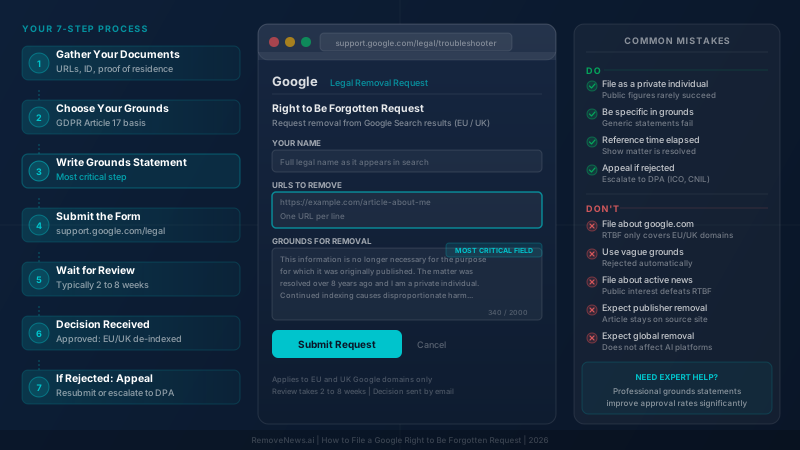
This is the most important part of your entire request. Google's review team reads thousands of grounds statements. Generic statements, short statements, and statements that simply describe what the article says rather than why it should be removed are rejected at a high rate. A strong grounds statement does five specific things.
1
Identifies the applicable GDPR Article 17 ground by name. State explicitly which ground you are relying on. "I am requesting erasure under GDPR Article 17(1)(a) on the basis that this data is no longer necessary for the purpose for which it was originally processed" is stronger than "I want this removed because it is old."
2
Establishes your status as a private individual. If you are not a public figure in connection with the subject matter of the article, say so directly. "I am a private individual who has never held public office, sought media coverage, or occupied any role that would place my personal history into the category of public interest" is the kind of language that helps reviewers understand your position.
3
Explains how much time has passed and why that matters. Time is one of the most important factors in RTBF decisions. If the article is from 2014, say so and explain what has changed in the intervening years. Has the matter been resolved? Have you rebuilt your life? Is there any ongoing public interest in the information being discoverable via your name in a Google search? The longer the gap between publication and request, the stronger this element of your argument becomes.
4
Addresses whether the matter is resolved. For articles about legal proceedings, regulatory actions, disputes, or other time-limited events, confirm the current status explicitly. "The matter described in this article was fully resolved in [year]. There are no ongoing proceedings, no outstanding obligations, and no public interest served by making this article discoverable through a search of my name."
5
States the proportionality argument plainly. Explain why the harm to you outweighs any residual public interest. Consider: the practical effect on your employment, family relationships, or professional reputation of the article appearing on page one of a search of your name. Be concrete. "This article is the first result when anyone searches my name and has directly cost me professional opportunities" is more persuasive than "this article causes me harm."
The form has a character limit. Write your statement in full before opening the form, then trim to fit without losing the key elements. A statement of 300 to 600 words is usually appropriate for a news article RTBF request. Shorter statements tend to be under-developed. Much longer statements risk burying the key arguments.
Not sure your grounds statement is strong enough? Our specialists have reviewed hundreds of RTBF submissions and can assess yours before you file, or write one on your behalf as part of a full removal engagement.
Google's official Right to Be Forgotten form is located at support.google.com/legal/troubleshooter/1114905. Navigate there directly. Do not use third-party tools or intermediary sites that claim to file on your behalf through unofficial channels.
The form will ask you to select the type of removal request. Choose "Remove information from Google Search results" and then select the European privacy removal option. You will need to confirm that you are an EU or UK resident and that the content appears in Google Search results when your name is searched.
The fields that matter most are the URL fields and the grounds statement field. For each URL you are targeting, paste the exact URL. If you are requesting removal of multiple URLs related to the same article (for example, both the article page and a cached version), list each separately. Google reviews each URL individually, so a weak grounds statement for one URL can result in partial approval and partial rejection.
In the grounds statement field, paste the statement you prepared in Step 3. Review it once more before submitting to confirm it is specific, factual, and directly tied to the applicable GDPR Article 17 ground. Once submitted, you will receive an acknowledgment email from Google confirming that the request has been received and is under review.
What the Form Asks For
Your name as it appears in the search results. This should match exactly how Google shows your name in connection with the content you want removed.
The country or countries where the content appears in search results. Select all EU and UK domains where the content is visible.
The exact URLs you want removed. One per line. No wildcards. No domain-level requests without specific page URLs.
Your grounds for removal. This is your grounds statement. It is the field with the highest impact on outcome.
Supporting documentation (optional at submission). Google may request documentation after initial review if the request is flagged for follow-up. Having it ready avoids delays.
Step 05
What Happens After You Submit
After submission, Google places your request into a review queue. The review is conducted by Google's legal and policy team, not by automated systems alone. A human reviewer reads your grounds statement and evaluates it against the Article 17 criteria and the public interest considerations in Article 17(3).
The review typically takes between two and eight weeks. During this time, your request status will show as "under review" if you check the confirmation email or the submission portal. You will not receive status updates during the review period. The process does not allow you to add information or modify your request after submission, so the quality of what you submit at Step 4 is what the reviewer will evaluate.
The decision is delivered by email to the address you used when filing. The email will either confirm that the URLs have been approved for removal, confirm that the request has been rejected (with a brief explanation), or, in some cases, request additional documentation before a decision is made. If additional documentation is requested, respond promptly, as delays in your response extend the overall timeline.
Step 06
If Your Request Is Approved: What De-indexing Actually Means
An approval from Google means the URLs you listed will be removed from search results on EU and UK Google domains. This is not instantaneous. De-indexing typically occurs within a few days to a couple of weeks after the approval email is sent. You can verify the de-indexing is complete by searching your name in an incognito browser window while connected to a VPN set to a European country, or by asking someone in Europe to run the search for you.
What de-indexing does not do is equally important to understand. The article remains on the publisher's website. Anyone who has the URL can still access it directly. The content is still accessible to users searching on google.com (the US domain) or any non-EU and non-UK Google domain. Other search engines, including Bing and DuckDuckGo, are completely unaffected. AI platforms including ChatGPT, Gemini, Perplexity, and others are also unaffected by the de-indexing.
For many EU and UK residents, de-indexing from European Google results is a meaningful and practical improvement. If your primary audience is in Europe and the content is primarily visible via European Google searches of your name, an approved RTBF request significantly reduces its reach. If you need broader removal, including from the publisher's site, see our guide on GDPR and news article removal for the full range of options available alongside or after an RTBF request.
Step 07
If Your Request Is Rejected: What to Do Next
Rejection from Google is not the final word. There are two primary routes forward after a rejection.
Route 1: Resubmit with a stronger grounds statement. Read the rejection email carefully. Google typically provides a brief explanation for why the request was denied. Common reasons include: the content is of legitimate public interest, the requester appears to be a public figure in connection with the content, or the grounds statement did not sufficiently explain why privacy rights outweigh public interest. Use this feedback to rewrite and strengthen your statement before resubmitting. A well-revised second submission that directly addresses the stated reason for rejection has a meaningfully better chance of success. See our dedicated guide on how to appeal a Google RTBF rejection for a step-by-step approach to the revision process.
Route 2: Escalate to your national Data Protection Authority. Every EU member state has a national DPA. The UK's DPA is the ICO data protection complaint service. If Google rejects your request, you can file a complaint with your national DPA asking them to investigate Google's decision. DPAs have investigatory and enforcement powers over data controllers operating in their jurisdiction. The European Data Protection Board coordinates enforcement across all EU member states. The ICO, CNIL (France), BfDI (Germany), AEPD (Spain), and other DPAs have each ordered Google to de-index content after initial rejections. Escalation adds time, typically several months to over a year, but it is a legitimate and often successful pathway that many people abandon prematurely. Our guide to the UK RTBF process and ICO escalation covers the ICO complaint process in detail.
Common Mistakes
What Gets RTBF Requests Rejected
Understanding the most common rejection reasons helps you avoid them before you file. Google's review team sees the same patterns repeatedly.
1
Filing as a public figure about content related to your public role. If you are a politician filing about coverage of your parliamentary votes, a CEO filing about coverage of a business decision, or any public figure filing about content directly connected to why you entered public life, the Article 17(3) public interest exception will almost certainly apply. RTBF requests about private life matters from public figures can sometimes succeed, but requests about public roles almost never do.
2
Submitting a vague or generic grounds statement. Statements like "this article is old" or "this information is no longer relevant" without specific factual context are rejected automatically. Google needs you to explain why, in your specific situation, the balance of rights and interests tips toward de-indexing. That explanation requires facts, not conclusions.
3
Filing about accurate, current, and active public-interest content. If the article describes ongoing proceedings, if the subject matter is still being actively reported on, or if there is a clear ongoing public interest in the information being discoverable, RTBF will not succeed. The right is designed for historical data that no longer serves a legitimate purpose, not for content that is currently relevant.
4
Filing about content on google.com rather than EU and UK domains. If your concern is visibility on the US Google index, this form will not help you. Confirm that the content appears in EU or UK search results specifically before filing.
Success Rate Reference
Assessing Your Situation Before You File
Not all RTBF requests have equal chances of success. The table below summarizes how Google and DPAs typically evaluate different situations, along with the grounds most likely to apply and what to include in your statement.
Situation
Likely to Succeed?
Grounds to Use
What to Include in Grounds Statement
News article about a private individual
Strong
Art. 17(1)(a): no longer necessary; Art. 17(1)(c): proportionality
Confirm private status; explain lack of ongoing public interest; describe disproportionate harm to privacy; note time elapsed
Old article that is no longer newsworthy
Good
Art. 17(1)(a): data no longer necessary for original purpose
State original publication date; explain what has changed since publication; confirm matter is resolved; argue no legitimate ongoing purpose is served by indexing
Article about a public figure
Unlikely
Art. 17(1)(c) if content concerns private life, not public role
Clearly distinguish between public role and private life; show the content falls outside the scope of the public role; note any passage of time that weakens public interest
Article with factual errors
Conditional
Art. 17(1)(d): data inaccurate; Art. 17(1)(a): if already corrected at source
Document each specific factual error; provide evidence of the correct facts; show that the publication was notified and did not correct; request de-indexing of the uncorrected version
Article about a resolved criminal matter
Good
Art. 17(1)(a): no longer necessary; rehabilitation and proportionality
Confirm resolution (acquittal, spent sentence, or rehabilitation); show time elapsed; argue that ongoing indexing prevents rehabilitation and serves no current public purpose; establish private individual status
Article still of active public interest
Very unlikely
None reliably applicable
Wait until the matter is resolved before filing; a request filed while public interest is active will be rejected and may establish a record that weakens future requests about the same content
Limits of the RTBF Process
It is important to have accurate expectations before investing time in an RTBF request. The process covers only Google's EU and UK search indexes. It does not remove the article from the publisher's website, affect google.com, affect Bing or other search engines, or address AI platforms like ChatGPT or Perplexity. For most people, it is one part of a broader privacy strategy rather than a complete solution. If you need removal from the publisher's site or broader search suppression, those require separate approaches that are covered in our complete RTBF and news article removal guide. Consider also removing it from AI search results and pursuing a suppression strategy for non-EU search engines. A news article removal attorney can coordinate all these pathways simultaneously.
For situations where RTBF is denied, unavailable (US residents have no formal RTBF right), or insufficient (AI search systems are unaffected by de-indexing), RemoveNews.ai provides editorial removal services that work in parallel with or in place of the RTBF route. Professional news article removal through Reputation Resolutions handles both the editorial outreach to publishers and the RTBF documentation process as part of a single engagement.
Free Consultation
Is your article removable? Find out -- free.
Tell us about your situation and a removal specialist will personally review it and respond within one business day. No pressure, no obligation.
No upfront payment -- you only pay if we succeed
A+ BBB Rated · 5,000+ Clients Helped · Since 2013
100% Confidential · Response within 1 business day
Frequently Asked Questions
Common Questions About Filing a Google RTBF Request
Who can file a Google Right to Be Forgotten request?
Only EU and UK residents can file a Right to Be Forgotten request with Google under GDPR and UK GDPR. The right does not extend to residents of other countries, including the United States, Canada, or Australia. If you are outside the EU or UK, you may have options under local privacy laws, but the GDPR-based Google RTBF process is not available to you.
How long does Google take to review a Right to Be Forgotten request?
Google's review typically takes between 2 and 8 weeks from the date of submission. You will receive an acknowledgment email when the request is received and a separate decision email when the review is complete. The timeline varies depending on the complexity of the request and the volume of requests Google is processing at any given time.
What happens to the original article if Google approves my request?
If Google approves your Right to Be Forgotten request, the URLs you listed will be de-indexed from EU and UK Google domains, such as google.fr, google.de, google.co.uk, and others. The article itself remains on the publisher's website and is still accessible to anyone who navigates directly to that URL. The removal affects only how the content appears in European Google search results. Google.com and other non-EU/UK domains are unaffected, as are AI platforms, Bing, and other search engines.
What should I write in the grounds statement?
Your grounds statement should explain specifically why your privacy rights outweigh the public interest in the content remaining indexed. Generic statements such as "this article embarrasses me" are rejected. Effective grounds statements address: how much time has passed since the event, whether you are a private individual rather than a public figure, whether the matter has been fully resolved, whether the ongoing indexing serves any legitimate public purpose, and how the continued availability of the content causes disproportionate harm to you. The more specific and factual your statement, the stronger your request.
What should I do if Google rejects my Right to Be Forgotten request?
A rejection is not the end. You can resubmit with a stronger and more specific grounds statement addressing the reasons Google cited for rejection. You can also escalate to your national Data Protection Authority. In the UK, this is the ICO. In France, it is the CNIL. In Germany, it is the BfDI. Each DPA has the authority to investigate Google's decision and order de-indexing if they find in your favour. Many successful RTBF outcomes come after an initial rejection and a DPA escalation.
Does a Right to Be Forgotten request remove content from AI platforms like ChatGPT?
No. A Google RTBF request applies only to Google's EU and UK search index. It has no effect on ChatGPT, Perplexity, Gemini, Copilot, or any other AI platform or search engine. If you need content removed from AI systems, that is a separate process governed by each platform's own policies and, in some cases, separate data subject rights requests under GDPR.
Filed and Rejected? Or Not Sure Where to Start? We Can Help.
Our team has helped thousands of individuals navigate the RTBF process, write grounds statements that get approved, and escalate to DPAs when Google says no.
CEO & Co-Founder, RemoveNews.ai · Reputation Resolutions
Anthony has spent 13+ years studying what makes negative news content stick — and how to remove it. He co-founded Reputation Resolutions and has helped 5,000+ clients remove and suppress damaging press coverage. He holds Corporate & Crisis Communications and Brand Management certifications from Cornell, a Digital Marketing certificate from NYU, and is a member of the Forbes Agency Council and Fast Company Executive Board.