-
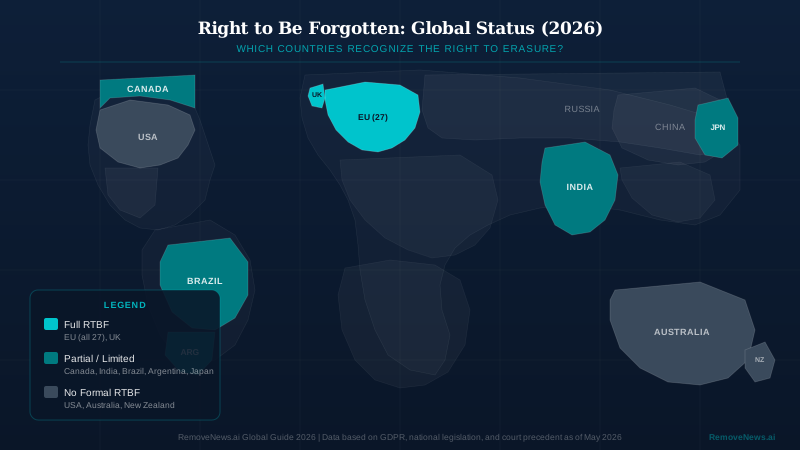
The EU has the strongest and most consistently enforced right to be forgotten. GDPR Article 17 creates a binding erasure right applicable to search engine de-indexing, enforced by national Data Protection Authorities with real sanction power.
-
The UK retained equivalent protections post-Brexit. UK GDPR, effective January 2021, mirrors GDPR Article 17 for practical purposes. The Information Commissioner's Office supervises and enforces it.
-
India, Canada, Brazil, Argentina, and Japan each have partial or limited rights. These range from provincial legislation (Quebec) to court-recognized principles (India, Argentina) to statutory erasure rights that focus on data processors rather than publishers (Brazil, Japan).
-
The US, Australia, and New Zealand have no formal right to be forgotten for news articles. Residents of these countries must rely on voluntary editorial removal, platform policies, and search suppression strategies rather than legal rights.
What the Right to Be Forgotten Actually Means (and What It Does Not)
The phrase "right to be forgotten" covers several related but distinct legal concepts. In its most precise form, it refers to the right recognized by the Court of Justice of the European Union in the 2014 Google Spain v. AEPD case, which established that individuals can request search engines to de-index links to personal information that is inaccurate, inadequate, irrelevant, or excessive relative to the purposes for which it was processed. GDPR Article 17, which came into force in May 2018, codified and expanded this right across all 27 EU member states.
Critically, the right to be forgotten as implemented under GDPR is primarily a search engine de-indexing right, not a publisher removal right. When a request succeeds, Google removes the relevant URLs from search results shown to users within the EU. The article itself remains on the publisher's website. Anyone who navigates directly to the publication can still read it. What disappears is the search-engine pathway that most people use to find it.
A second form of the right, sometimes called the right to erasure, applies to personal data held by data processors and controllers. This version of the right is what most data protection laws outside the EU have adopted. It allows individuals to request that companies delete their personal data from databases and systems. It does not typically apply to published journalism or search engine results in the way that the Google Spain decision established.
Understanding this distinction is essential for anyone evaluating their options across different jurisdictions. The country-by-country analysis below focuses on the search engine de-indexing version of the right, because that is what matters for individuals seeking to manage how news articles appear in Google when their name is searched.
Even in countries with no formal right to be forgotten, Google maintains its own content removal policies that can result in de-indexing regardless of local law. These include policies on doxxing, sensitive personal information (such as bank account details or medical records published without consent), and outdated content. These policy-based removals are distinct from legally mandated ones and are evaluated case by case. See our guide on the complete right to be forgotten process for a fuller treatment of both legal and policy-based pathways.
The European Union: The Gold Standard
Legal basis: GDPR Article 17 (Right to Erasure), operative since May 25, 2018. Enforced by national Data Protection Authorities (DPAs) in each member state.
GDPR Article 17 grants individuals the right to obtain from a controller the erasure of personal data concerning them without undue delay. The grounds on which erasure can be demanded include: the data is no longer necessary for the purpose for which it was collected; the individual withdraws consent; the data has been unlawfully processed; or erasure is required to comply with a legal obligation.
For search engine de-indexing purposes, the Google Spain framework established that search engines are data controllers with respect to the personal data they surface in results. A resident of any EU member state can submit a de-indexing request to Google using a standardized form. Google evaluates whether the content meets the criteria and, if so, removes the URLs from results displayed within the EU. The process is free and does not require a lawyer.
Key limitations within the EU framework: GDPR includes a journalism and public interest exception that limits erasure rights where the data processing is necessary for the exercise of the right to freedom of expression and information. This exception is applied by DPAs and courts and means that articles about matters of genuine public concern, particularly those involving public figures in their public roles, are harder to de-index than articles about private individuals in private matters. The exception is not unlimited, and DPAs regularly order de-indexing of content about private individuals that no longer serves a legitimate public purpose.
Germany's Federal Court of Justice has issued some of the most detailed jurisprudence on balancing personality rights against press freedom under GDPR. France's CNIL (Commission Nationale de l'Informatique et des Libertes) has been one of the most active DPAs in enforcing de-indexing obligations. The Spanish AEPD, which brought the original Google Spain case, continues to handle a high volume of de-indexing requests. All 27 member states apply the same Article 17 framework, but enforcement emphasis and DPA resources vary.
For residents of EU countries dealing with news article de-indexing, the right is real, functional, and supported by an administrative infrastructure. Our detailed guide on GDPR and news article removal covers the request process, evaluation criteria, and appeal options in detail.
United Kingdom: Post-Brexit Continuity
Legal basis: UK GDPR (the EU GDPR as retained in UK domestic law by the European Union (Withdrawal) Act 2018, effective January 1, 2021). Supervised by the Information Commissioner's Office (ICO).
When the UK left the European Union, it incorporated GDPR directly into domestic law as UK GDPR. For the right to be forgotten, the practical effect is functionally identical to the EU framework. Article 17 of UK GDPR mirrors EU GDPR Article 17 in its structure, grounds, and limitations. The journalism and public interest exceptions apply in the same way.
The Information Commissioner's Office serves as the UK's supervisory authority. Individuals can submit de-indexing requests directly to Google and, if dissatisfied with Google's response, can escalate to the ICO. The ICO has the power to issue enforcement notices and impose fines for GDPR violations, though in practice it focuses on systemic failures by large organizations rather than individual de-indexing disputes.
One important post-Brexit consideration: A successful de-indexing request under UK GDPR removes content from Google's UK-facing results (google.co.uk), not from EU-facing results. EU residents whose content appears in UK-based publications need to file separate requests under EU GDPR. Conversely, UK residents whose content appears in EU-based publications may need to file under both frameworks. The geographic scope of each framework is distinct.
The UK government has explored reforms to its data protection regime through the Data Protection and Digital Information Bill, but as of May 2026 the core right to erasure structure from UK GDPR remains intact. Our dedicated guide on the UK right to be forgotten and ICO process covers the mechanics in full.
Canada: Provincial Progress, Federal Gap
Legal basis: PIPEDA (federal, no formal RTBF); Quebec Law 25 / Bill 64 (provincial, limited de-indexing right, fully effective September 2023); proposed federal CPPA (pending as of 2026). Supervised by the Office of the Privacy Commissioner of Canada (OPC) federally; Commission d'acces a l'information (CAI) in Quebec.
Canada's federal privacy framework, the Personal Information Protection and Electronic Documents Act (PIPEDA), does not contain a formal right to be forgotten equivalent to GDPR. The Office of the Privacy Commissioner of Canada has issued guidance indicating that de-indexing requests may be appropriate in certain circumstances, particularly where personal information has become outdated or was never accurate, but this guidance does not create binding legal rights enforceable against search engines.
Quebec's Law 25 (formerly Bill 64), which came into full effect in September 2023, represents the most significant legislative development for Canadian residents. Quebec's statute includes a right of de-indexing: individuals may request that operators of a technology that makes information about them public cease disseminating the information or de-index any hyperlink attached to their name that gives access to it, where the dissemination causes serious injury to their reputation or privacy. This is a real, enforceable right for Quebec residents, supervised by the Commission d'acces a l'information.
The federal Consumer Privacy Protection Act (CPPA), proposed to replace PIPEDA, includes enhanced erasure rights but had not been enacted into law as of May 2026. If passed, it would extend some erasure protections to all Canadians, though the scope with respect to search engines and published news articles remains to be seen in implementing regulations.
In practice, Google does honor some de-indexing requests from Canadian residents, particularly where content falls within categories Google's own policies address (outdated information, content about minors, sensitive personal data). But this is discretionary, not legally compelled, for most Canadian provinces outside Quebec.
India: Judicial Recognition Without Codification
Legal basis: Supreme Court of India recognition of privacy as a fundamental right (Puttaswamy v. Union of India, 2017); various High Court decisions ordering de-indexing in specific cases; Digital Personal Data Protection Act (DPDP Act, 2023) with limited scope for search engines. No designated central DPA yet operational for this purpose.
India's right to be forgotten emerged through judicial development rather than legislation. The Supreme Court's landmark 2017 decision in Justice K.S. Puttaswamy v. Union of India established privacy as a fundamental right under the Indian Constitution. In the years following, several High Courts applied this principle to de-indexing requests, ordering Google to remove specific URLs from search results in individual cases.
The Karnataka High Court, in particular, has issued several notable orders requiring de-indexing of content from individuals' names in search results, grounding those orders in the constitutional right to privacy and the right to live with dignity. The Rajasthan High Court has similarly recognized a right to be forgotten in cases involving individuals acquitted of criminal charges or involved in personal disputes that entered the public record.
The Digital Personal Data Protection Act (DPDP Act), enacted in August 2023, includes a statutory right to erasure. However, the DPDP Act's right to erasure is directed at data fiduciaries (companies that collect and process personal data) rather than at news publishers or search engines in their capacity as content aggregators. The practical application of the DPDP Act to news article de-indexing remains to be developed through regulations and case law, and as of 2026, enforcement infrastructure under the Act is still being established.
For Indian residents seeking de-indexing of news articles, the available path is primarily through court petitions rather than administrative processes. This makes the right expensive, slow, and inconsistently available compared to the EU's administrative DPA framework.
Not sure which jurisdiction applies to your situation? Our specialists can assess your options across multiple frameworks and identify the strongest available path for your specific circumstances.
Get a Free ConsultationBrazil and Argentina: Latin America's Early Movers
Legal basis: Lei Geral de Protecao de Dados (LGPD, Law 13.709/2018, effective 2020). Right to erasure in Article 18. Supervised by the Autoridade Nacional de Protecao de Dados (ANPD). Journalism exceptions significantly limit application to news articles.
Brazil's General Data Protection Law (LGPD) was modeled substantially on GDPR and includes a right to erasure of personal data in Article 18. In formal structure, the LGPD's erasure right resembles GDPR's Article 17. However, the LGPD contains broad exceptions for journalism and freedom of expression that significantly limit its application to published news articles.
The ANPD, established to supervise the LGPD, has been building its enforcement infrastructure since 2021 and is still maturing as an institution. Practical enforcement of de-indexing requests against search engines through the ANPD has been limited. Brazilian courts have in some cases ordered Google to remove search results, but the volume and consistency of such orders remains well below the EU level.
Legal basis: Personal Data Protection Law (Law 25.326, 2000) and case law; Argentine courts have issued Google de-indexing orders in landmark cases. Supervised by the Agencia de Acceso a la Informacion Publica (AAIP).
Argentina has one of the oldest and most developed right-to-be-forgotten case law traditions outside Europe. The country's courts began addressing de-indexing claims against Google and Yahoo in the mid-2000s, making Argentina one of the first non-European countries to recognize this right through judicial decisions. The Argentine Supreme Court addressed the issue in the Da Cunha case (2014), establishing a framework for evaluating claims against search engines.
Argentine courts have ordered Google to de-index links to personal content, particularly in cases involving private individuals whose images or personal information appeared in search results without consent. The right has been grounded in both Argentina's constitutional right to honor and privacy and in the Personal Data Protection Law.
The practical scope of Argentine court orders is limited by enforcement reach. Orders issued by Argentine courts apply within Argentina's jurisdiction but do not compel global removal in the way that EU GDPR enforcement can influence Google's global practices. Nevertheless, Argentina's legal tradition in this area is sophisticated and has influenced Latin American privacy law development.
Japan: APPI Amendments and Court-Ordered De-Indexing
Legal basis: Act on the Protection of Personal Information (APPI), amended significantly in 2022 with deletion request rights; Supreme Court of Japan has recognized a right to de-indexing in specific circumstances. Supervised by the Personal Information Protection Commission (PPC).
Japan's approach to the right to be forgotten combines legislative and judicial development. The 2022 amendments to the Act on the Protection of Personal Information introduced new rights for individuals to request deletion of their personal information held by businesses. These amendments brought APPI somewhat closer to GDPR's data subject rights framework, though the specific application to search engine de-indexing of news content remains limited by journalism exceptions.
The Supreme Court of Japan addressed de-indexing directly in a 2017 decision involving a man convicted of a crime who sought removal of search results referencing his past conviction. The Court established a balancing test: whether the right to have information deleted outweighs the need to provide the information to the public, evaluated against factors including the sensitivity of the information, the time elapsed since the relevant events, and the current degree of public concern. The Court ultimately denied the request in that case, finding the public interest in the information still outweighed the privacy claim, but the framework established that such requests are cognizable in principle.
Japanese courts have granted de-indexing orders in subsequent cases involving private individuals, particularly where the information was outdated, the individuals had served their sentences, or the content related to matters that no longer served a legitimate informational purpose. The Personal Information Protection Commission has enforcement authority over APPI violations but has focused primarily on data breach and commercial data processing issues rather than search engine de-indexing disputes.
Australia and New Zealand: Reform Discussions, No Formal Right
Legal basis: Privacy Act 1988 does not include a right to be forgotten for search engines or news articles. Law reform proposals under the Privacy Act Review (Attorney-General's Department, 2023 Report) include some enhanced access and correction rights but do not create a Google de-indexing right. Supervised by the Office of the Australian Information Commissioner (OAIC).
Australia's Privacy Act 1988 governs the handling of personal information by Australian government agencies and many private sector organizations. It includes a right of access to personal information and a right of correction of inaccurate information, but these rights apply to the holder of the data (the organization that collected it) rather than to search engines or news publishers. There is no right to compel Google to de-index search results under Australian privacy law.
The Australian Attorney-General's Department published a comprehensive Privacy Act Review Report in 2023 recommending significant strengthening of the Privacy Act. Some recommendations would enhance individual rights over personal information, including expanded correction and deletion rights. However, even the reform proposals fall short of creating a formal right to be forgotten for news article search results. As of May 2026, the legislative reform process continues without final enactment of the recommended changes.
Australian courts have considered de-indexing arguments in individual cases but have not established a broad common law right. Residents of Australia seeking removal of news articles from Google must rely on voluntary editorial processes, Google's own content policies, or search suppression strategies. Our resource on publisher protection laws across Australia, the US, Canada, and the UK examines the legal environment in more detail.
Legal basis: Privacy Act 2020 includes rights of access and correction of personal information, but not a right to de-index search engine results or compel removal of published news articles. Supervised by the Office of the Privacy Commissioner.
New Zealand's Privacy Act 2020, which replaced the 1993 Act, modernized the country's data protection framework considerably. It includes information privacy principles governing how agencies collect, hold, use, and disclose personal information, and it gives individuals a right to request access to and correction of their personal information held by an agency. However, the Act does not create a right to be forgotten equivalent to GDPR, and New Zealand courts have not yet issued broad de-indexing orders against search engines.
New Zealand's Privacy Commissioner has the power to investigate complaints and issue compliance notices, but these powers are directed at organizations that collect and hold personal data rather than at search engines indexing published news content. There is no administrative pathway in New Zealand equivalent to the EU's DPA-based process for de-indexing requests.
United States: The First Amendment Wall
Legal basis: No federal right to be forgotten. California Consumer Privacy Act (CCPA, as amended by CPRA) covers business-held consumer data but explicitly excludes journalistic content. No state has enacted a news-article-specific right to erasure. First Amendment provides strong constitutional protection against compelled de-indexing of truthful content.
The United States has no federal right to be forgotten, and as of 2026, no state has enacted one for news articles or search results. The primary reason is constitutional: the First Amendment to the US Constitution provides the strongest freedom of speech and freedom of the press protections of any major democracy. A federal law compelling search engines to de-index truthful, lawfully published news articles would face immediate and likely successful First Amendment challenges.
The California Consumer Privacy Act (CCPA), significantly amended by the California Privacy Rights Act (CPRA) effective January 2023, gives California residents the right to request deletion of personal information held by businesses that collect it. However, the CCPA explicitly carves out an exception for personal information collected, maintained, used, communicated, or disclosed for journalistic, artistic, literary, or other expressive purposes. The CCPA does not create any right to have news articles de-indexed from Google.
Section 230 of the Communications Decency Act provides additional structural protection for search engines and online platforms in the US context. It largely immunizes platforms from liability for content created by third parties (including news publishers), which makes compelling de-indexing through tort litigation especially difficult. This combination of First Amendment protection and Section 230 immunity creates a legal environment where neither legislative nor judicial paths to news-article de-indexing are practically available.
US residents dealing with negative news articles must rely on: voluntary editorial removal requests to publishers; Google's own content policies for specific categories (sensitive personal information, doxxing, outdated content about people who are not public figures); and search suppression through building positive content that ranks above the negative article. Our detailed analysis of the right to be forgotten in the United States covers the available options and their realistic outcomes.
Russia and China operate internet censorship frameworks that have surface-level similarities to the right to be forgotten but are fundamentally different in nature and purpose. Russia's "right to be forgotten" law (Federal Law No. 264-FZ, 2016) allows individuals to request removal of certain outdated information from Russian search engines, but it operates within a broader framework of state-directed internet control that has been used to suppress political speech and journalism. China's internet regulation framework includes extensive content removal powers, but these are state-censorship mechanisms rather than individual privacy rights. Neither represents a genuine right to be forgotten in the GDPR sense and neither is analyzed in this guide.
Country-by-Country Comparison Table
The table below summarizes the practical position for residents of ten jurisdictions seeking to address news articles that appear when their name is searched on Google.
| Resident / Country | Has Formal RTBF? | Applies to Google De-indexing? | Supervising Authority | Practical Effectiveness |
|---|---|---|---|---|
| EU Resident (any of 27 member states) | Yes (GDPR Art. 17) | Yes | National DPA (e.g., CNIL, AEPD, BfDI) | High for private individuals; limited for public figures on matters of public concern |
| UK Resident | Yes (UK GDPR Art. 17) | Yes | Information Commissioner's Office (ICO) | High; functionally equivalent to EU GDPR for most purposes |
| Canadian Resident (Quebec) | Limited (Law 25) | Yes (Quebec only) | Commission d'acces a l'information (CAI) | Moderate; provincial scope only; federal gap remains |
| Canadian Resident (other provinces) | No (federal only) | Not formally | Office of the Privacy Commissioner (OPC) | Low; relies on OPC guidance and Google discretion |
| Indian Resident | Judicially recognized | Case by case (courts) | Courts; DPDP Board (being established) | Low to moderate; requires litigation; inconsistent outcomes |
| Brazilian Resident | Partial (LGPD Art. 18) | Limited (journalism exemptions) | Autoridade Nacional de Protecao de Dados (ANPD) | Low to moderate; ANPD still maturing; journalism exception broad |
| Argentine Resident | Case law recognized | Yes (court orders) | Agencia de Acceso a la Informacion Publica (AAIP); courts | Moderate; established case law but litigation-dependent |
| Japanese Resident | Partial (APPI + case law) | Case by case (courts) | Personal Information Protection Commission (PPC); courts | Low to moderate; court orders possible; no administrative pathway |
| Australian Resident | No | No | Office of the Australian Information Commissioner (OAIC) | Very low; relies on voluntary editorial removal and Google policies |
| New Zealand Resident | No | No | Office of the Privacy Commissioner | Very low; relies on voluntary editorial removal and Google policies |
| US Resident | No | No | No federal authority; FTC (limited) | Very low for legal compulsion; suppression and editorial removal are primary tools |
What to Do If Your Country Has No Right to Be Forgotten
Living in a jurisdiction without a formal right to be forgotten does not mean you are without options. It means the options are different, and the outcomes depend more on editorial discretion, platform policy, and proactive strategy than on legal rights. The following steps represent best practice for individuals in Australia, New Zealand, the United States, or other non-RTBF jurisdictions.
-
1Document what exists in search results before taking any action. Search your full name in an incognito browser, screenshot and save every result from the first three pages, and record which articles appear, in which positions, and under which search queries. This baseline is essential for measuring improvement and for any discussions with publishers or reputation specialists.
-
2Request editorial review from the publisher directly. Many publications have editorial corrections or removal policies that they apply even without legal compulsion. Requests are most successful when the article contains factual inaccuracies, the underlying matter has been resolved, the article concerns a private individual whose relevance to the story has ended, or significant time has passed since publication. Frame the request professionally and factually, not emotionally.
-
3Review Google's own removal policies for applicable categories. Google will remove content from search results under its own policies for certain categories regardless of local law. These include content that contains sensitive personal information (government ID numbers, financial account details, medical records), doxxing content, content about minors, non-consensual intimate imagery, and outdated content about private individuals. If the article falls into any of these categories, a Google policy-based removal request is worth pursuing independently of any legal right.
-
4Build a search suppression strategy for content that cannot be removed. Where removal is not possible, pushing the problematic article from page one to page two or three of search results is the next best outcome. This is achieved by creating and optimizing positive content, including a personal website, professional profiles, authored articles in credible publications, and online mentions that accumulate inbound links. This is a longer-term strategy that typically requires six to eighteen months of sustained effort to show significant results.
-
5Engage a specialist with experience in your specific jurisdiction and publication type. The difference in outcomes between a well-executed professional approach and a self-directed one is significant. Specialists who work with news article removal regularly know which publications respond to requests, which editorial arguments are most effective, and which suppression tactics produce measurable results for specific content types.
- Am I a public figure or a private individual for purposes of this article? The distinction significantly affects both the legal framework and the practical likelihood of editorial removal. Private individuals have stronger claims in nearly every jurisdiction.
- Is the article accurate? Factual inaccuracies open editorial and, in some jurisdictions, legal pathways not available for accurate reporting. Identifying and documenting specific inaccuracies before engaging a publisher or specialist is essential.
- Has the underlying matter been resolved? Resolved charges, dropped cases, settled disputes, and rehabilitated individuals all have stronger arguments for removal or de-indexing than ongoing situations.
- Which jurisdiction am I in, and which jurisdiction is the publisher in? Even if you are in a non-RTBF country, if the publisher is EU-based, EU GDPR may apply to their processing of your data. Similarly, if you relocated from an EU country, the article may relate to activities conducted while you were an EU resident.
- How long has the article been online, and has traffic to it increased or decreased? Older articles that are declining in relevance are easier removal targets than recently published or recently reshared content.
Common Questions About the Right to Be Forgotten by Country
Your Reputation Matters. Know Your Options.
Whether you are in the EU with a full legal right, or in the US with no formal framework, our specialists help you identify the strongest available path and execute it effectively.
Free assessment. Confidential. No obligation.