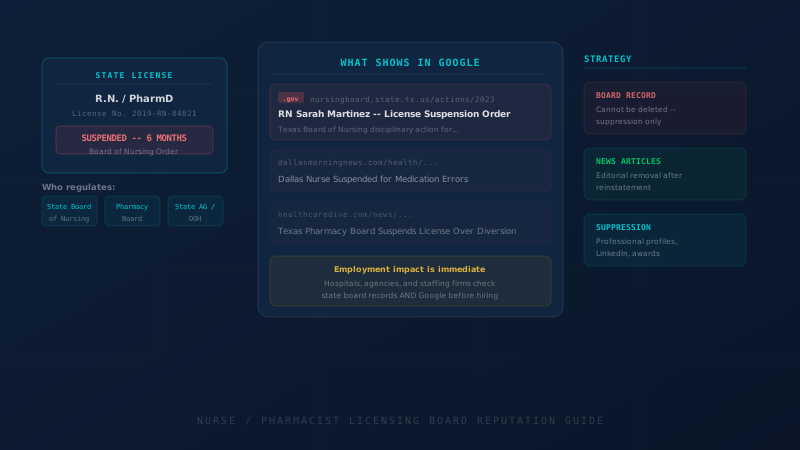
The Board Action Is Resolved. The Google Results Aren't.
State nursing and pharmacy boards publish disciplinary actions on government websites that rank at the top of Google -- giving any search of your name immediate access to your professional record, regardless of how long ago the matter was resolved. Local news outlets then compound the problem by covering healthcare worker discipline as a patient safety story, creating a second layer of indexed coverage that follows nurses and pharmacists through every job application, credentialing inquiry, and patient search. This guide explains what is permanent, what is potentially fixable, and what the most effective path forward looks like for licensed healthcare professionals dealing with both tracks of exposure.
By Anthony WillFounder & CEO, Reputation Resolutions · Removing articles since 2013
Updated June 30, 2026Published May 12, 2026 · 11 min read
Key Takeaways
State nursing and pharmacy boards publish disciplinary actions on government websites with high Google authority. These board records are permanent and cannot be removed -- they stay in the public record even after reinstatement.
News articles covering board actions are separate from board records and are often the more actionable target. Publishers can correct, update, or remove coverage that is outdated or inaccurate -- unlike government databases, they are not permanent by design.
A resolved discipline significantly strengthens editorial removal arguments. Publishers are more receptive to requests when probation is completed and the license is reinstated -- the underlying issue is closed and the article no longer serves a current public safety purpose.
Google's content removal tools cover some healthcare licensing scenarios. Particularly when the article reveals sensitive personal medical information or when charges were ultimately dismissed, specific de-indexing pathways may apply.
The Two-Track Reputation Problem for Nurses and Pharmacists
Healthcare professionals who have gone through state board discipline face a reputation problem that operates on two entirely separate tracks -- and conflating them leads to wasted effort aimed at the wrong target.
Track 1 is the board record itself. State nursing boards publish disciplinary actions on their official state websites. Pharmacy boards do the same. These are .gov or quasi-governmental domains with enormous authority in Google's eyes. When someone searches "[your name] nurse license" or "[your name] pharmacist," these government records frequently appear at or near the top of results. They are permanent. License reinstatement does not remove the notation of the discipline -- the history stays in the public record. This is not a problem that can be solved through removal. It requires a different approach entirely: search suppression through the creation of authoritative counter-content that pushes board records lower in results.
Track 2 is the news coverage of the board action. Local hospital beat reporters, regional healthcare publications, and local television stations actively cover nursing and pharmacy board discipline as a patient safety story. When a board action is reported in the news, the resulting article is indexed by Google and surfaces alongside -- or even above -- the official board record in name searches. These articles appear in employer background research, patient review site lookups, and credentialing checks conducted by hospitals and pharmacy systems. Unlike the board record, news articles are not government publications. The publisher made an editorial decision to cover the story, and they retain the ability to make a different editorial decision -- to update, correct, or remove the coverage.
The board record problem is permanent. The news article problem is potentially solvable. Understanding which track you are dealing with determines every subsequent step.
We remove damaging professional coverage — you only pay after it’s gone.
No upfront payment No retainer A+ BBB Rated 5,000+ clients helped In business since 2013 Only Pay For Results True Removal Experts
State nursing and pharmacy boards publish disciplinary actions on government websites that rank at the top of Google -- giving any search of your name immediate access to your professional record, reg
Section 02
How State Boards Publish Disciplinary Records
Every state nursing board maintains a public license verification system that includes discipline history. At the national level, the National Council of State Boards of Nursing (NCSBN) operates NURSYS, a centralized database that aggregates license and disciplinary data from participating state boards. NURSYS is used by employers, hospitals, travel nursing agencies, and the public to verify credentials and check disciplinary history. A search of your name in NURSYS returns your license status and any discipline the state board has reported to the system.
For pharmacists, the National Association of Boards of Pharmacy maintains the NABP e-Profile system (formerly known as NABP CPE Monitor), which tracks pharmacist licensure and includes discipline data accessible to employers and licensing boards across states. Individual state pharmacy board websites also publish discipline notices independently -- often in a searchable public database and in quarterly discipline bulletins that remain permanently archived on the board website.
These records stay even after license reinstatement. The notation of the discipline -- the type of action, the basis, and the date -- remains a permanent part of the public record. Reinstatement is added as a subsequent event, not a replacement of the discipline entry. Google indexes state board disciplinary databases heavily because they sit on high-authority government domains. A board discipline notice on a state .gov website will outrank almost any counter-content a nurse or pharmacist can create independently.
This is the permanent track. There is no mechanism for removal. The strategy for managing it is suppression -- building enough authoritative, professionally relevant content elsewhere online that the board record moves from the first page of results to the second or third. That work is valuable and worth doing, but it operates on a different timeline and with different tools than addressing news coverage.
Section 03
Why News Coverage of Board Actions Is Different
Local newspapers and television stations cover nursing and pharmacy board discipline because editors frame it as a patient safety story. Medication errors, allegations of patient neglect, substance use in a clinical setting, inappropriate prescribing -- these are the kinds of stories that regional health reporters are actively looking for. They serve a genuine public interest purpose at the moment the board action is reported: warning the community that a licensed healthcare professional has been disciplined.
But that moment passes. A board action resolved years ago, a probation completed, a license reinstated -- these developments strip the article of its current public safety rationale. The nurse or pharmacist is no longer under discipline. The public safety concern that justified the original coverage no longer exists in the same form. The article, however, remains indexed by Google indefinitely -- continuing to cause professional harm without serving a meaningful current purpose.
Unlike the board record, the news article is not on a government website. A regional newspaper or local TV station made an editorial decision to cover the story. They can make a different editorial decision. Publishers have the authority to update articles to reflect resolution of the underlying matter, to add corrections when factual errors exist, and in some cases to remove articles entirely when the original public interest justification has lapsed. The threshold for each outcome differs by publication type and editorial policy, but the pathway exists -- and that is the fundamental distinction from the board record track.
The argument that tends to work most effectively with editors is not a claim of a right to removal. It is an editorial argument: the case is closed, the license is reinstated, the public safety concern that drove the original coverage is no longer current, and continuing to rank this article prominently causes ongoing harm disproportionate to any remaining public benefit. Well-documented, professionally framed requests grounded in these arguments succeed with meaningful frequency -- particularly for smaller regional publications that lack dedicated legal teams to push back.
Key Distinction
The nursing board record and the news article about it are two different problems with two different solutions. The board record requires a suppression strategy -- building positive authoritative content to push the government record out of the top search results. The news article may qualify for editorial removal or Google de-indexing. Conflating the two wastes time and effort aimed at the wrong target. A nurse who spends months trying to get NURSYS to remove a record while ignoring an actionable local newspaper article is solving the wrong problem first.
Section 04
What Grounds Actually Work for Removal Requests
Not every editorial removal request succeeds, but certain factual circumstances substantially improve the odds. Understanding which grounds are strongest helps nurses and pharmacists prioritize their approach and frame requests in terms that resonate with editorial decision-makers.
Factual errors in the original reporting. This is one of the most powerful grounds available. Board complaints are frequently filed before an investigation is complete. Reporters covering the complaint stage -- rather than waiting for the board's final determination -- often describe allegations as established facts, misidentify the type of discipline issued, or report the wrong license status. If the article contains verifiable inaccuracies, documenting them with specificity creates a legitimate correction claim that most publications cannot reasonably refuse. Even a partial correction that adds context about the actual outcome of the case significantly reduces the article's reputational impact.
Investigation or complaint dismissed or resolved in the nurse or pharmacist's favor. This is the strongest possible removal ground. If the board ultimately took no action, dismissed the complaint, or found the allegations unsubstantiated, the article's premise is factually incorrect. The publication reported a board action that did not result in discipline. Many editors will update or remove coverage in this scenario -- the article's factual foundation is gone. This ground applies even if the publication accurately reported the complaint at the time it was filed.
Discipline completed and license reinstated. A resolved disciplinary matter changes the editorial calculus significantly. The public safety rationale for the article was the existence of an active disciplinary proceeding or sanction. Once the probation is complete and the license is fully reinstated, that rationale has lapsed. The article now describes a closed historical matter while continuing to rank on page one of a current name search. Framing the removal request around recency and proportionality -- the ongoing harm relative to the diminished public interest -- is effective with many regional publishers.
Article includes personal medical information about the subject. Some board actions involve a nurse or pharmacist's personal substance use treatment, mental health history, or medical condition. When a news article references this information -- particularly if it was disclosed in board proceedings without the subject's consent -- editors are often receptive to removal or redaction requests framed around the personal and sensitive nature of the information. This is not a legal basis for forced removal, but it is a compelling editorial argument that many publishers take seriously.
Article contains HIPAA-adjacent concerns about patient information. If the original article identified patients by name, described their conditions in ways that enable identification, or included details that were not part of a public court record, editors may be receptive to requests for redaction or removal on the grounds that the coverage raises patient privacy concerns. This is a softer argument than the others -- HIPAA does not directly bind news publishers -- but it resonates with health editors who are sensitive to patient confidentiality norms.
Important Approach Note
Never contact a journalist or editor claiming a legal right to removal. Nurses and pharmacists have no enforceable legal right to compel article removal in the United States. The First Amendment protects editorial decisions. Framing a removal request as a demand rather than an editorial request frequently triggers a defensive response from the publication -- and in some cases prompts a follow-up story about the attempt to suppress coverage. Frame all requests as editorial requests based on accuracy, recency, and proportionality. The goal is to give the editor a journalistically sound reason to act, not a legal threat that puts them on the defensive.
Section 05
Google De-Indexing: When It Applies to Healthcare Licensing Cases
Google offers several content removal tools that may apply to nurses and pharmacists dealing with news articles about board discipline. Understanding which tools apply to which circumstances prevents wasted effort on requests that Google will not process.
Outdated content removal. Google's outdated content removal tool allows users to request de-indexing of search results that no longer reflect the current state of the source URL. If a news article has been updated or removed by the publisher, this tool can accelerate the removal of cached versions and outdated search snippets. It can also apply when an article is several years old and references a disciplinary matter that has since been publicly resolved. This tool requires demonstrating that the indexed content no longer reflects the actual content of the URL -- so it works best when publisher updates have already been made, or when the source page has been removed.
Sensitive personal information removal. Google has expanded its policies around sensitive personal information to include content that reveals certain categories of private data without consent. If a news article about a board action includes a nurse or pharmacist's home address, personal medical history unrelated to the board proceeding, or other categories covered under Google's sensitive information policies, a removal request through this pathway may be processed. The bar is meaningful -- the information must fall into specific protected categories -- but healthcare professionals whose board actions involved disclosure of personal medical records or treatment history may have viable claims here.
Standard de-indexing requires publisher cooperation first. For most news articles that do not meet the specific criteria above, Google will not de-index content simply because it is damaging or outdated. Google's standard process for de-indexing requires the source publisher to implement a noindex meta tag or to modify their robots.txt file to block Googlebot. This means source removal -- getting the publisher to take the article down or add a noindex directive -- must come before Google de-indexing can be achieved through the standard pathway. Attempting to circumvent this by submitting de-indexing requests without publisher action wastes time and creates a false expectation of success.
Google AI Overviews and AI search results. Successful de-indexing of a source article benefits both standard Google search results and Google's AI Overview responses. When Google's AI systems can no longer access a source article, they stop surfacing that content in AI-generated summaries that appear above standard search results. For nurses and pharmacists whose board actions are being cited in AI Overview boxes -- which now appear prominently for many name searches -- source removal followed by de-indexing is the most effective tool. Our guide on removing content from AI search and ChatGPT covers the AI-specific considerations in more detail.
Section 06
Removal Difficulty by Source Type
Source
Removal Difficulty
Timeframe
Notes
State nursing board website (NURSYS)
Impossible
N/A -- permanent
Record stays even after reinstatement. Suppression strategy required.
State pharmacy board website
Impossible
N/A -- permanent
NABP database also permanent. Government record cannot be removed.
Local newspaper article
Moderate
4-12 weeks
Strongest case when discipline is resolved and license reinstated. Factual errors further strengthen the request.
Local TV station story
Moderate-Hard
6-16 weeks
Video content -- broadcast editors are generally more protective of published stories than print editors. Correction or update is more common than full removal.
Healthcare trade publication
Moderate
4-10 weeks
Often receptive to correction or update requests. Trade editors understand license reinstatement and are familiar with board processes.
Google (standard search)
Hard
8-20 weeks
Requires source removal first. De-indexing follows publisher action -- it does not substitute for it.
Background check services
Moderate
4-8 weeks
FCRA dispute process available for consumer reporting agency records. Accuracy disputes are most viable when the underlying action has been resolved.
Section 07
The 6-Step Plan for Nurses and Pharmacists
1
Separate the board record from the news articles. Conduct a thorough Google inventory of both tracks separately. Search your full name combined with your license type, your state, and the word "license" or "board." Document every result: which are official board records on government domains, and which are news articles or third-party coverage. These require entirely different approaches and should not be treated as a single problem.
2
Assess the current status of your license. Is your license fully active and reinstated? Has probation been completed? These facts are the foundation of every editorial removal argument. A fully reinstated license with a clean current standing is your strongest asset in any removal request. Gather the official documentation of your current license status from your state board before taking any other action.
3
Identify factual errors or outdated information in each article. Read every article carefully and document, with specificity, any inaccuracies -- mischaracterized allegations, incorrect license status, charges that were ultimately dismissed, outcomes that were never reported. Factual inaccuracy is your most powerful removal argument and should be identified before any outreach begins.
4
Submit editorial removal or correction requests for each article. Paste the article URL into RemoveNews.ai to identify the appropriate editorial contact and generate a professional removal request framed around accuracy, recency, and proportionality. Professional requests submitted through proper editorial channels -- not demand letters or social media pressure -- yield substantially better outcomes than DIY approaches.
5
Pursue Google de-indexing for articles where source cooperation is unlikely. For older articles with resolved outcomes where the publisher is unresponsive or unwilling to act, explore Google's outdated content removal tool and sensitive personal information removal pathways. If the article is 3 or more years old and references a discipline that is now fully resolved, the outdated content pathway may apply. For articles containing personal medical history, the sensitive information pathway warrants assessment.
6
Build authoritative counter-content to suppress remaining coverage. A fully optimized LinkedIn profile highlighting continuing education, specialty certifications, professional organization memberships, and patient care philosophy creates indexed content that competes with board records and news articles for page-one visibility. Published contributions to nursing or pharmacy professional journals, membership profiles on professional association sites, and interviews in healthcare media all contribute to the suppression effort. This is the long-term solution for the board record track and a valuable supplement for any news articles that survive the editorial removal process.
Your board record can't be removed. Your news article might be. Find out in 60 seconds -- paste any article URL into RemoveNews.ai for an instant assessment of your removal options.
The period immediately following license reinstatement is the strongest window available for editorial removal requests. This is not intuitive -- many nurses and pharmacists assume that more time passing will make a removal request easier to make, because the event feels more distant. The opposite is true in editorial terms.
When reinstatement is recent, the editorial argument is at its sharpest: the underlying matter was just resolved. The news article was accurate at the time it was published. The discipline is now over. The license is fully reinstated. The article continues to rank on Google as though the situation is current. The case for updating or removing the coverage is directly tied to a concrete, datable event -- reinstatement -- that just occurred. Editors can point to that event as the reason for taking action without appearing to have yielded to pressure without justification.
After two to three years, editors start treating the article differently. It is no longer coverage of a recent event being corrected in light of subsequent developments -- it is becoming historical record. The older an article gets, the more an editor's default position shifts toward "leave it up as an accurate account of what happened at the time." The argument that the article is outdated weakens as it competes with the counterargument that it is archived history.
For nurses and pharmacists who have completed probation or had their license reinstated within the past 12 months, acting now -- rather than waiting -- dramatically improves success rates. The same removal request that might succeed today with a well-framed editorial argument may face a much more resistant editor 18 months from now. The reinstatement window is real, and it closes. You can verify your current license status using license verification portals before approaching any publisher. Once a publisher removes the article, Google's legal removal tools can accelerate de-indexing.
For related guidance on how news articles about healthcare professionals interact with broader online reputation concerns, our article on physician medical board actions and news coverage covers the physician-specific version of this problem, including medical board licensing records and how physician discipline is handled differently by news publishers. Dentists and chiropractors facing similar board action coverage will find applicable guidance in our article on dental and chiropractic board action news articles. If your board action appears in government press releases in addition to news articles, our guide on removing government press releases from Google addresses that additional layer of exposure.
Tell us about your situation and a removal specialist will personally review it and respond within one business day. No pressure, no obligation.
No upfront payment -- you only pay if we succeed
A+ BBB Rated · 5,000+ Clients Helped · Since 2013
100% Confidential · Response within 1 business day
Frequently Asked Questions
Common Questions From Nurses and Pharmacists
Can a nurse or pharmacist force a news article about their board action to be removed?
No. Nurses and pharmacists have no legal right to compel a news publisher to remove an article in the United States. The First Amendment protects editorial decisions by publishers. However, removal requests framed as editorial requests based on accuracy, recency, and proportionality are often successful -- particularly when the underlying discipline has been resolved, the license has been reinstated, or the original article contains factual errors. A professional reputation specialist can substantially improve the odds of a successful editorial removal request compared to a self-directed approach.
How long does a nursing board disciplinary action stay on Google?
The board record itself on the state nursing board website or in the NURSYS database is permanent -- it will not be removed regardless of subsequent reinstatement. News articles about the board action, however, are a separate problem. News articles remain indexed by Google indefinitely unless the publisher removes or de-indexes the content. Without active intervention, an article can remain on page one of a name search for years or even decades. Proactive editorial removal and search suppression strategies are the primary tools available to nurses seeking to limit the ongoing visibility of news coverage.
What is NURSYS and can I get my record removed from it?
NURSYS is the national nurse licensure and disciplinary database maintained by the National Council of State Boards of Nursing. It aggregates license verification and disciplinary data from participating state nursing boards and is used by employers, healthcare facilities, and the public to verify nurse credentials. Disciplinary actions recorded in NURSYS are permanent -- they cannot be removed even after a license is reinstated or probation is completed. The discipline stays in the public record as a historical notation. This is why separating the board record problem from the news article problem is essential: NURSYS requires a suppression strategy, not a removal strategy.
If my pharmacy license was reinstated, can I get the news article removed?
License reinstatement is one of the strongest grounds available for requesting editorial removal of a news article about a pharmacy board action. Publishers are most receptive to removal or update requests when the underlying matter is fully closed. A completed probation or reinstated license means the article no longer reflects current circumstances -- it is historical content that continues to cause reputational harm without serving a current public safety purpose. Submitting a well-documented editorial request within 12 months of reinstatement, when the resolution is recent, yields significantly higher success rates than waiting.
Does Google de-index articles about nursing or pharmacy board actions?
Google's de-indexing tools can apply to healthcare licensing cases in limited circumstances. Google's outdated content removal tool may apply if the article is several years old and references discipline that has since been resolved. Google's sensitive personal information removal tool may apply if the article includes the subject's home address, medical history, or similar personal information without consent. However, Google will not de-index content simply because it is embarrassing or professionally damaging. For most cases, publisher cooperation -- obtaining a noindex tag or removal of the source article -- must come before Google will de-index the content from search results.
How does a news article about board discipline affect future employment?
News articles about nursing or pharmacy board discipline create a persistent barrier across multiple stages of the employment process. Healthcare employers routinely conduct Google searches on candidates in addition to formal background checks. A news article that appears on page one of a name search can prevent an interview invitation, prompt an HR hold during onboarding, or create complications during credentialing at a hospital or pharmacy system. Travel nursing agencies and pharmacy staffing firms are particularly sensitive to negative online coverage because their clients -- the healthcare facilities -- conduct their own searches. Addressing news coverage proactively, before a job search begins, eliminates this barrier.
The Board Record Is Permanent. The News Article Doesn't Have to Be.
Our specialists understand the difference between nursing and pharmacy board records and the news coverage about them -- and we know which strategies work for each. Confidential assessment, no obligation.
CEO & Co-Founder, RemoveNews.ai · Reputation Resolutions
Anthony has spent 13+ years studying what makes negative news content stick — and how to remove it. He co-founded Reputation Resolutions and has helped 5,000+ clients remove and suppress damaging press coverage. He holds Corporate & Crisis Communications and Brand Management certifications from Cornell, a Digital Marketing certificate from NYU, and is a member of the Forbes Agency Council and Fast Company Executive Board.