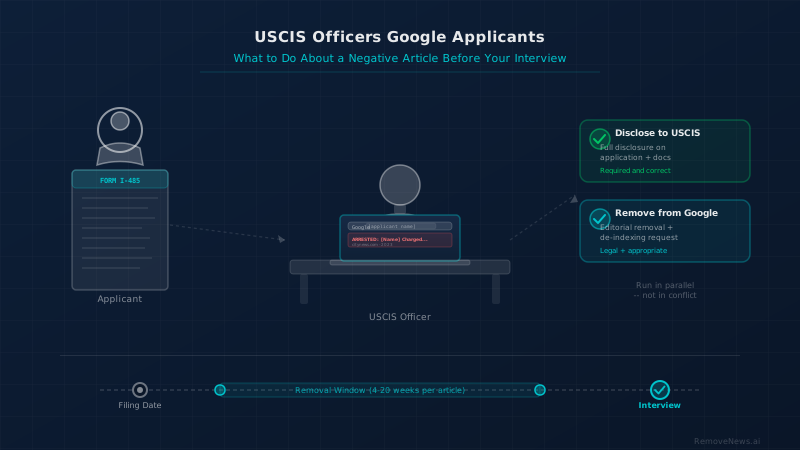
USCIS Officers Google Applicants. Here Is What to Do About a Negative Article Before Your Interview.
Immigration adjudicators and consular officers routinely conduct open-source research on applicants, including Google searches, as part of the background check process. A negative news article -- an old arrest report, a licensing board action, a civil lawsuit -- can surface in an officer's search and create questions that complicate or delay an otherwise approvable case. Addressing negative online content before an immigration interview is not about hiding information; it is about ensuring that what an officer finds is accurate, current, and contextualized.
By Anthony WillFounder & CEO, Reputation Resolutions · Removing articles since 2013
Updated June 30, 2026Published May 12, 2026 · 11 min read
Key Takeaways
USCIS officers and consular officials use open-source intelligence (OSINT) including Google searches as part of their adjudication process. Negative articles that an applicant would expect to be irrelevant can be raised at an interview.
An applicant is not required to disclose news articles about themselves, but they are required to disclose the underlying events. An officer who finds a news article about an event the applicant did not disclose may treat that as a misrepresentation, which is far more serious than the underlying event.
Removing or de-indexing a negative article before an immigration interview does not constitute concealment. It is a legal and legitimate reputation management action. The disclosure obligation runs to USCIS, not to the internet.
For articles about resolved criminal matters (expunged, dismissed, no conviction), removal from Google is both more feasible and more important in the immigration context because even dismissed charges can complicate applications if not properly documented.
How USCIS and Consular Officers Use the Internet During Adjudication
USCIS officers adjudicating immigration petitions and applications -- including the I-485 (adjustment of status), I-130 (petition for alien relative), N-400 (naturalization), and various employment-based visa categories -- are trained to conduct open-source research as part of the background check process. This is not an informal practice or the exception. It is a structured component of how officers verify that information provided on applications is complete and accurate. The USCIS adjudication process and AILA's immigration attorney resources both acknowledge that an applicant's online footprint is part of the modern adjudication landscape.
Open-source research conducted by USCIS typically includes Google searches of the applicant's full name and known name variations, review of publicly accessible social media profiles, and examination of public records available through platforms like Justia, CourtListener, PACER, and state court portals. Consular officers at US embassies and consulates conducting immigrant visa interviews similarly conduct open-source checks before and during the interview process. Cornell Law's immigration law overview provides background on the legal framework within which these adjudications occur. For articles that qualify, Google's removal tools can be used to request de-indexing before your interview.
What officers are looking for includes: criminal history not disclosed on the application, civil fraud allegations or financial crime coverage, immigration violations or status inconsistencies, national security concerns, public benefit use, and any information that contradicts or supplements the application as filed. This is the same information that appears when anyone types a person's name into Google.
The critical point is that an officer's job is to verify. A news article that appears to contradict or supplement the application is a red flag -- not because news articles are inherently reliable evidence, but because the officer must now ask questions. An article that says an applicant was arrested in 2019, when the applicant did not address a 2019 arrest anywhere in their application, creates a gap the officer must resolve. That gap -- and the questions it generates -- is the problem that proactive online content management addresses.
Officers are not required to tell applicants in advance what they have found online. An article may be sitting in an officer's file before you walk into the interview room. Understanding this dynamic is the first step toward addressing it effectively.
We remove damaging professional coverage — you only pay after it’s gone.
No upfront payment No retainer A+ BBB Rated 5,000+ clients helped In business since 2013 Only Pay For Results True Removal Experts
Immigration adjudicators and consular officers routinely conduct open-source research on applicants, including Google searches, as part of the background check process.
Section 02
The Disclosure Trap -- Why Concealment Is More Dangerous Than the Underlying Event
Immigration applications ask about criminal history, civil violations, prior immigration proceedings, and other significant events. An applicant who was arrested, charged, named in a civil action, or the subject of a licensing board proceeding has a disclosure obligation on questions about those specific categories of events. The obligation is to disclose the underlying event to USCIS -- not to make it searchable on Google.
This distinction is legally and practically important, and it is widely misunderstood. Consider two scenarios.
Scenario A: An applicant was arrested in 2021, the charges were dismissed, and a local news article about the arrest remains indexed on Google. The applicant disclosed the arrest on their I-485 and attached the court disposition showing dismissal. The applicant also retained a reputation specialist who submitted a de-indexing request to Google. The article disappears from search results before the interview. At the interview, the officer searches the applicant's name and finds nothing negative. The case proceeds without complication from the arrest.
Scenario B: An applicant was arrested in 2021, the charges were dismissed, and a local news article about the arrest remains indexed on Google. The applicant -- believing the dismissed charges were irrelevant -- did not disclose the arrest on their I-485. The applicant also did not pursue removal of the article. At the interview, the officer searches the applicant's name and finds the article. The officer now has an article describing an arrest and an application with no disclosure of any arrest. The officer may treat the gap as a material misrepresentation.
In Scenario A, the de-indexing was protective but not essential to the legal outcome -- the disclosure was complete. In Scenario B, removing the article from Google after the fact does not cure the misrepresentation problem, because the officer already has the application on file. The key rule is: disclose fully to USCIS, and separately manage what appears in Google. These are independent actions with independent legal significance.
Conversely, an applicant who removes a news article about an event that was fully and properly disclosed on their application has done nothing wrong with respect to either Google or USCIS. The disclosure obligation is met through the application. Managing what the internet shows is a separate matter entirely.
Attorney Perspective
"Immigration attorneys consistently advise clients to assume that USCIS will find everything. The correct approach is: disclose all required events fully on the application, obtain proper documentation (court records, disposition letters, expungement orders), and then separately address what appears in Google. An article that says 'ARRESTED' when the disposition was 'DISMISSED' is creating a false impression that proper documentation corrects -- but removing the article eliminates the issue entirely."
Section 03
Which Types of Articles Create the Most Risk in Immigration Cases
Not all negative online content carries the same immigration risk. The categories below are ranked by the severity of the concern they typically create for officers reviewing an application.
High Risk
Arrest articles where the disposition (dismissed, expunged, acquitted) is not mentioned in the article. These are the most dangerous category because the article implies unresolved criminal conduct. An officer who finds an article reading "John Smith Arrested for Wire Fraud" and does not see any subsequent coverage reporting dismissal has no basis to infer a favorable outcome. If the applicant disclosed the arrest and has documentation of the dismissal, the article is contradicted by the record -- but it will still prompt questions. If the applicant did not disclose the arrest, the article creates a misrepresentation problem.
Articles about civil fraud, money laundering, or financial crimes. These imply conduct that may constitute crimes involving moral turpitude (CIMT), a legal category that can render applicants inadmissible or unable to demonstrate the good moral character required for naturalization. Even a civil allegation -- a regulatory agency complaint, a private lawsuit alleging fraud -- can trigger CIMT analysis if the underlying conduct matches the pattern USCIS looks for.
Articles about immigration violations or status issues. Any article that suggests an applicant was unlawfully present, worked without authorization, or previously entered through improper means directly implicates inadmissibility grounds and prior immigration history questions on the application.
Articles about national security-adjacent matters. Associations with organizations, individuals, or events that touch on national security concerns will be reviewed extremely carefully and may trigger additional background check processes regardless of the applicant's actual relationship to the subject matter of the article.
Moderate Risk
Licensing board discipline articles. Professional misconduct findings by a state licensing board -- for a medical license, law license, real estate license, financial services registration -- may trigger good moral character questions and can indicate conduct the officer will want to understand. Unresolved discipline is more concerning than resolved matters.
Old civil lawsuit articles where the suit was dismissed or settled without admission of liability. A civil lawsuit does not generally require disclosure on most immigration applications, but an article about a civil suit -- particularly one suggesting fraud, deceptive practices, or exploitation -- can create questions at the interview. The fact that the matter was dismissed or settled favorably is often not captured in the original article.
Old business articles about company failures or regulatory investigations. Articles about companies the applicant owned or managed that faced regulatory scrutiny, bankruptcy, or investor disputes can surface and prompt officer inquiry, particularly in employment-based cases where the applicant's business reputation is relevant.
Lower Risk (but still worth addressing)
Arrest articles where the article itself mentions dismissal or acquittal. If the article reports the resolution, the officer has context. The risk is lower, but the article still establishes that an arrest occurred and may still prompt a disclosure verification question.
Articles about minor incidents with clear resolution documented. Traffic incidents, small civil disputes, brief mentions in court coverage -- these are lower priority but still worth monitoring as part of a comprehensive pre-interview audit.
Section 04
The Timeline -- When to Act Relative to Your Immigration Process
Strategic timing matters because the tools available for removing or de-indexing content operate on their own timelines that do not pause for immigration deadlines. Understanding where you are in the process shapes which approaches are available and which should be prioritized.
Before filing: If you know you have negative online content and you have not yet filed your petition or application, address the content now. Google de-indexing and editorial removal processes take four to twenty weeks depending on the article, the publication, and the grounds for the request. Starting before filing gives you the maximum window to work through the process and to confirm that de-indexed content has actually disappeared from search results before the interview occurs.
After filing, before interview: This is the most common window in which clients seek help. After an I-485 is filed, there is typically a twelve to twenty-four month wait before an interview is scheduled, varying significantly by USCIS field office. This window is generally sufficient to pursue both editorial removal from the publication and Google de-indexing. Both tracks should be initiated promptly rather than waiting until the interview is imminent. For visa applicants going through a consular interview, the U.S. Department of State's visa information page outlines what consular officers review. For a deeper dive on the removal process itself, see our guide on .
Immediately before interview: If an interview is imminent -- scheduled within the next four to eight weeks -- editorial removal may not be achievable in time. The priority shifts to Google de-indexing (faster, especially for arrest records of dismissed charges) and to preparing thorough documentation of the underlying events for the interview itself. The officer may find the article if it is still indexed; the best mitigation at this stage is to be prepared with the full story, documented. Do not walk into an immigration interview without having Googled yourself in an incognito window the day before.
After a problem: If a USCIS officer raised a news article at an interview and the case is pending -- whether with a Request for Evidence (RFE), a Notice of Intent to Deny (NOID), or simply in a pending status -- work with immigration counsel immediately to address the article's content formally in any response to USCIS. Simultaneously pursue removal to prevent the article from affecting any future application or resubmission if needed. Understanding how Google handles removal requests is essential background for this phase -- our resource on whether Google removes negative articles explains the process and realistic outcomes.
Important Legal Clarification
Removing a news article from Google before an immigration interview is legal and appropriate. It is not fraud. It is not concealment. Your disclosure obligation runs to USCIS through your application and interview -- not to the public internet. However, do not remove any documentation that you are required to submit to USCIS (court records, dispositions, expungement orders, licensing board letters). Those records must be preserved and submitted to USCIS as part of your application package. Managing what appears in Google and maintaining your documentary record for USCIS are completely separate actions with completely separate purposes.
Section 05
Which Articles Are Most Removable in the Immigration Context
The grounds for removal or de-indexing in the immigration context often align closely with the grounds that matter most to USCIS: the legal status of the underlying matter. This means that the articles most harmful to immigration cases are frequently the same articles with the strongest grounds for removal. Use Google's legal removal tool for content that violates your rights, and work with a news article removal attorney to coordinate editorial and legal tracks simultaneously. Our guide on the right to be forgotten covers the full range of de-indexing options available to applicants.
Expunged or sealed records. If the underlying criminal matter was expunged or the record was sealed by a court, the news article about the original arrest is a strong candidate for both editorial removal and Google de-indexing. The legal record has been formally altered; the article reflects a legal status that no longer exists. Many publications will update or remove coverage when presented with documentation of expungement. Google has specific policies addressing outdated criminal record information, and expunged offense articles often qualify for removal through Google's own tools. For a detailed analysis of this specific scenario, see our article on .
Dismissed charges. An article about criminal charges that were dismissed before trial -- by the prosecutor, by the court, or through a diversion program -- is factually incomplete. The article describes a charge but omits the resolution. This incompleteness is both the source of the immigration risk and the basis for the removal argument. The article creates a materially false impression. Many publications will add a correction or note, and some will remove the article when presented with the dismissal order. Google's removal tools for outdated content are also applicable here.
No conviction. Arrest articles where the prosecution declined to charge, the grand jury failed to indict, or the case resulted in an acquittal at trial are among the strongest candidates for removal. The article implies guilt that was formally and legally not found. The distinction between arrest and conviction -- legally fundamental -- is typically absent from the article's framing, and a correction or removal request can make this argument directly to the publication.
Old civil matters. Dismissed civil suits, matters settled without any admission of liability, and regulatory inquiries that were closed without findings are all candidates for removal on the basis of outdated content. The argument that an article about a dismissed civil lawsuit continues to create a misleading impression of ongoing or unresolved dispute is editorially sound and frequently persuasive.
Licensing board actions with reinstatement. If the underlying professional disciplinary matter is resolved -- the license is reinstated, the sanction period has ended, the board has closed the matter -- an article about the original disciplinary action is describing a professional status that no longer reflects the current state. Reinstatement documentation is a strong basis for requesting that publications update or remove coverage of the original action.
Section 06
Immigration Risk and Removal Feasibility by Article Type
Article Type
Immigration Risk
Removal Feasibility
Priority
Arrest article (no disposition mentioned)
High
Moderate-High
Urgent
Arrest article (charges dismissed)
High
High
Urgent
Expunged offense article
High
High
Urgent
Civil fraud or financial crime coverage
High
Moderate
High
Licensing board discipline (unresolved)
Moderate
Moderate
High
Licensing board discipline (resolved)
Moderate
High
High
Old dismissed civil suit
Moderate
Moderate-High
Moderate
Business failure / bankruptcy coverage
Low-Moderate
Moderate
Moderate
Section 07
6-Step Immigration-Specific Removal Plan
1
Google yourself in incognito mode using every name variation you use and have used. This includes maiden name, middle name, any Anglicized or Americanized name, and the spelling of your name as it appears on your passport. Document every negative result -- note the URL, the publication name, the date of the article, and the nature of the content. This is your baseline inventory and the starting point for everything that follows.
2
Consult with your immigration attorney about your disclosure obligations for each event reflected in the articles. Do this before taking any online action. Your attorney needs to know what is online, what happened, and what your application says. Ensure your application and any required attachments address each event fully, regardless of what you decide to do with the online content. If your application is not yet filed, this is the time to make sure it will be complete and accurate when it is.
3
Obtain official documentation for each event reflected in the articles. This means court disposition letters, expungement orders, reinstatement letters from licensing boards, dismissal notices, settlement agreements with no-admission clauses, and any other official record that documents the resolution of the underlying matter. These documents are what you need for both USCIS submission and removal requests. Without them, your removal grounds are significantly weakened.
4
Pursue editorial removal for each article where grounds exist. For each article where the underlying matter was expunged, dismissed, acquitted, or resolved, submit a formal removal request to the publication with supporting documentation. Paste the article URL into RemoveNews.ai to generate a professional, documented request. The strength of your documentation is the primary factor in editorial removal success. Do not send informal or emotional requests -- publication editors respond to factual, well-documented grounds for removal or correction.
5
Simultaneously pursue Google de-indexing -- especially for arrest articles where charges were dismissed or records were expunged. Google's own removal tools specifically address outdated criminal record information, and expunged and dismissed charge articles often qualify. A successful de-indexing removes the article from Google search results even if it remains on the publication's website, which is sufficient to prevent an officer from finding it through a standard name search. The two tracks -- editorial removal and Google de-indexing -- should run in parallel, not sequentially.
6
Set a calendar reminder 30 days before your interview to re-check Google and confirm that de-indexed articles have not reappeared. Google's index is dynamic; de-indexed content can occasionally reappear if the publication recrawls or updates the page. Confirm the search results immediately before your interview. If any article remains indexed despite your efforts, prepare a clear, documented explanation of the underlying event and its resolution to have ready for the interview. Do not be caught off guard by content you already knew existed.
Your interview is coming. Find out which articles are removable before you walk in.
When News Article Removal Isn't Possible: What We Can Do for Immigration Cases
When a news article cannot be removed -- either because the publisher declines, the content is factually accurate, or the article falls outside Google's de-indexing criteria -- what matters most in immigration and visa contexts is how the article is contextualized alongside other online information about you. USCIS officers and consular officials conducting background reviews do not see only the article; they see everything that appears in a search of your name. Building a strong, authoritative, factual online presence -- professional profiles, organizational affiliations, published statements, and other credible content -- gives adjudicators a fuller picture that contextualizes rather than is overwhelmed by a single article. A well-executed suppression strategy can move a damaging article off the first page of search results and replace it with sources that accurately represent your background.
Our team has experience with immigration-sensitive cases and understands the specific content concerns that carry weight in visa and green card adjudications. We provide a direct assessment of whether removal or suppression is the more realistic outcome for your article, and we work on a pay-for-results basis for removal cases. Reputation Resolutions has served 5,000+ clients over 13+ years. A free consultation delivers a specific answer about your situation within one business day.
Not Sure What's Possible?
Our team reviews every situation individually and gives you a direct answer -- what's removable, what can be suppressed, and what a realistic timeline looks like. Schedule a free consultation and hear back within one business day. No pressure, no obligation.
Free Consultation
Is your article removable? Find out -- free.
Tell us about your situation and a removal specialist will personally review it and respond within one business day. No pressure, no obligation.
No upfront payment -- you only pay if we succeed
A+ BBB Rated · 5,000+ Clients Helped · Since 2013
100% Confidential · Response within 1 business day
Frequently Asked Questions
Common Questions About News Articles and Immigration
Can removing a news article from Google hurt my immigration case?
No. Removing a news article from Google before an immigration interview is a legal and appropriate reputation management action. Your disclosure obligation as an immigration applicant runs to USCIS through your application and interview -- not to the public internet. As long as you have fully and accurately disclosed all required events on your application forms, removing a news article about those events from Google does not constitute concealment, misrepresentation, or fraud. The two actions are legally independent.
Do I have to tell USCIS about an arrest if the article has been removed from Google?
Yes. Your obligation to disclose arrests and other criminal history to USCIS is determined by the questions on your application forms, not by what is searchable on Google. If your application asks about arrests and you were arrested, you must disclose it regardless of whether you have removed the news article about it from Google. Failure to disclose a required event is a misrepresentation, which is far more serious than the underlying event itself. Always consult an immigration attorney about your specific disclosure obligations before filing.
How do USCIS officers find news articles about applicants?
USCIS officers are trained to conduct open-source intelligence (OSINT) research as part of the adjudication process. This typically includes Google searches of the applicant's full name and name variations, social media review, and review of publicly available court and government records. Consular officers at US embassies conducting immigrant visa interviews similarly conduct open-source checks. The same search results that appear when anyone Googles a person's name are visible to these officers.
Can an expunged arrest article affect my immigration case?
Yes, it can -- and this is one of the most important distinctions in immigration law. Unlike in many state criminal law contexts where an expungement allows you to answer "no" to questions about arrests, most USCIS forms still require disclosure of expunged arrests. A news article about the original arrest that remains online can also be found by an officer and raise questions, even if the underlying record has been sealed. This makes expunged offense articles both high-risk and high-priority for removal. Consult an immigration attorney about your specific disclosure obligations for expunged records.
How long does it take to remove or de-index an article before an immigration interview?
The timeline depends on the approach. Editorial removal -- convincing the publisher to take down or update the article -- typically takes four to sixteen weeks, and success depends on the strength of the grounds (expungement, dismissal, factual error, resolved case). Google de-indexing requests for qualifying content (outdated arrest records, expunged offenses) typically take two to eight weeks after a successful request is submitted. Because timelines vary, it is important to begin the process as early as possible -- ideally before filing your petition, or at least immediately after filing when the interview is still months away.
What if an officer already found a negative article at my interview?
If a USCIS officer raised a news article at your interview and the case is pending -- whether with a Request for Evidence, a Notice of Intent to Deny, or simply in a pending status -- work with your immigration attorney immediately. The attorney can help you address the article's content formally in your response to USCIS, provide documentation of the underlying event's disposition, and contextualize the article for the officer. Simultaneously, pursuing removal of the article from Google can help prevent it from affecting a future application or a resubmission if the current case is not approved.
CEO & Co-Founder, RemoveNews.ai · Reputation Resolutions
Anthony has spent 13+ years studying what makes negative news content stick — and how to remove it. He co-founded Reputation Resolutions and has helped 5,000+ clients remove and suppress damaging press coverage. He holds Corporate & Crisis Communications and Brand Management certifications from Cornell, a Digital Marketing certificate from NYU, and is a member of the Forbes Agency Council and Fast Company Executive Board.