-
Executives face higher scrutiny and higher stakes. A single article that ranks on page one for a CEO's name can derail an IPO, a board appointment, or a capital raise -- even if the underlying matter was resolved years ago.
-
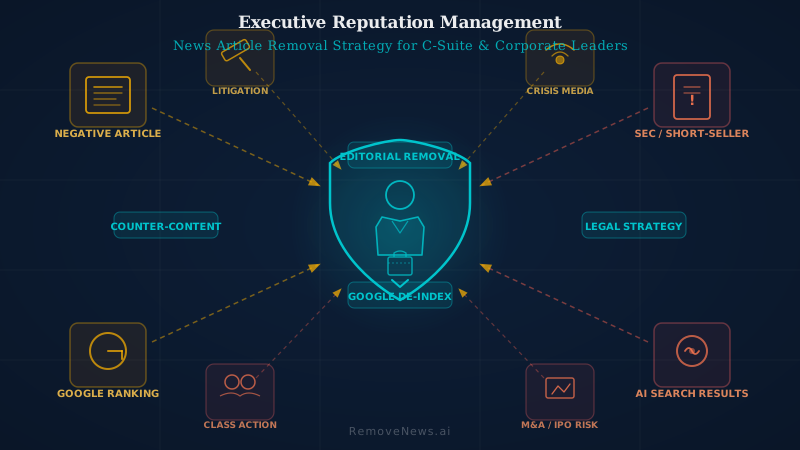
Public figure status raises the defamation bar but does not eliminate removal paths. Editorial correction, Google de-indexing, and counter-content suppression remain effective regardless of public figure status.
-
Short-seller reports and SEC enforcement articles are a distinct category. They require specialized approaches involving investor relations, securities counsel, and formal rebuttal strategies in addition to standard removal techniques.
-
Responding publicly to a negative article almost always makes the situation worse. The Streisand Effect is particularly acute for executives, whose responses attract media attention that amplifies the original story.
Why Executives Face Different Challenges Than Private Individuals
When a private individual appears in a negative news article, the legal and practical landscape is straightforward: defamation law applies in its standard form, requiring the plaintiff to show a false statement of fact that caused harm. For executives and other public figures, the standard is materially higher. Under the framework established in New York Times Co. v. Sullivan and its progeny, a public figure who seeks to bring a defamation claim must demonstrate actual malice -- that the publisher knew the statement was false or acted with reckless disregard for its truth or falsity.
This does not mean defamation claims are unavailable to executives. It means they are harder to win, and that the litigation route is often a poor strategic choice when other options exist. The practical effect of public figure status is that executives must generally pursue non-litigation paths as their primary strategy: editorial outreach, factual correction requests, Google de-indexing, and counter-content suppression.
But the public figure standard cuts both ways. Executives who are subject to press coverage are also executives with resources, institutional leverage, and access to professional support -- corporate communications teams, outside PR firms, and sophisticated legal counsel. These assets improve the probability of successful editorial negotiation dramatically. A well-resourced, properly intermediated approach to a publication is far more likely to yield a correction or removal than an angry email from a lawyer threatening litigation.
The stakes are also categorically higher. For a private individual, a negative article may affect job prospects or personal relationships. For an executive, the same article can disrupt a board recruitment process that requires a clean online footprint; complicate an M&A transaction in which the buyer's advisors conduct name-level due diligence on the management team; create problems in a private equity fundraising process where LPs conduct their own reputational diligence; or trigger an IPO underwriter's disclosure review that surfaces the article as a risk factor.
Executives named in negative articles should also be aware that those articles are not static objects. They are indexed by Google, cited by AI search systems, republished on aggregator sites, and referenced by future journalists covering related stories. An article from three years ago about a controversy that has since resolved can still appear on page one of a Google search for an executive's name -- and in AI-generated summaries of that executive's background.
The correct targets for executive news article removal are articles that contain verifiable factual errors, articles describing controversies that have been fully resolved with no ongoing relevance, and articles that are significantly outdated relative to the executive's current role and conduct. Attempting removal of accurate, recent articles covering ongoing matters is almost always counterproductive and carries significant risk of generating new, more prominent coverage. See our full guide on executive negative news article removal for a complete assessment framework.
Assessing the Article Before Taking Any Action
The single most important step in any executive reputation matter is an honest assessment of the article's factual accuracy, currency, and search impact. Executives who skip this step and proceed directly to removal demands frequently trigger outcomes far worse than the original article.
The assessment framework has three dimensions. Factual accuracy asks whether the article's core claims are substantially true. An article about an executive who was named in a lawsuit but who was ultimately cleared can still be technically accurate about the lawsuit itself, even if the outcome is either omitted or buried. Factual accuracy is the most important filter: accurate articles require a fundamentally different strategy from inaccurate ones.
Currency asks whether the article is describing a matter of ongoing relevance or one that has been fully resolved. An article from 2019 about a company controversy that the executive left behind in 2021 is far more amenable to removal or de-indexing than a current article about active litigation. Currency arguments are among the most persuasive in editorial requests -- publications have legitimate interests in not maintaining a permanent stigma for matters that have been resolved and where continued visibility serves no editorial purpose.
Search visibility determines urgency. An article that does not rank in the first three pages of a Google search for the executive's name is causing limited practical harm and may not warrant aggressive intervention. An article on page one, particularly one that appears in the first five results, is being seen by virtually every person who searches the executive's name -- which at the C-suite level includes board members, investors, potential partners, journalists, and counterparties in transactions.
If an article is broadly accurate and describes a recent, ongoing, or unresolved matter, do not attempt removal. Public removal demands made by or on behalf of executives almost always generate follow-up coverage that is more damaging than the original article -- because "executive tries to suppress article about [controversy]" is itself a story. The Streisand Effect is named for the 2003 incident in which an attempt to suppress aerial photographs of a private residence generated millions of views. For executives, the dynamic is far more severe because the financial and reputational stakes attract more media interest. Read our dedicated guide on the Streisand Effect and news article removal before taking any public action.
The assessment should also evaluate the publication type. Articles from national financial publications (the Wall Street Journal, Bloomberg, Reuters) operate under different editorial norms than articles from regional newspapers, legal trade press, or online-only outlets. Large national publications have robust editorial policies that make removal rare but corrections achievable when errors are documented. Smaller and mid-tier publications have greater flexibility and are more responsive to negotiated resolution.
Editorial Removal for Executives: How to Approach Publications Without Triggering a Counter-Story
The most effective editorial removal outcomes for executives share several characteristics: they are initiated through a professional intermediary rather than directly by the executive or their in-house team; they present documented factual errors or clear resolution context rather than demanding removal as a right; and they frame the request in terms of the publication's own editorial standards and journalistic obligations rather than the executive's preferences.
The correction versus removal distinction is critical. Corrections are substantially easier to obtain than removals and are often more strategically valuable. A published correction that documents factual errors and notes the resolution of the underlying matter creates a new, indexed piece of content that appears alongside the original -- and in some cases, Google will surface the correction in search results in a way that mitigates the original article's impact. In contrast, demanding full removal without strong grounds gives the publication a reason to re-examine the story and potentially publish a more comprehensive follow-up.
The question of whether to use a PR firm, outside counsel, or a reputation specialist as the intermediary depends on the nature of the article. If the article involves active litigation, outside counsel should be involved in any communication with the publication to ensure that attorney-client privilege is maintained over the substance of the communications and to avoid statements that could be used against the executive in the underlying matter. If the article involves completed business controversies, a reputation specialist or communications professional is often more effective because they can engage the publication on editorial terms rather than legal ones.
Direct approaches by executives or their in-house communications teams are almost always inadvisable. The executive's involvement signals that the article is causing significant distress, which increases the story's perceived newsworthiness. A measured approach through a professional intermediary -- one that positions the request as a routine editorial matter rather than a crisis -- is more likely to achieve a quiet resolution.
- Have you documented every specific factual error? Vague claims of inaccuracy are easily dismissed. Specific errors supported by documentary evidence -- court records, SEC filings, press releases -- are actionable.
- Is the underlying matter resolved? Dismissal orders, settlement agreements (to the extent they can be disclosed), regulatory closure letters, and acquittal records are all powerful grounds for editorial reconsideration.
- What is your minimum acceptable outcome? Prioritize: full removal is best, but a published correction with resolution context may be sufficient. Knowing your minimum outcome prevents a counterproductive escalation.
- Has the article been indexed for long enough to assess its search impact? Articles published within the past two weeks may not yet reflect their final search ranking. Assess visibility after 30 days before committing to a removal strategy.
- Is active litigation ongoing? If so, involve outside counsel before any communication with the publication to protect privilege and avoid adverse admissions.
Google De-indexing for Executives: Outdated Content Requests and Legal Removal
Google's de-indexing tools are underutilized by executives and their advisors, often because the process is misunderstood. De-indexing does not remove the article from the publication's website. It removes the article from Google's search index, meaning that even if a person navigates directly to the URL, the article remains accessible -- but it will no longer appear in Google search results for the executive's name or related queries.
For executives, de-indexing is often the more practical path to reputation protection than editorial removal, particularly when dealing with large publications that have strict editorial independence policies. A major financial newspaper may be unwilling to remove an article that meets its editorial standards, but Google may still de-index that same article if it meets Google's criteria for outdated content or legal removal.
Google's Outdated Content removal tool is designed for content that has been removed or substantially changed at the source but still appears in search results. It is not designed for articles that remain live at the publication. However, a more powerful tool is available for content that is genuinely outdated in a legal or policy sense: Google's legal removal request process under its policies for personal information, doxxing, and, in European jurisdictions, the right to be forgotten.
For executives seeking de-indexing of older articles in non-European jurisdictions, the most effective argument is that the article describes information that is no longer accurate -- for example, that it describes an executive as being under investigation when the investigation has since been closed. Google evaluates these requests case by case. The probability of success is higher when the article is more than two years old, when the underlying matter has been formally resolved, and when the executive can demonstrate that continued indexing causes concrete harm disproportionate to any public interest served by the article's continued visibility.
An important but underappreciated benefit of de-indexing is its effect on AI search systems. When Google de-indexes an article, the major AI search assistants -- which rely substantially on Google's index for real-time web content -- also lose access to that article when generating summaries and answers about the executive. This makes de-indexing particularly valuable in the current search environment, where AI-generated summaries are increasingly the first thing a person sees when searching a name. For a full analysis of Google's approach to news article removal, see our guide on whether Google removes negative articles.
Short-Seller Reports and SEC Enforcement Articles: A Special Category
Activist short-seller reports occupy a uniquely difficult position in executive reputation management. They are typically published by research firms that take short positions in a company's stock before releasing a report that makes negative claims about the company or its leadership. The economic incentive creates obvious conflicts of interest, but the courts have generally treated these reports as protected opinion or as fair commentary on matters of public concern related to publicly traded companies.
From a removal standpoint, short-seller reports present several challenges. The reports themselves are typically hosted on the research firm's own website, where the firm has complete editorial control and no journalistic obligation to respond to correction requests. The secondary coverage generated by the reports -- articles in financial media that summarize and amplify the report's claims -- is more amenable to traditional editorial approaches, but only where the secondary article contains its own factual errors beyond those in the underlying report.
Google's treatment of short-seller reports is cautious. The search giant has historically been reluctant to de-index content that relates to public companies and their officers, viewing such content as serving a legitimate public interest in market transparency. The exception is content that makes personal claims about executives that go beyond their roles as corporate officers -- for example, allegations of personal misconduct that are not supported by any legal or regulatory proceeding.
The most effective strategy for executives facing short-seller reports is a documented rebuttal. A detailed, point-by-point response published on the company's investor relations website, submitted as an SEC Form 8-K, creates a formal record that ranks in search results alongside the original report. Over time, the rebuttal -- particularly if it is comprehensive and supported by audited financial data -- can displace the report in search rankings as the more authoritative and cited document. For detailed guidance on this category, see our dedicated resources on short-seller report removal and SEC enforcement press release removal.
SEC enforcement press releases are a distinct but related category. When the SEC takes a formal enforcement action, it issues a press release that is indexed by Google, archived by the SEC's own website, and widely republished by financial media. The SEC press release itself cannot be removed from the SEC's website -- it is a federal government record -- but the secondary coverage can be addressed through editorial channels, and the SEC press release can sometimes be de-indexed from Google when the underlying matter has been resolved without a finding of fraud or when the executive was not a named defendant and is mentioned only incidentally.
Class Actions and Business Litigation Press Releases
One of the most common sources of executive reputation damage is the litigation press release. When a class action lawsuit is filed against a company, plaintiff law firms routinely issue press releases announcing the lawsuit and naming executive officers. These releases are distributed through PR wire services, indexed by Google almost immediately, and republished on legal aggregator sites, investor watchdog pages, and financial news outlets.
The press release itself is often more damaging than the underlying lawsuit. It is written in advocacy language designed to attract additional plaintiffs, it makes the most serious possible allegations without any qualification for the fact that a lawsuit is not a finding of wrongdoing, and it typically ranks highly in Google searches for the named executive because it is distributed to dozens of indexed domains simultaneously on the day of publication.
The good news is that litigation press releases are among the most amenable to post-resolution removal. When a class action is dismissed with prejudice, settled on terms that include no admission of wrongdoing, or otherwise resolved favorably, there is a strong factual basis for editorial removal requests and Google de-indexing requests. The wire services that distributed the original press release -- BusinessWire, Globe Newswire, PR Newswire -- each have procedures for removing or updating distributed releases. The plaintiff law firm itself is often willing to issue a follow-up release or correction as part of a settlement negotiation.
For executives dealing with ongoing litigation coverage, the appropriate strategy is a combination of monitoring (to catch new articles as they are published), documented counter-content (company press releases, CEO statements through investor relations channels, and authored commentary that establishes a competing narrative), and preparation for a post-resolution removal campaign. See our dedicated guides on news article lawsuit removal and class action press release removal for the complete process.
When settling a class action or business dispute, the removal of litigation press releases and associated online content can and should be a negotiated term. Many plaintiff firms are willing to agree to remove or update their distribution as part of the settlement package. This should be addressed explicitly in settlement discussions, ideally by outside counsel with experience in reputation management as well as litigation, because the documentation of what content will be removed or updated needs to be specific enough to be enforceable.
Crisis Communications and Media Response Strategy
The decision of whether to respond publicly to a negative article is one of the highest-stakes choices an executive faces in a reputation matter. The default answer, for most situations, is to not respond publicly -- but there are narrow circumstances in which a well-crafted response is more strategically valuable than silence.
The case for response is strongest when three conditions are met simultaneously: the article contains a verifiable, documentable factual error; the executive has evidence that definitively disproves the error; and the publication or a competing outlet is willing to publish the response in a form that will rank in Google search results alongside the original article. When all three conditions are present, a documented, factual response can permanently alter the information environment for that search query.
The case against response is compelling in virtually all other circumstances. Public responses by executives to negative articles consistently generate follow-up coverage. Journalists view an executive response as evidence that the original story has impact, which increases the story's editorial value and often prompts additional reporting. In litigation contexts, public responses create statements of record that can be used by opposing counsel. In regulatory contexts, they can be construed as attempts to influence the regulatory process.
The Streisand Effect is particularly acute for high-profile executives. When a recognizable CEO attempts to have an article removed, suppressed, or publicly contested, the story shifts from the original controversy to the executive's attempt at suppression -- which is itself a more compelling story and one that is much harder to manage. This dynamic is especially pronounced on social media, where screenshots of removal demands circulate widely and independently of the original article. Our resources on crisis communications for negative news coverage and whether to respond publicly to a negative article cover the decision framework in detail.
When a response is warranted, it should be delivered through a carefully chosen channel that the executive controls -- not through social media, and not through a reactive statement to a journalist. Options include a published byline in a publication that reaches the same audience as the original article; a letter to the editor that meets the publication's editorial standards for correction; or a formal statement filed with a regulatory body that becomes a matter of public record and indexes in search results.
Named in a Scandal That Is Not Your Own
Among the most frustrating reputation situations for executives is being named incidentally in coverage of someone else's scandal. This scenario is common: a company's former CEO is implicated in misconduct, and the current CEO is named in the article as having been present during the relevant period, or as having been appointed by the board that failed to act. An executive's former colleague faces regulatory action, and the executive is mentioned as a former business partner. A private equity fund's portfolio company becomes the subject of an investigation, and the executive who sat on the board is named in the coverage.
In these situations, the executive has limited control over the original article because the story is genuinely about someone else, and removing the executive's name may not serve the publication's editorial interest in accurately describing the network of people involved. The standard editorial removal request -- centered on factual error or outdated context -- is often unavailable because the mention may be technically accurate.
The most effective path for executives named incidentally in others' coverage is a combination of targeted de-indexing and active counter-content. Google will sometimes de-index content where an individual's name appears only peripherally and where continued indexing of that person's name in connection with the content causes harm disproportionate to any public interest served. This argument is stronger when the executive's involvement was genuinely tangential, when the underlying matter did not involve any formal proceedings against the executive personally, and when the executive has since separated from the organization or relationship described in the article.
Counter-content is the most reliable long-term strategy in these situations. Building a robust set of indexed content about the executive's current role, achievements, and professional profile causes the incidental mention to rank lower relative to a larger volume of positive and neutral content. This is the approach that works even when removal fails. See our guide on being named in someone else's scandal for the complete strategic framework.
Building a Defensive Content Profile
The most durable protection against negative news article damage is a well-developed defensive content profile -- a set of high-authority, positively indexed digital assets that compete with negative articles for search ranking. For executives, this is both more achievable and more important than for private individuals, because executives typically have access to institutional publishing platforms, professional networks, and media opportunities that can generate authoritative indexed content.
LinkedIn is the single most important platform for executive defensive content. A well-maintained LinkedIn profile with a complete work history, regular posts on industry topics, and a substantial number of connections will typically rank in the first three results for an executive's name search, often above news articles. LinkedIn's domain authority is among the highest on the internet, and Google's algorithms treat LinkedIn profile content as highly relevant for searches on professional individuals. Executives whose LinkedIn profiles are sparse, outdated, or maintained only as a resume should treat profile development as an urgent priority.
Wikipedia is the second most powerful platform for executive defensive content -- but it is also the most difficult to build correctly. Wikipedia has strict neutrality and sourcing requirements, and articles about executives that are created or substantially edited by PR firms or by people with a conflict of interest are frequently flagged and deleted. When a Wikipedia article about an executive is appropriate given the executive's public profile, it should be developed with the assistance of an experienced Wikipedia editor who understands notability standards and neutral point of view requirements. A well-maintained Wikipedia article consistently ranks among the top results for any name search.
Press interviews and bylined articles in relevant trade or business publications create indexed content that ranks by virtue of the publication's domain authority. An executive who has been quoted in a Wall Street Journal article about industry trends has a piece of content that will rank in name searches, and that content is neutral to positive in character. A bylined article in a publication read by the executive's professional peers creates similar benefits while also establishing thought leadership that has business development value independent of its reputation management function.
Speaking profiles on conference websites, industry association pages, and professional directories create a cluster of lower-authority but still meaningful indexed content that contributes to a positive search result page. When ten or fifteen such profiles exist alongside a LinkedIn page, a Wikipedia article, and several press mentions, the combined volume of positive and neutral content can effectively suppress a single negative article to page two or beyond of a Google search -- particularly for articles that are more than eighteen months old.
Company bio pages and investor relations profiles are often overlooked as reputation management tools, but they rank well for searches on executive names because the company's domain authority extends to individual executive pages. An executive whose company website bio page is current, detailed, and regularly linked from press releases and company news will find that the company bio page consistently appears in the first few results for a name search.
Executive facing a negative news article? Our specialists work with C-suite executives, founders, and public company officers to assess removal options, manage editorial negotiations, and build defensive content profiles -- all with complete confidentiality.
Get a Confidential AssessmentWhich Approach Fits Your Situation
The right strategy depends heavily on what type of article is causing the problem. The table below summarizes the five most common article categories executives face, along with removal grounds, recommended approach, typical timeline, and overall difficulty.
| Article Type | Removal Grounds | Best Approach | Timeline | Difficulty |
|---|---|---|---|---|
| Litigation / Class Action Press Release | Dismissal, settlement without admission, factual errors in original release | Wire service takedown + editorial removal + Google de-index; negotiate removal as settlement term | 2 -- 8 weeks post-resolution | Moderate |
| Short-Seller Report | Demonstrably false factual claims; personal misconduct allegations not arising from executive role | Formal rebuttal via IR site + SEC 8-K; counter-content suppression; legal action where specific false facts are provable | 6 -- 18 months | High |
| SEC Enforcement Press Release | Matter resolved without fraud finding; executive not named defendant (incidental mention); outdated content | Google de-index request for secondary coverage; editorial removal of media republications; counter-content for SEC page itself | 3 -- 12 months | High |
| Business / Corporate Controversy Article | Factual errors; outdated context; controversy fully resolved; executive departed organization | Editorial correction or removal request through professional intermediary; Google outdated content request; counter-content | 2 -- 12 weeks | Moderate |
| Incidental Name Mention in Third-Party Scandal | Peripheral involvement; no personal proceedings; executive separated from organization or relationship described | Google de-index request emphasizing disproportionate harm; counter-content suppression as primary long-term strategy | 1 -- 6 months for de-index; 6 -- 18 months for suppression | Lower |
Common Questions About Executive Reputation and News Article Removal
Protect Your Executive Profile. Control What Ranks First.
Our team has worked with CEOs, CFOs, founders, and public company officers to address news article problems at every stage -- from emergency crisis response to long-term search suppression. All engagements are fully confidential.
Free assessment. Confidential. No obligation.