-
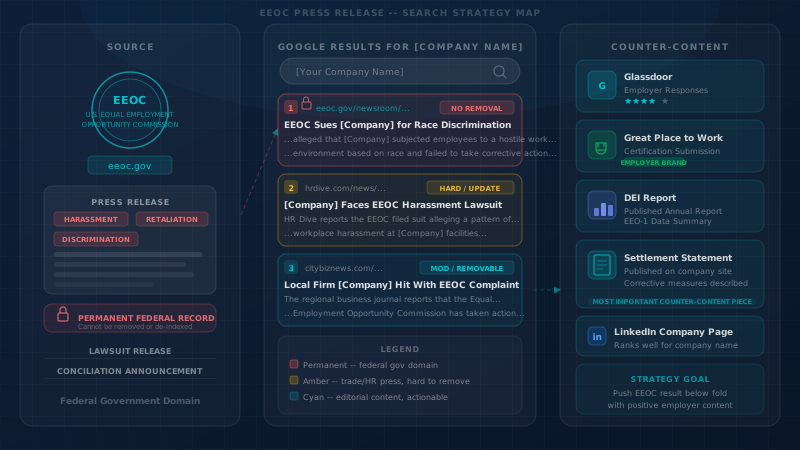
EEOC press releases are published on eeoc.gov, a federal government domain -- they are permanent public records that cannot be removed or de-indexed from Google. No legal demand, no takedown request, and no Google form will change this. The eeoc.gov URL stays.
-
The EEOC publishes press releases for lawsuits it files AND for conciliation agreements (pre-litigation settlements) -- both types rank similarly in Google and require the same strategic response. Even companies that settled early, before any lawsuit was filed, often have a public EEOC announcement ranking for their name.
-
News articles covering the EEOC action are separate editorial targets -- local business press, HR trade publications, and regional TV stations regularly cover EEOC enforcement and are often more receptive to removal requests than federal records. Separating the federal record from the editorial layer is the first step in a realistic strategy.
-
For employers, the counter-content strategy focuses on demonstrating current workplace culture and compliance -- published DEI reports, third-party certifications, and employee recognition rankings give Google positive, employer-brand content to surface. This is the long-term path to pushing EEOC coverage below the fold.
What the EEOC Publishes and Why It Ranks So Well
The EEOC maintains a dedicated newsroom at eeoc.gov/newsroom where it publishes press releases for every significant enforcement action it takes. These releases are not buried in a regulatory portal -- they are publicly indexed pages written to be read, shared, and found. The combination of elements in each release explains why they rank so well in Google searches for the company name.
A standard EEOC press release includes the company name in the headline, the type of discrimination alleged (race, sex, age, disability, harassment, retaliation), the dollar amount of the settlement or damages sought, and direct quotes from EEOC regional attorneys. That combination of a specific company name paired with emotionally charged discrimination terminology on a federal government domain creates a search result that outranks almost everything else for "[company name] discrimination" searches -- and in many cases for a plain "[company name]" search as well.
Employers named in EEOC enforcement actions face two distinct categories of publication, and understanding the difference matters for strategy.
Lawsuit Press Releases
The EEOC files suit in federal district court after exhausting the conciliation process. When it does, it issues a press release describing the complaint in detail -- naming the employer, describing the alleged conduct, identifying the affected employees or class, and often including the specific dollar amount sought. These releases may be updated as the case progresses through litigation or when it resolves. In many cases the original release remains indexed even after a resolution notice is added, meaning the initial "EEOC Sues [Company]" headline continues to surface in search long after the matter is closed.
Conciliation Agreement and Settlement Announcements
When the EEOC reaches a pre-litigation settlement through its administrative conciliation process, it frequently publishes a press release announcing the agreement. These releases include the settlement dollar amount and the remediation measures the employer agreed to -- training programs, policy changes, monitoring provisions. For many smaller employers, this type of announcement is the only public record of an EEOC charge that never became a lawsuit. It still ranks. It still includes the words "discrimination" or "harassment" in connection with the company name. And it is just as permanent as a lawsuit release.
For employers trying to understand their full exposure, the practical rule is simple: if the EEOC took a formal action against your company and considered it significant enough to announce, there is a press release, and it is indexed in Google. The type of action does not change that baseline reality.
The Permanent Record Problem -- eeoc.gov
eeoc.gov is a federal government domain. Its content is not subject to removal requests from the companies named in it. This is the most important thing employers need to understand before developing any strategy around an EEOC press release, and it needs to be stated plainly: there is no process for removing an EEOC press release from eeoc.gov, and there is no process for de-indexing eeoc.gov content from Google.
Google's legal removal tools -- the ones that allow individuals and companies to request de-indexing of certain content -- do not apply to federal government domains. The EEOC's own policies do not include a mechanism for named respondents to request removal or correction of press releases. Employment counsel, even highly skilled and well-connected attorneys, cannot compel the EEOC to remove a press release. This is not a gap in the legal framework or an oversight -- it is a deliberate feature of how federal enforcement transparency works.
What this means practically: if the EEOC has published a press release about your company, that press release will appear in Google for as long as eeoc.gov remains online. The strategy is not removal. The strategy is management. Every resource an employer invests in trying to remove the eeoc.gov URL is wasted. Every resource invested in managing the search landscape around it has real potential to improve outcomes.
"The EEOC press release uses the word 'discrimination' or 'harassment' in the first sentence. Job candidates, clients, and partners searching your company name will see it. The response is not to pretend it doesn't exist -- it is to ensure that when someone searches your company, they find a body of positive, current content that puts the EEOC action in context as a resolved historical matter."
News Articles About the EEOC Action -- The Actionable Layer
Alongside the eeoc.gov press release, most significant EEOC enforcement actions generate secondary coverage in local business journals, regional newspapers, HR trade press, and local television news. Unlike the federal press release, these editorial publications are independent businesses with their own editorial policies -- and those policies create real opportunities for employers.
The type of publication determines the removal approach and the probability of success. Not all editorial targets are equally receptive.
Local business journals covering small and mid-market companies are generally the most responsive outlet category. These publications have smaller editorial teams, often maintain ongoing relationships with the business community they cover, and have fewer resources to defend legacy content. A post-settlement removal request that is professionally prepared and accompanied by documentation of the resolution has a meaningful chance of success. These requests typically take four to ten weeks to resolve.
Regional newspapers are moderately responsive. The strength of the removal argument matters significantly here. An article that describes a lawsuit as pending when it has since fully settled -- particularly one with factual details that are now outdated or that were inaccurate when written -- gives editors a genuine news-accuracy reason to act. Articles with factual errors (wrong settlement amount, incorrect description of the alleged conduct, misidentified respondent entities) open a correction or removal path that the publication is professionally obligated to take seriously.
HR trade press such as HR Dive and SHRM coverage represents the hardest editorial target in this category. These outlets cover EEOC enforcement as a professional compliance resource for HR practitioners -- the articles serve an ongoing educational function and are rarely removed. However, publications in this space are often receptive to resolution updates. A well-documented update request that provides factual information about the case resolution can result in an addendum or follow-up piece that, while not removing the original, at least creates a second indexed result showing the matter is closed.
Local TV news segments range from moderately difficult to hard depending on whether the station has digitized its archive and how actively it maintains legacy web content. Stations that have migrated to digital-first operations are generally more amenable to post-settlement requests than those treating the web as a passive archive.
For any editorial target, the most important prerequisite is documentation. The settlement agreement, the consent decree, the EEOC closure letter, or the court dismissal order -- whichever applies -- is the factual foundation of the removal argument. Without documentation of resolution, an editorial removal request rests on little more than the employer's preference, which editors are not obligated to honor.
For additional context on how these editorial removal arguments are structured, the guide on removing negative news articles about a business covers the general framework that applies across all business reputation scenarios.
Do not respond to an EEOC press release with a combative public statement disputing the allegations after a settlement. Settlement agreements often include provisions about public statements. Review the settlement terms with employment counsel before issuing any public response. A statement that violates the settlement agreement is a separate legal problem -- and it will not improve the search ranking situation.
The Counter-Content Strategy for Employers
Because the eeoc.gov press release cannot be removed, the central long-term strategy for most employers is building enough positive, authoritative content about the company that the EEOC release is no longer the dominant result in a company name search. This is a genuine strategy with a real timeline -- it is not a euphemism for giving up.
Employer brand content is the foundation. Published employee reviews, actively managed Glassdoor management responses, Great Place to Work certification, and inclusion on Best Employer lists published by regional business journals or national outlets all generate indexed content associated with the company name. Each piece of employer brand content gives Google an additional positive signal to surface when someone searches the company. The compound effect of multiple employer brand assets -- all consistently positive, all recently published -- significantly improves the search landscape over time.
DEI reporting is particularly useful in the context of an EEOC enforcement action because it directly addresses the subject matter of the press release. A published diversity and inclusion report or an annual EEO-1 data summary demonstrates current compliance posture in the exact area where the EEOC press release claims the company fell short. It does not erase the press release, but it provides Google an authoritative, current, company-controlled document to rank alongside it.
The settlement outcome statement is the single most important piece of counter-content most employers can publish. This is a factual company statement -- written after review with employment counsel and after confirming what the settlement agreement permits -- that acknowledges the resolution of the EEOC matter and describes the corrective measures the company has taken. Published on the company's own newsroom page or about page, this document gives Google a company-controlled, current, indexed result to surface when someone searches the company in connection with the EEOC matter. It should be concise, professional, and focused on the company's current commitment to the workplace values the EEOC enforcement highlighted. It should not re-litigate the facts or characterize the underlying allegations.
HR trade press engagement builds positive industry standing in exactly the space where EEOC enforcement coverage tends to appear. Contributing as a source to HR Dive, SHRM, or employment law publications -- providing expert perspective on compliance best practices, training program design, or policy development -- positions company leadership as a constructive participant in workplace culture improvement rather than a passive respondent to enforcement. These contributions generate indexed content with the company name attached to positive compliance leadership rather than enforcement findings.
LinkedIn company page maintenance is often overlooked but consistently effective. A well-maintained company LinkedIn page with regular posts about workplace culture, employee recognition, and company values ranks very well for company name searches. LinkedIn's domain authority is extremely high, and a LinkedIn company page that is actively maintained will almost always appear in the first page of Google results for a company name search -- often above news articles.
For a broader framework on how counter-content interacts with government enforcement records, the guide on government press release removal addresses the full range of federal and state enforcement publications that follow similar permanent-record rules.
What Happens When Multiple EEOC Charges Hit the Same Company
Some employers face not one EEOC press release but several -- enforcement actions filed or announced over multiple years, each generating its own indexed URL on eeoc.gov and often its own round of editorial coverage. The compound effect is substantially worse than a single release.
Each EEOC release is a separate indexed URL. A Google search for the company name surfaces each one independently. If three enforcement actions generated press releases over six years, a searcher may see three separate eeoc.gov results in the first page of results for the company name, in addition to any editorial coverage each action generated. The search result page for that company looks almost entirely like an enforcement history.
The strategic response to multiple releases requires individual assessment of each one. Is each matter resolved or still pending? Are there factual errors in any of the releases or in the editorial coverage? Which editorial articles are outdated because their described cases are now closed? Each release and each editorial article must be evaluated on its own merits before the right approach to it can be determined.
However, for companies with multiple EEOC releases, a sustained employer brand program is categorically more effective than attempting to address each release individually. The counter-content effort must be proportionally robust -- a single settlement statement will not meaningfully shift the search landscape when three separate eeoc.gov URLs are competing for the top of the results. Great Place to Work certification, annual DEI reporting, regular LinkedIn publishing, and strategic employer brand content all need to operate simultaneously and continuously to generate enough volume of positive, authoritative content to compete with multiple permanent federal records.
Understanding whether any of the editorial coverage qualifies for removal is important context here. The guide on whether Google removes negative articles explains what de-indexing is actually available for and how the process works for editorial content that is separately from government records.
Removal Probability by Content Type
| Content Type | Removal Possible | Best Approach | Timeline |
|---|---|---|---|
| EEOC press release (eeoc.gov) | No -- permanent federal record | Counter-content + settlement outcome statement | Ongoing |
| Local business journal article | Moderate | Post-settlement editorial removal request | 4-10 weeks |
| Regional newspaper article | Moderate | Post-settlement editorial removal request | 4-12 weeks |
| HR Dive / SHRM article | Hard | Update / correction request | 6-14 weeks |
| Local TV news segment | Moderate-Hard | Post-settlement editorial request | 6-16 weeks |
| Google search result (eeoc.gov URL) | No | Counter-content to push below fold | 12-24 months |
| Wire service copy of EEOC release | Hard | Policy complaint; outdated content removal post-resolution | 8-16 weeks |
6-Step Plan for Named Employers
-
1Run a full Google audit for your company name. Search your company name in an incognito browser window. Identify every EEOC-related URL in the first three pages of results. Separate the eeoc.gov results (permanent, not actionable for removal) from editorial results (local newspapers, trade press, TV -- potentially actionable). Document what you find with screenshots. This baseline audit is the foundation of every subsequent decision.
-
2Confirm the current status of each EEOC matter. Is each enforcement action resolved by settlement, closed by consent decree, dismissed, or still pending? Settlement documentation, consent decrees, and EEOC closure letters are the factual foundation of your editorial arguments. You cannot make a credible "outdated content" argument to a news outlet without documentation showing the matter is closed.
-
3Review your settlement agreement with employment counsel before issuing any public statements. Many EEOC settlement agreements include provisions governing what the company may say publicly about the enforcement action. A public statement that violates those provisions creates a separate legal problem. Confirm what is permissible before drafting any counter-content that references the EEOC matter directly.
-
4Publish a factual settlement outcome statement on your company's newsroom or about page. This is the most important single counter-content piece for most employers. Acknowledge the resolution, describe the corrective measures taken, and express the company's current commitment to a compliant and respectful workplace. Keep it professional, factual, and forward-looking. This document gives Google a company-controlled, current, indexed result to surface alongside the eeoc.gov press release.
-
5For each editorial news article, assess removal grounds and submit professional requests. For each article covering the EEOC action, evaluate whether the matter it describes is now resolved (outdated content argument), whether it contains factual errors (correction / removal argument), and which type of outlet published it (to calibrate your expectations). Submit professionally prepared editorial requests for each article where removal or update grounds exist. Do not approach these requests informally -- a well-structured removal request with documentation significantly outperforms an ad hoc inquiry.
-
6Launch or accelerate the employer brand content program. Glassdoor management responses, Great Place to Work certification submission, DEI report publication, employee recognition program participation, and regular LinkedIn company page activity all build the positive search presence that pushes EEOC coverage down over time. This is not a one-time project -- it is an ongoing program. Companies that maintain it consistently see meaningful improvement in their search landscape over 12 to 24 months.
The EEOC release ranks. The news articles about it might come down. Start here -- a confidential assessment of what is actionable for your company.
Get a Free AssessmentYour Company Name Deserves More Than EEOC Results.
Our team has helped employers navigate EEOC enforcement coverage, editorial removal requests, and sustained counter-content strategies. We understand the compliance constraints and the realistic timeline.
Free assessment. Confidential. No obligation.