The Board Case Is Closed. Your Google Results Tell a Different Story.
Dentists and chiropractors face a reputation problem unique among healthcare providers: their state boards publish disciplinary actions on government websites that rank at the top of Google for their name, and local news outlets and dental and chiropractic trade press cover board actions independently as consumer protection stories. Unlike most healthcare providers, they are also heavily reviewed on consumer platforms including Yelp, Healthgrades, and Zocdoc, meaning the reputation surface is wider and the paths to resolution are more complicated.
By Anthony WillFounder & CEO, Reputation Resolutions · Removing articles since 2013
Updated June 30, 2026Published May 12, 2026 · 12 min read
Key Takeaways
State dental and chiropractic boards publish disciplinary actions on government websites that rank highly in Google. These records cannot be removed, but news articles about those actions are a separate and often actionable target with their own editorial process.
Patient review platforms are a third track with their own distinct process. Healthgrades, Yelp, Zocdoc, and Vitals are separate from board records and news coverage, and each has its own dispute and removal procedures.
Billing fraud
allegations and Medicare or Medicaid exclusion notices are treated differently from clinical discipline. Federal exclusion databases have their own publication and ranking footprint and require a separate strategy from state board discipline.
A resolved board action creates the strongest grounds for editorial removal. Probation completed, license reinstated, or charges dismissed -- these outcomes give a dentist or chiropractor the most compelling argument for requesting article removal from a news publisher.
The Three-Track Reputation Problem for Dentists and Chiropractors
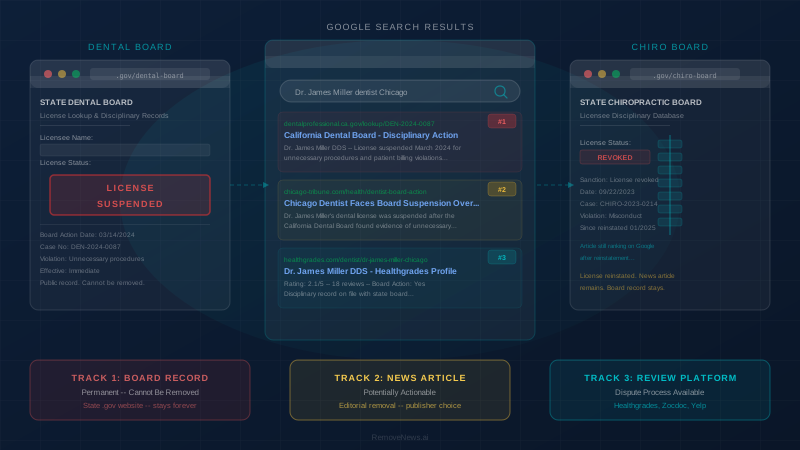
When a dentist or chiropractor faces a state board disciplinary action, the reputation damage does not arrive through a single channel. It arrives through three distinct tracks, each with its own audience, its own permanence, and its own remediation pathway. Treating them as a single problem is the first mistake practitioners make.
Track 1 is the board record itself. Every state dental board and every state chiropractic board maintains a public-facing website on a .gov domain. When a disciplinary action is taken -- license suspension, probation, revocation, or formal censure -- that action is published on the board's official website as a permanent public record. These pages rank extremely well in Google for searches on a practitioner's name combined with their profession and location. This is by design. The boards are required to make disciplinary records accessible to the public as a consumer protection measure. No amount of petitioning the board will remove a legitimately published disciplinary record. It is permanent.
Track 2 is news coverage of the board action. Local newspapers, local television stations, dental trade publications such as Dental Tribune, chiropractic trade outlets such as Chiropractic Economics, and regional health news websites independently cover board disciplinary actions as consumer protection journalism. The publisher made an editorial decision to cover the story. That is a critical distinction. Because the publisher made an editorial choice, the publisher can also make an editorial choice to update or remove the coverage. The board record is permanent. The news article is not inherently so.
Track 3 is patient review platforms. Healthgrades, Zocdoc, Vitals, and Yelp are heavily weighted in Google's local ranking algorithm for healthcare providers. These platforms are consumer-facing and appear prominently when a patient searches for a dentist or chiropractor by name. Board discipline can appear on these platforms either because the platform automatically pulls data from state board records or because patients leave reviews referencing the board action. Each platform has its own dispute and removal procedures that are distinct from both the board record process and the news article removal process.
All three tracks are indexed and searchable. A prospective patient who searches for a dentist's name may encounter the board's .gov page at position one, a news article at position two, and a Healthgrades profile with a low star rating and a note about board discipline at position three. Each of these three results requires a different strategy. Understanding that distinction before taking action is essential.
We remove damaging professional coverage — you only pay after it’s gone.
No upfront payment No retainer A+ BBB Rated 5,000+ clients helped In business since 2013 Only Pay For Results True Removal Experts
Dentists and chiropractors face a reputation problem unique among healthcare providers: their state boards publish disciplinary actions on government websites that rank at the top of Google for their
Section 02
How State Dental and Chiropractic Boards Publish Discipline
State dental boards publish disciplinary actions on their state-operated .gov websites as a matter of public record and legal requirement. The American Dental Association provides guidance on professional standards, while your state dental board controls the public disciplinary record. All fifty states maintain searchable licensee databases that include disciplinary history. When a board issues a formal order -- whether that is a letter of reprimand, a period of probation, a license suspension, or a license revocation -- the order becomes part of the public record and is posted to the board's website.
Chiropractic boards operate similarly. Each state's chiropractic licensing board maintains its own public database. Because chiropractic is governed at the state level without a national federation equivalent to the Federation of State Medical Boards (which covers physicians but not dentists), there is no single national portal aggregating chiropractic discipline across states. State chiropractic databases must be queried individually.
For dentists, a critical distinction exists between the public-facing state board website and the National Practitioner Data Bank (NPDB). The NPDB is a federal database maintained by the Health Resources and Services Administration (HRSA) that records state board disciplinary actions taken against dentists, as well as malpractice payments and adverse clinical privilege actions. The NPDB is not public. Patients cannot query the NPDB. It is accessible only to hospitals, dental school faculty practices, health plans, and other credentialing entities conducting formal background reviews of practitioners before granting staff privileges or panel participation.
This distinction matters enormously for strategy. The state dental board website -- fully public and Google-indexed -- is what patients see. The NPDB record is what hospital credentialing committees and insurance panels see. A dentist who resolves their board case and focuses attention on the NPDB in isolation is often overlooking the problem that their patients are actually encountering in daily Google searches.
For practitioners who have faced Medicare or Medicaid fraud allegations or billing violations, there is an additional federal layer: the OIG List of Excluded Individuals and Entities (LEIE). This is addressed in detail in the Medicare and Medicaid exclusion section below, but it is worth noting here that the LEIE is fully public, actively indexed by Google, and constitutes a separate fourth track for those who have been federally excluded.
Section 03
Why News Coverage of Dental and Chiropractic Discipline Is Different
Local newspapers, regional television stations, and dental and chiropractic trade publications cover board disciplinary actions as a matter of consumer protection journalism. The framing is almost always identical: a patient-safety story about a provider whose conduct was found to fall below the standard of care or to violate professional ethics. For the practitioner, the coverage often feels more damaging than the underlying board action itself, because the news article reaches a far broader audience and persists in Google search results indefinitely.
The most common triggers for news coverage of dental and chiropractic board actions include patient complaints about unnecessary or fraudulent procedures -- particularly unnecessary extractions, implants, or orthodontic treatment in dentistry, and unnecessary spinal manipulation or treatment plans in chiropractic. Billing fraud and insurance overbilling are frequently covered, especially when Medicare or Medicaid is involved. Sexual misconduct allegations generate significant press regardless of the ultimate board disposition. Controlled substance prescribing violations attract coverage in markets where opioid prescribing has been a public health focus. Practicing with a lapsed or suspended license generates particularly strong coverage because it is both a legal violation and an immediate patient safety concern.
The key distinction between the board record and the news article -- the distinction that creates the opportunity for action -- is that the publisher exercised editorial judgment. The board did not choose to publish a disciplinary record; it is required by law to do so. The local newspaper chose to assign a reporter to the story. It chose to publish it. It chose what to emphasize in the headline. And because the publisher made that editorial choice, the publisher retains the authority to revisit it. When a practitioner's situation changes -- when a case is resolved, a license is reinstated, or allegations are found to be unsupported -- there is a legitimate editorial basis for requesting that the publisher update or remove the article. Once the publisher acts, Google's legal removal process can be used to accelerate de-indexing. No equivalent mechanism exists for the board's own record.
Practice Insight
"The NPDB report and the local news article are not the same problem. Credentialing entities query the NPDB -- patients query Google. A dentist or chiropractor who resolves their board case and focuses only on the NPDB is often ignoring the problem their patients are actually finding."
Section 04
Medicare and Medicaid Exclusion: When Federal Records Are the Problem
For dentists and chiropractors who have faced Medicare or Medicaid billing fraud allegations, the federal exclusion system creates a separate and particularly challenging reputation track. The Office of Inspector General of the Department of Health and Human Services maintains the List of Excluded Individuals and Entities -- universally referred to as the LEIE -- which catalogues all providers who have been excluded from participation in Medicare, Medicaid, and other federal healthcare programs.
Unlike the NPDB, the LEIE is fully public and searchable at oig.hhs.gov. Individual exclusion records on the LEIE website are indexed by Google and frequently rank on page one of search results for an excluded provider's name. This means that a dentist or chiropractor who has been excluded from Medicare or Medicaid will typically find an OIG government page among the top results when anyone searches their name. The LEIE record cannot be altered, updated, or removed until reinstatement is formally granted by the OIG through its reinstatement application process.
Reinstatement from LEIE exclusion is not automatic. It requires a formal application, documentation demonstrating that the basis for exclusion no longer applies, and OIG review. Minimum exclusion periods vary by the underlying violation. Mandatory exclusions triggered by criminal convictions carry minimum five-year exclusion periods. Permissive exclusions triggered by administrative findings can carry shorter periods. Once reinstatement is granted, the OIG updates the LEIE record, which removes the active exclusion flag. However, the historical record of exclusion may still appear in archived government documents and news articles that independently covered the original exclusion.
SAM.gov -- the federal System for Award Management -- is a related exclusion database that affects providers who contract with federal government entities or receive federal grants. Providers who work with federally qualified health centers, Veterans Affairs facilities, or other government-funded entities may find SAM.gov exclusion records appearing in Google alongside LEIE records. The SAM.gov exclusion process runs parallel to but separate from OIG LEIE exclusion.
News articles covering a Medicare or Medicaid exclusion are, critically, a separate target from the federal database records themselves. A news article in a local paper covering the OIG exclusion announcement can be approached for editorial removal independently of the LEIE record. Even before reinstatement is granted -- if the circumstances of the exclusion have changed or if the article contains factual errors -- there may be grounds to approach the publisher. After reinstatement, the argument for editorial removal becomes significantly stronger, because the article now describes a status that the government has formally reversed.
Critical Caution
Never contact a reporter claiming a right to removal. Dentists and chiropractors, like all licensed professionals, have no legal right to force article removal in the United States. All removal requests must be framed as editorial requests based on accuracy, recency, and public interest -- not as demands. A poorly handled outreach to a journalist can result in a follow-up article about the removal attempt, compounding the original coverage.
What Grounds Actually Work for Editorial Removal Requests
Not all removal requests succeed, and not all situations create equally strong grounds for requesting editorial action. Understanding which grounds actually move publishers to act is essential before investing time and resources in an outreach campaign.
Board case dismissed or resolved without discipline. When a board investigation concluded with no finding of violation -- a complaint was investigated and closed, or formal proceedings were initiated and then dismissed -- the original news article describing the investigation as if discipline were certain may be factually misleading. This is among the strongest grounds available, because the factual premise of the original coverage has been contradicted by the outcome. Publishers are most responsive to accuracy-based arguments.
Discipline completed and license reinstated. A dentist or chiropractor who has served a period of probation, completed required continuing education, paid any required fines, and had their license reinstated in good standing has a compelling argument that the article no longer accurately describes their current professional status. The article describes a past state of affairs, not the present one. For local outlets covering a community healthcare provider, this argument often resonates -- the public interest in knowing about active discipline is much stronger than the public interest in preserving indefinitely an article about discipline that has been fully resolved.
Allegations later found to be false or unsupported. Board investigations sometimes conclude with findings that the original patient complaints were unsubstantiated. When a news article was based on those complaints and the board ultimately determined they lacked merit, the factual foundation of the article has been explicitly rejected by the regulatory authority that investigated the matter. This is a strong editorial argument, though not all publishers will acknowledge it without additional documentation.
Factual errors in the coverage. Inaccuracies in the number of patient complaints, the nature of the sanctions described, the timeline of events, or the specific allegations can provide grounds for a formal correction request. Correction requests are often more successful than removal requests because they ask the publisher to do something less than full removal -- they ask for a targeted fix, which is more consistent with journalistic norms around accuracy. A successful correction can sometimes also provide the opening for a broader conversation about the current relevance of the article.
Articles from small or dormant outlets. Local newspapers that have reduced their digital archive maintenance, community news blogs that are no longer actively updated, and hyperlocal outlets with minimal domain authority are sometimes more receptive to removal requests or de-indexing arrangements. Publishers who no longer actively maintain archives may be willing to remove old articles that generate little traffic and require ongoing hosting costs.
Articles identifying patients or including patient-identifying details. While HIPAA does not give a practitioner a legal basis to demand removal -- HIPAA regulates the provider, not the press -- editors are often responsive to the argument that a published article may allow readers to identify specific patients by circumstances, even without using names. Framing a removal or significant redaction request around patient privacy can be effective at outlets that take their ethical obligations seriously, particularly community newspapers with strong local reputations to protect.
Section 06
Removal Difficulty by Source
Source
Removal Difficulty
Timeframe
Notes
State dental or chiropractic board website
Impossible
N/A -- permanent
Record stays even after reinstatement; this is by legal design
OIG LEIE (Medicare or Medicaid exclusion)
Impossible until reinstated
N/A -- permanent until reinstatement
Reinstatement application required before OIG updates the record
Local newspaper article
Moderate
4-12 weeks
Strongest case when discipline is fully resolved and license reinstated
Local TV station story
Moderate-Hard
6-16 weeks
Video format and broadcast archives make editors more protective of original content
Dental or chiropractic trade publication
Moderate
4-10 weeks
Trade outlets often receptive to follow-up coverage showing resolution; correction pathway frequently available
Healthgrades or Zocdoc profile
Moderate
4-8 weeks
Formal dispute process available; NPDB-sourced data may update automatically after board resolution
Google (standard search)
Hard
8-20 weeks
Requires source removal or de-indexing at the publisher level first; Google de-indexing is a separate request
Section 07
The 6-Step Plan for Dentists and Chiropractors
The following steps reflect best practice for dental and chiropractic practitioners dealing with a board action that has generated Google visibility. Each step should be completed in order, as earlier steps provide the factual foundation for later ones.
1
Map all three tracks separately. Identify the current status of your board record on the state dental or chiropractic board website. Confirm your NPDB status -- if you have hospital privileges or insurance panel participation, your credentialing contacts can often tell you what appears in their NPDB query. If Medicare or Medicaid billing issues were involved, check the OIG LEIE directly at oig.hhs.gov. Then separately identify all news articles and review platform entries. Treat each track as a distinct problem with its own solution.
2
Confirm the current status of your license and any board case outcome. Obtain written documentation of your current license standing -- a good standing letter from the board, the formal reinstatement order, or the dismissal notice for any investigation. This documentation is the foundation of every editorial argument you will make to news publishers. Without it, removal requests are significantly weaker.
3
Identify every news article ranking for your name. Open an incognito browser window and search for "[your full name] dentist [city]" or "[your full name] chiropractor [city]." Also search for your name alone, your name plus your practice name, and your name combined with terms like "board" or "suspension" or "discipline." Document every result on the first three pages. Screenshots with timestamps are useful for tracking progress.
4
Assess removal grounds for each article and initiate outreach. For each article identified, determine which grounds apply: resolved case, factual errors, outdated information, patient privacy concerns. Paste the article URL into RemoveNews.ai to generate a removal request framework and find the appropriate editorial contact. Each article requires a tailored outreach, not a form letter. Generic removal requests are almost always rejected.
5
Pursue Google de-indexing for articles where the publisher is unresponsive. If a publisher does not respond to a well-reasoned editorial removal request within a reasonable timeframe, a Google de-indexing request via Google Search Console is the next step. This is particularly relevant for older articles where the discipline is fully resolved, the article is no longer actively maintained, and the publisher has no apparent business reason to preserve the article's indexing. De-indexing does not remove the article from the publisher's website but removes it from Google search results.
6
Build counter-content to push board record and article rankings down. A strong and actively maintained Healthgrades profile, a verified Google Business Profile with current information, continuing education credentials and professional association memberships published on a personal or practice website, authored articles in dental or chiropractic trade publications, and speaking engagements at professional conferences all give Google positive signals to surface. Counter-content does not remove negative results, but it competes with them for ranking position and can move them off the first page over time.
Your license is active. Your patients deserve to know that. Find out if your article qualifies for removal in 60 seconds.
The Patient Review Problem: A Separate but Related Issue
Healthgrades, Zocdoc, and Vitals populate provider profiles using a combination of data sources. Some of that data comes directly from public state board records -- meaning board discipline can appear on a consumer-facing platform even when no journalist ever wrote about the case. Healthgrades in particular has historically sourced board action data from state licensing databases and displays it prominently on provider profiles under a "Malpractice and Sanctions" or similar section heading. A dentist or chiropractor who focuses exclusively on news articles and ignores the Healthgrades profile may find that the Healthgrades result is actually the more prominently ranked item for their name.
The dispute processes for each platform are distinct. Healthgrades provides a provider dispute portal accessible through the Healthgrades provider center, where practitioners can claim their profile and initiate a formal dispute of inaccurate information. The dispute process involves providing documentation -- the same board documentation described above in the six-step plan -- and Healthgrades reviews the submission. Outcomes vary; board data that has been updated by the state is often reflected relatively quickly, while older or unresolved data can be more difficult to correct.
Zocdoc operates somewhat differently. Because Zocdoc is primarily a booking platform, practitioners often have an existing relationship with Zocdoc through practice management tools. Profile management is typically handled through the Zocdoc provider portal, and disputes about board action data are addressed through the same support channel. Zocdoc's responsiveness to disputes depends on whether the practitioner maintains an active booking relationship with the platform.
Vitals uses a similar data sourcing approach to Healthgrades and provides a dispute mechanism through its provider portal. The dispute process typically requires documentation of current license status and any board case resolution.
Yelp negative reviews are a separate issue with a different process. Yelp's content policies prohibit reviews that are not based on personal experience, reviews generated by competitors or third parties, and reviews containing defamatory or false factual claims. Reviews that describe a genuine patient experience -- even a negative one, even one referencing a board action -- are generally not removable through Yelp's internal process simply because the practitioner finds them damaging. Flagging reviews for Yelp's moderation team is appropriate when there is a specific policy violation to cite, but it is not an effective strategy for reviews that are adverse but accurate.
Your Practice Has Moved Forward. Your Search Results Should Too.
Our team has helped dentists, oral surgeons, orthodontists, and chiropractors address board action news coverage and review platform issues since 2013.
Tell us about your situation and a removal specialist will personally review it and respond within one business day. No pressure, no obligation.
No upfront payment -- you only pay if we succeed
A+ BBB Rated · 5,000+ Clients Helped · Since 2013
100% Confidential · Response within 1 business day
Frequently Asked Questions
Common Questions About Dental and Chiropractic Board Actions, Google, and News Articles
Can a dentist or chiropractor force a news article about their board action to be removed?
No licensed professional in the United States has a legal right to force a news outlet to remove an article. Dentists and chiropractors can request editorial removal based on accuracy, recency, and public interest, and those requests sometimes succeed -- particularly when the board case has been resolved, the discipline is complete, and the license has been reinstated. All removal requests must be framed as editorial requests, not legal demands. A professional reputation firm with experience in healthcare licensing can significantly improve the outcome compared to a self-directed approach.
How long does a dental board disciplinary action stay on Google?
The state dental or chiropractic board's own website listing is permanent and cannot be removed regardless of whether the case was resolved or the license reinstated. However, news articles about the board action are a separate matter. Those articles may remain indefinitely unless the publisher agrees to update or remove them, or unless a Google de-indexing request is granted. In practice, news articles from smaller local outlets have been successfully removed months to years after the original board action, particularly when the discipline has been fully resolved and documented.
What is the NPDB and can patients see my record?
The National Practitioner Data Bank (NPDB) is a federal database maintained by the Health Resources and Services Administration (HRSA) that records malpractice payments, state board disciplinary actions, and certain adverse clinical privilege actions against healthcare providers including dentists. The NPDB is not public. Patients cannot query it directly. It is accessible only to hospitals, health plans, and other credentialing entities conducting formal background checks on practitioners. However, the state board's own public website -- which is indexed by Google -- is separately visible to anyone who searches a dentist's name. The two records are distinct.
If my dental license was reinstated, can I get the news article removed?
License reinstatement is one of the strongest grounds available for requesting editorial removal from a news publisher. When a dentist or chiropractor can document that their license has been reinstated, that the disciplinary period is complete, and that they are in good standing with the board, the original article describing the suspension or revocation becomes less accurate as a description of current professional status. Many publishers will update articles to reflect reinstatement, add a correction, or in some cases remove the article entirely. The success rate depends on the publication, the nature of the original coverage, and how the removal request is framed.
Does a Medicare exclusion show up in Google search results?
Yes. The OIG List of Excluded Individuals and Entities (LEIE) is a publicly searchable federal database, and individual exclusion records on the LEIE website are indexed by Google and frequently rank on the first page of search results for an excluded provider's name. Unlike the NPDB, the LEIE is fully public. An exclusion record will appear in Google searches until the provider is reinstated and the record is updated in the database. News articles covering the exclusion are a separate and independently actionable target -- those can potentially be approached for editorial removal even before reinstatement is formally granted.
How do I remove negative information from Healthgrades?
Healthgrades populates provider profiles using a combination of public state board data, credentialing-sourced information, and consumer reviews. For board discipline data that appears on a Healthgrades profile, the appropriate channel is Healthgrades' provider dispute process, accessible through the provider portal at Healthgrades.com. For consumer reviews that violate Healthgrades' content policies -- such as reviews not based on personal experience or reviews containing demonstrably false factual claims -- a flagging process is available. Reviews that accurately reflect a patient experience are generally not removable through Healthgrades' internal process regardless of how they affect the provider's rating.
CEO & Co-Founder, RemoveNews.ai · Reputation Resolutions
Anthony has spent 13+ years studying what makes negative news content stick — and how to remove it. He co-founded Reputation Resolutions and has helped 5,000+ clients remove and suppress damaging press coverage. He holds Corporate & Crisis Communications and Brand Management certifications from Cornell, a Digital Marketing certificate from NYU, and is a member of the Forbes Agency Council and Fast Company Executive Board.