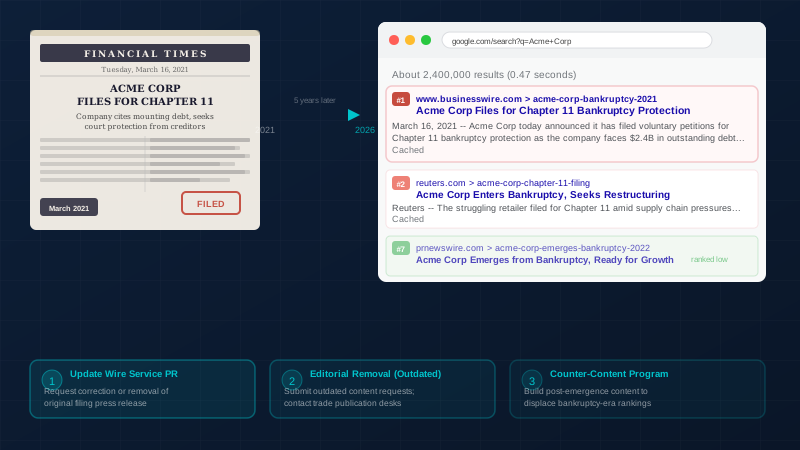
The Bankruptcy Is Behind You. The News Coverage Doesn't Know That.
A company that successfully emerges from Chapter 11 bankruptcy has, in legal and financial terms, a new start: reorganized debt, new capital structure, new leadership in many cases, and a court-confirmed plan of reorganization. But Google's index does not recognize legal fresh starts. The filing press releases, bankruptcy court coverage, vendor and customer notices, and creditor committee news from the original filing continue to rank for the company name, creating a reputation problem that undermines every attempt to move forward.
By Anthony WillFounder & CEO, Reputation Resolutions · Removing articles since 2013
Updated June 30, 2026Published May 12, 2026 · 6 min read
Key Takeaways
Bankruptcy filings are public court records on PACER and published on court dockets -- these cannot be removed, but they are not typically what ranks in consumer Google searches; the news articles and press releases about the filing are the primary targets.
News articles describing a company's bankruptcy as ongoing or unresolved are strong candidates for outdated content removal from Google once the company has emerged -- "changed circumstances" is the exact criterion Google's tool addresses.
Wire service press releases published at the time of filing can be corrected or removed by the company as the submitter -- most companies never do this after emergence, leaving an easily corrected oversight in place.
Rebranding does not eliminate the search problem. If the company operated under the same name before and after bankruptcy, Google's index links both histories under that name; a rebrand requires deliberate SEO strategy, not just a name change.
What Ranks After a Corporate Bankruptcy -- and Why
The first step in addressing a post-emergence reputation problem is mapping the exact search result landscape. A typical Google search for the name of a company that has been through Chapter 11 produces a predictable set of result types, each with different origins and different removal pathways. Understanding the map is essential before beginning any campaign.
Bankruptcy Filing Press ReleaseThe company's own press release announcing the Chapter 11 filing, distributed via wire service and published on the company's newsroom. This is often the highest-ranking result for "[company name] bankruptcy." Because the company was the original submitter, this is also one of the most directly addressable targets -- and among the most commonly overlooked.
News Articles from the Filing DateBusiness press (Bloomberg, Reuters, WSJ) and trade publications covered the filing. These articles are dated to the filing period and describe the company's financial distress in the present tense, with no reference to the subsequent emergence. They have accumulated inbound links over the years, giving them persistent ranking authority.
Court Docket ReferencesLaw firm press releases, creditor committee announcements, and court hearing coverage from the reorganization process. These are typically from multiple mid-tier sources and rank in aggregate, filling additional search result positions with bankruptcy-era content.
Vendor and Customer NoticesSome companies published vendor or customer notices about the filing that were subsequently indexed by Google. These notices, often written to inform business partners of the proceedings, remain indexed and rank for the company name years after the proceedings closed.
Plan of Reorganization CoverageArticles covering the confirmation of the plan, which describe the bankruptcy as ongoing or nearing resolution. These articles, while technically describing progress, still frame the company as a reorganizing entity rather than an emerged business. They contribute to the overall weight of bankruptcy-era content on the page.
The compound problem is that each of these is a separate indexed URL, often from multiple high-authority domains. Together they can fill an entire page of Google results with bankruptcy-era content. A company that emerged from bankruptcy in 2022 may have a Google results page in 2026 that shows nothing but 2021 bankruptcy coverage for the first two pages, because no systematic post-emergence content strategy was deployed.
A company that successfully emerges from Chapter 11 bankruptcy has, in legal and financial terms, a new start: reorganized debt, new capital structure, new leadership in many cases, and a court-confir
Section 02
The Permanent Layer -- Court Records
Before beginning any removal campaign, companies need to understand what cannot be removed and accept it as the permanent foundation around which everything else is built. PACER, the federal court docket system, is a permanent public record. Bankruptcy filings, creditor lists, asset schedules, reorganization plans, and court orders are all public and indexed to varying degrees. The US Courts bankruptcy portal provides official guidance on how these records are maintained.
PACER itself is not heavily indexed by Google because it requires a login to access. However, third-party legal research services that aggregate PACER content are indexed and rank in Google. CourtListener and Justia are the primary aggregators, and their pages for a company's bankruptcy case will appear in Google search results regardless of what other actions are taken.
These third-party records have their own removal processes, but the bar is high. CourtListener and Justia accept removal requests in limited circumstances -- sealed records, identity errors in the underlying court documents -- but do not remove records simply because the case is closed or because the company has emerged and restructured. A closed bankruptcy case is still a historical public record, and these services treat it as such.
The strategic implication is clear: effort directed at CourtListener and Justia case pages is almost always wasted. Accept the permanent layer of court record aggregators and redirect resources to the editorial and wire service content where meaningful improvement is achievable.
Strategic Perspective
"The most common mistake post-emergence is to focus removal effort on the court documents, which are largely permanent, rather than on the news articles and press releases, which are editorial content. A company that redirects its effort to the wire service copies of its own filing press release, and to the trade press articles describing the filing as ongoing, will see faster results than one trying to get a Justia case page removed."
Section 03
The Wire Service Press Release -- A Direct Target
The company filed its own bankruptcy announcement via wire service. That single fact gives the company a lever that does not exist for third-party coverage: as the submitter of record, the company has standing to request changes. This is one of the most underutilized tools in post-emergence reputation management.
Request correction. The company can request that the wire service update the press release to reflect the emergence from bankruptcy and the current company status. PR Newswire, Business Wire, and GlobeNewswire all allow submitters to distribute updated or corrected versions of previously issued releases. An updated version that notes the company emerged from bankruptcy on a specific date and provides current information about the business significantly changes the content associated with the original URL.
Request removal. The company can request that the original filing press release be removed from the wire service's archive entirely. If the company has a current newsroom with post-emergence content, the old filing press release is an unnecessary liability. Wire services process removal requests from verified original submitters, though policies vary by service and removal is not guaranteed in all cases. It is worth pursuing in parallel with the correction request.
Add a successor press release. Regardless of what happens to the original, distributing a new press release announcing the successful emergence from bankruptcy gives Google a second, more current press release to rank alongside or instead of the original. This successor release should describe the company's current status, capital structure, leadership, and forward strategy. It creates a narrative of resolution that the original filing press release, standing alone, cannot provide.
Most companies never take these steps. The bankruptcy team -- outside counsel, restructuring advisors, and financial communications specialists -- moves on after emergence, and the ongoing management of the PR archive falls to no one. Correcting this oversight is typically a matter of weeks, not months, and the impact on search results can be substantial.
Section 04
News Articles -- The Editorial Track
For news articles from the filing period, the approach depends on the publication type, but the core argument is consistent: the article describes a situation that no longer exists.
Outdated content removal. This is the strongest first-line argument for post-emergence companies. Google outdated content removal is specifically designed for exactly this scenario. An article that describes a company as currently in bankruptcy proceedings, or as a financially distressed enterprise in active reorganization, is factually outdated once the company has received court confirmation of its emergence. Submitting Google outdated content removal requests for each qualifying URL -- with documentation of the emergence date and current company status -- is the appropriate starting point for articles that cannot be editorially removed. You can also attempt to deindex the article on Google directly through Search Console where the company controls the content.
Editorial removal requests. For articles that describe the company as a distressed business, a struggling enterprise, or a bankruptcy case when it is none of those things, the "no longer current" argument is strong with editors at smaller regional and trade publications. These publications typically do not have the resources or editorial mandate to monitor the ongoing status of every company they have covered. A well-documented, professional request that provides the emergence date, a copy of the court order, and a brief description of the company's current status frequently results in either removal or the addition of an update note. Our resource on how Google handles negative article removal requests covers the mechanics of this process in detail.
Major outlet strategy. Bloomberg, Reuters, and WSJ articles about corporate bankruptcies are not candidates for full removal in most cases. These publications maintain archives as permanent editorial records. However, major outlets typically publish follow-up articles when a company emerges from bankruptcy. If the original filing article does not link to or reference the emergence coverage, requesting an editorial update -- specifically, the addition of a note at the top of the article stating that the company emerged from bankruptcy on a specific date and linking to the emergence coverage -- is a realistic ask. The goal is not removal but annotation: transforming the article from an unresolved narrative into a historical record with a clear resolution.
For questions about how long the removal process takes at different publication types, our article on how long it takes to remove a news article provides realistic timeline expectations.
Rebrand Warning
"A rebrand does not reset your Google history. If your company operated as 'Acme Corp' before bankruptcy and rebranded to 'Apex Co' after emergence, Google will still index '[Acme Corp] bankruptcy' content heavily -- especially if the rebrand is described in any article that mentions the old name. A rebrand must be accompanied by deliberate counter-content strategy under the new name, or the old name's bankruptcy history will follow the new brand through association."
Section 05
The Individual Executive's Problem
Corporate reputation problems do not stay corporate. Executives, officers, and directors named in bankruptcy coverage face a personal reputation problem that is separate from the company's institutional reputation problem and that persists regardless of what happens to company-level coverage.
An article that says "[Company] filed for bankruptcy, CEO [Name] announced..." creates a permanent association between the executive's name and the bankruptcy. For executives who have moved on to new companies, new board roles, or new ventures, this association is particularly damaging. A prospective employer conducting a name search, a board evaluating a directorship candidate, or an investor considering backing a new fund will encounter the bankruptcy association in search results for the executive's name, even if the company itself has effectively managed its own coverage.
For executives who have left the company, the editorial removal argument is strong. The executive is no longer at the company, the bankruptcy is fully resolved, and the article's continued ranking for their personal name is disproportionate to current public interest. Publications respond more readily to removal requests when the individual has a clear current role that demonstrates they have moved on, and when the underlying matter is definitively closed.
For executives who remain at the reorganized company, removal is harder to pursue on "moved on" grounds, since the executive's continued role at the company maintains the relevance of the historical coverage. In this case, counter-content under their name is the primary path. Interview coverage in trade publications, profiles in business press, conference speaking appearances that generate published write-ups, board memberships that create indexed biographical content -- each piece of authoritative content under the executive's name builds a competing body of indexed material that can, over time, displace bankruptcy-era coverage from page one of search results for their name.
The company emerged. The news didn't move on. We know the path -- from wire service corrections to editorial removal to counter-content programs built for post-emergence companies.
Audit all bankruptcy-related URLs ranking for your company name in the first three pages of Google. Include the company's own press releases, wire service copies, news articles, and court references. List each URL separately, noting the source domain, publication date, content description, and current Google ranking position. This audit is the foundation for prioritizing removal efforts.
2
Address your own content first. The wire service filing press release and the company newsroom page are the lowest-friction targets because the company has direct control or submitter standing. Request removal or add a noindex tag to the original filing press release on the company newsroom. Contact the wire service to request correction or removal of the wire-distributed version. Distribute an updated emergence announcement via wire service to create a current, positive counterpoint.
3
For news articles from the filing period, assess each for outdated content removal eligibility. If the article describes the company as distressed or in active bankruptcy proceedings that are now resolved, it qualifies for Google's outdated content removal tool. Submit requests for each qualifying URL with documentation of the emergence date and, where available, a link to the court order confirming the plan of reorganization.
4
Contact editorial desks at trade publications with post-emergence documentation. Request that articles be updated to note the successful emergence and current company status. Provide the emergence date, a one-paragraph summary of the current business, and the contact information for a company spokesperson. For publications that will not update, request the addition of a brief editorial note at the top of the article indicating the company has since emerged from bankruptcy.
5
For executive-specific coverage, pursue separate editorial requests framed around the executive's current role and non-involvement with the historical matter. The argument for executive-level removal is distinct from the corporate argument and should be submitted separately, framed around the executive as an individual rather than as a representative of the company. Provide a brief biography describing the executive's current activities.
6
Publish a sustained post-emergence content program. Company news, growth announcements, leadership profiles, customer success stories, product launches, and partnership announcements give Google a current, positive body of indexed content to rank alongside or instead of the historical bankruptcy coverage. This program must be sustained over twelve to eighteen months to build the indexed content volume necessary to compete with legacy coverage from multiple high-authority domains.
Free Consultation
Is your article removable? Find out -- free.
Tell us about your situation and a removal specialist will personally review it and respond within one business day. No pressure, no obligation.
No upfront payment -- you only pay if we succeed
A+ BBB Rated · 5,000+ Clients Helped · Since 2013
100% Confidential · Response within 1 business day
Frequently Asked Questions
Common Questions About Bankruptcy News and Google Rankings
Can a company remove news articles about its bankruptcy after it emerges?
Yes, in many cases. Once a company has emerged from Chapter 11 and has a confirmed plan of reorganization, articles that describe the company as currently in bankruptcy or financially distressed are factually outdated. Google's outdated content removal tool is specifically designed for this scenario. Editorial removal requests to trade publications and regional business press are also viable, particularly when supported by documentation of the court-confirmed emergence. Major business outlets like Bloomberg and Reuters are harder targets but may add update notes. Wire service press releases issued by the company at the time of filing can be corrected or removed by the company as the original submitter.
How long does bankruptcy news stay in Google after a company restructures?
Without active intervention, bankruptcy news articles can remain prominently ranked in Google for five to ten years or longer. Google's algorithm does not automatically demote articles because the underlying legal situation has changed. The articles continue to accumulate inbound links from aggregators, legal research sites, and industry publications, which sustains their ranking authority. Active removal and counter-content efforts are required to change what ranks. The timeline for improvement depends on the number of articles, their domain authority, and the strategy deployed -- but companies that begin the process promptly after emergence see meaningful improvement within six to eighteen months.
Does rebranding after bankruptcy fix the Google search problem?
Not automatically. If the company operated under the same name before and after bankruptcy, Google's index links both histories under that name. A rebrand to a new name removes the direct association for new searches under the new name, but any article that mentions both the old name and the bankruptcy will continue to surface when someone searches the old name. If the rebrand is described in news articles that reference the old name, that coverage can inadvertently extend the association. A rebrand must be accompanied by a deliberate SEO and counter-content strategy under the new name, with active management of the old name's search footprint.
Can executives named in bankruptcy coverage get their mentions removed?
In many cases, yes. Executives named in bankruptcy coverage face a personal reputation problem separate from the company's. The standard editorial removal framework applies: the bankruptcy is resolved, the executive may no longer be at the company, and the article's continued ranking for their personal name is disproportionate to current public interest. For executives who have moved on to new roles, the argument is particularly strong. Removal requests framed around the executive's current role and non-involvement with the historical matter have a meaningful success rate with regional and trade publications. Counter-content under the executive's name -- interview coverage, board profiles, conference speaking -- is the primary path for major outlet coverage that will not be editorially removed.
How do I get an old bankruptcy press release off PR Newswire?
As the original submitter of the press release, the company can contact PR Newswire's client services directly to request a correction or removal. PR Newswire, Business Wire, and GlobeNewswire all allow submitters to request that releases be updated or withdrawn. The process typically requires proof of submitter identity and a written request explaining the basis for the change. The most common approach is to distribute a new press release announcing the successful emergence from bankruptcy, which gives wire services a current record to display and deprioritizes the original filing release. Removal of the original is also possible in many cases and should be pursued simultaneously.
What is the best counter-content strategy after emerging from bankruptcy?
The most effective counter-content strategy combines several elements: distributing a wire service press release announcing the successful emergence from bankruptcy and the company's current status; publishing a sustained stream of company news including growth announcements, new partnerships, product launches, and customer success stories; securing interview coverage and executive profiles in relevant trade and business publications; and building out the company's official online presence with current, indexed content. The goal is to give Google a strong portfolio of current, positive indexed content to rank alongside or above the historical bankruptcy coverage. Volume and authority both matter -- a single press release is insufficient; a sustained program over twelve to eighteen months is required.
The Company Emerged. Let the Search Results Catch Up.
Post-emergence reputation recovery requires a coordinated approach across wire services, editorial desks, Google's tools, and counter-content. Our team has built this program for companies across industries.
CEO & Co-Founder, RemoveNews.ai · Reputation Resolutions
Anthony has spent 13+ years studying what makes negative news content stick — and how to remove it. He co-founded Reputation Resolutions and has helped 5,000+ clients remove and suppress damaging press coverage. He holds Corporate & Crisis Communications and Brand Management certifications from Cornell, a Digital Marketing certificate from NYU, and is a member of the Forbes Agency Council and Fast Company Executive Board.