Defamation Law by State: How News Article Defamation Rules Differ Across the US (2026 Guide)
The federal constitutional floor set by New York Times v. Sullivan applies everywhere -- but beyond that, states diverge significantly on fault standards, retraction statutes, anti-SLAPP protections, and punitive damages. If a news article has published something false and harmful about you, the state you're in changes what leverage you have before you ever consider filing suit.
By Anthony WillFounder & CEO, Reputation Resolutions · Removing articles since 2013
Updated June 30, 2026Published May 19, 2026 · 9 min read
Key Takeaways -- Defamation Law by State
The First Amendment sets a constitutional ceiling, not a uniform standard. States may add protections for defendants beyond what the federal baseline requires -- and many do, dramatically changing the practical risk and leverage on both sides of a defamation dispute.
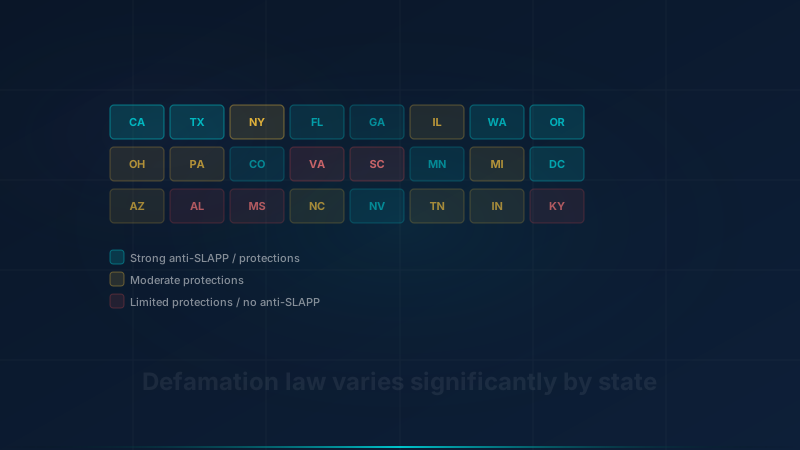
Anti-SLAPP statutes are the most consequential state-level variation. In California and Texas, a well-resourced defendant can get a defamation suit dismissed early and shift attorneys' fees to the plaintiff -- dramatically changing the litigation calculus and limiting legal action as a removal strategy.
Retraction statutes offer leverage before litigation. Most states allow publishers to limit or eliminate punitive damages by issuing a prompt correction. Knowing your state's retraction statute -- and citing it in a demand -- is often more effective than threatening a lawsuit.
Statute of limitations deadlines are unforgiving. Most states impose a one-year limitations period for defamation, with the clock starting at publication. Once it expires, your legal options narrow significantly -- making timely editorial outreach the highest-priority first step.
⚠ The AI Amplification Problem
State defamation law determines whether you have a viable legal claim. But winning that claim -- or even leveraging it to compel a retraction -- does not remove the article from Google search results or from AI-generated answers. In 2026, Google AI Overviews, ChatGPT, Perplexity, and Gemini actively surface news article content in response to queries about people. A defamatory article that was partially suppressed in traditional search may still appear in an AI Overview when someone searches your name. The legal track and the removal track are two separate paths -- and for most people, the editorial removal path produces faster, more visible results independently of any defamation claim.
Most people assume defamation law is federal. It is not. The First Amendment -- interpreted through the Supreme Court's landmark ruling in New York Times Co. v. Sullivan, 376 U.S. 254 (1964) -- establishes a constitutional floor that all states must honor. Public officials and public figures must prove "actual malice" (knowledge of falsity or reckless disregard for truth) to recover damages for a defamatory statement. No state can strip that protection away from publishers.
But below that federal ceiling, defamation law is almost entirely a creature of state common law and state statute. Each state has developed its own rules governing:
1
Fault standard for private figures:Gertz v. Robert Welch, Inc., 418 U.S. 323 (1974) held that states may not impose strict liability for defamation even for private figures -- a negligence standard is the constitutional floor. But states vary on whether they stop at negligence or require a higher showing, and courts in states like New York have historically applied near-actual-malice standards even to private figure cases involving media defendants.
2
Retraction statutes: The majority of states have statutes that limit damages -- especially punitive damages -- when a publisher issues a timely correction. The procedural requirements and timelines differ significantly: some require a demand before any suit is filed; others require the plaintiff to have given the publisher an opportunity to retract before punitive damages can be sought.
3
Statute of limitations: Most states impose a one-year limitations period for defamation claims. A handful allow two years. When the clock starts -- the "single publication rule" versus a "discovery rule" -- varies and can be outcome-determinative for older articles.
4
Anti-SLAPP protections: Strategic Lawsuits Against Public Participation statutes allow defendants sued for speech on public issues to seek early dismissal and fee-shifting. California's Code of Civil Procedure § 425.16 and Texas's Citizens Participation Act (Tex. Civ. Prac. & Rem. Code § 27.001 et seq.) are the most powerful. States without anti-SLAPP statutes -- or with weak ones -- leave defendants more exposed to litigation as a pressure tactic.
5
Punitive damages availability: Some states cap punitive damages or require clear and convincing evidence of actual malice even for private figures before punitive damages can be recovered. Others have no meaningful cap and allow punitive damages upon a showing of ordinary malice under state law -- a meaningfully lower bar than the constitutional actual malice standard.
We have handled defamation-adjacent news article removal cases across all 50 states since 2013. This guide reflects what we have observed across thousands of cases -- not just the law on paper, but how state-specific rules shape practical outcomes in editorial negotiations and legal escalations.
This is informational, not legal advice
This article provides general information about state defamation law frameworks. It is not legal advice and does not create an attorney-client relationship. Defamation law is highly fact-specific, and your situation may involve factors not addressed here. If you are considering legal action or have received a defamation demand letter, consult a qualified media attorney in your specific state. The Reporters Committee for Freedom of the Press maintains state-specific resources, and Cornell Law School's Legal Information Institute provides accessible overviews of defamation doctrine.
We help remove content using your legal rights — you only pay after it’s gone.
No upfront payment No retainer A+ BBB Rated 5,000+ clients helped In business since 2013 Only Pay For Results True Removal Experts
The federal constitutional floor set by New York Times v.
The Baseline
The Federal Floor: What All States Must Follow
Before examining state-level variation, it is essential to understand what cannot vary. The First Amendment imposes three constitutional requirements on all state defamation law:
New York Times v. Sullivan: Actual Malice for Public Officials and Public Figures
The Supreme Court's unanimous 1964 ruling in New York Times Co. v. Sullivan, 376 U.S. 254 (1964) established that the First Amendment prohibits a public official from recovering damages for a defamatory falsehood relating to official conduct unless the statement was made with "actual malice" -- that is, with knowledge that it was false or with reckless disregard for whether it was false or not. The Court later extended this standard to "all-purpose" public figures (celebrities, prominent public intellectuals) and "limited-purpose" public figures (private individuals who voluntarily inject themselves into a specific public controversy).
Actual malice is a subjective standard -- it asks what the defendant knew or suspected at the time of publication, not what a reasonable journalist would have known. It is a high bar. Most news organizations defeated in defamation suits were found to have met it through conduct like publishing without any attempt to verify a claim, or consciously ignoring contradictory evidence already in hand.
Gertz v. Robert Welch: Negligence Floor for Private Figures
In Gertz v. Robert Welch, Inc., 418 U.S. 323 (1974), the Supreme Court held that states may not impose liability without fault for a defamatory statement about a private figure, even when the statement involves a matter of public concern. Negligence -- failing to exercise the standard of care a reasonable publisher would exercise -- is the constitutional minimum fault requirement for private figures. States remain free to impose a higher standard (actual malice) if they choose, but they cannot go lower than negligence. Several states have effectively adopted the higher standard by judicial practice even without mandating it by statute.
The distinction between public and private figure matters enormously. For individuals trying to challenge false news coverage about themselves, the first question is always: how would a court classify me? Private figures have a meaningfully lower burden -- negligence rather than actual malice -- but the classification is not always intuitive. Someone who has never sought the public spotlight may still be classified as a limited-purpose public figure if the article involves a controversy they voluntarily entered. See our guide on the private figure standard for a full breakdown.
From our case experience across all 50 states
The public/private figure distinction shapes every aspect of a defamation claim, but it also shapes editorial negotiations. Publications know that private figures have a lower legal bar to clear. When we make editorial removal requests on behalf of clearly private individuals -- people who have never sought media attention, who appear in news articles through no voluntary act of their own -- that private figure status is part of the argument. A publisher assessing litigation risk will weigh whether the subject is a private figure and therefore a more viable plaintiff. Understanding your own classification is part of knowing your leverage.
State-by-State Analysis
Key State Comparison: Defamation Law for News Article Cases
The following table summarizes the most practically important defamation law variables across six states that together represent a wide range of legal environments. For state law lookup, Cornell LII's state defamation table provides a starting point, though statutes are regularly amended and court interpretations evolve. Cornell Law's defamation overview and the Reporters Committee state-by-state guide are also essential references for jurisdiction-specific research.
State
Fault Standard (Private)
SOL
Anti-SLAPP
Retraction Statute
Notable Features
California
Negligence
1 year (CCP § 340)
Very Strong CCP § 425.16
Strong Civ. Code § 48a
Anti-SLAPP provides early dismissal + mandatory fee-shifting. Retraction demand must be served before filing suit; failure to do so limits recovery to special damages. Shield law (Evidence Code § 1070) is among the strongest in the country.
New York
Gross irresponsibility (media defendants, matters of public concern)
1 year (CPLR § 215)
Moderate Civil Rights Law § 76-a (strengthened 2020)
Limited Civil Rights Law § 74 (fair report privilege)
New York courts apply "grossly irresponsible" standard for media defendants on matters of public concern (Chapadeau doctrine), which is effectively higher than negligence. The 2020 anti-SLAPP reform significantly expanded § 76-a's reach. NY shield law (Civil Rights Law § 79-h) is one of the strongest in the nation for protecting sources.
Texas
Negligence
1 year (Tex. Civ. Prac. & Rem. Code § 16.002)
Strongest in US TCPA (§ 27.001 et seq.)
Strong Tex. Civ. Prac. & Rem. Code § 73.055
Texas TCPA is widely regarded as the most aggressive anti-SLAPP statute in the country -- provides early dismissal, mandatory fee-shifting, and sanctions. Retraction demand must be made before filing; proper retraction limits recovery to actual damages. The "media defendant" safe harbor for fair and accurate reports of official proceedings (§ 73.005) is broad.
Florida
Negligence
2 years (Fla. Stat. § 95.11(4)(g))
Moderate Fla. Stat. § 768.295
Moderate Fla. Stat. § 770.02
Florida's two-year SOL is one of the longer ones in the US. The 2023 SB 1316 reforms attempted to change the actual malice standard for media defendants but faced constitutional challenges. Retraction must be demanded within a specified period before suit; proper retraction limits exemplary damages.
Georgia
Negligence
1 year (O.C.G.A. § 9-3-33)
Moderate O.C.G.A. § 9-11-11.1
Moderate O.C.G.A. § 51-5-11
Georgia's fair comment privilege is broad under common law. The anti-SLAPP statute (§ 9-11-11.1) was significantly expanded in 2016 to cover speech on matters of public concern, with fee-shifting available. Punitive damages require clear and convincing evidence of actual malice under O.C.G.A. § 51-12-5.1.
Illinois
Negligence
1 year (735 ILCS 5/13-201)
Weak / Limited No general anti-SLAPP
Strong 740 ILCS 145/1 et seq.
Illinois has no general anti-SLAPP statute, which makes it one of the more plaintiff-friendly jurisdictions for initiating defamation litigation. The retraction statute (740 ILCS 145) is procedurally demanding for plaintiffs -- demands must be properly served -- but effectively limits damages if publication retracts. Consumer fraud laws (815 ILCS 505) can occasionally be leveraged in false commercial speech contexts.
Two patterns stand out across this data. First, the one-year statute of limitations is near-universal -- if you are considering any legal leverage based on a news article, time is your most constrained resource. Second, anti-SLAPP strength is the single biggest variable affecting whether litigation is a realistic option: a Texas or California media defendant with TCPA or § 425.16 protection can effectively neutralize a defamation suit through early dismissal, turning the legal process itself into a cost and risk for the plaintiff rather than the defendant.
The Most Important Variable
Anti-SLAPP Laws: The Most Important State Variation for News Defendants
Anti-SLAPP statutes -- laws designed to prevent Strategic Lawsuits Against Public Participation -- are the single most consequential state-level variable when evaluating a defamation claim against a news organization. Understanding them is essential whether you are considering litigation as leverage or simply want to understand what legal paths are realistically available to you. For a full discussion of how anti-SLAPP laws affect plaintiffs' ability to sue news publishers, see our guide on anti-SLAPP and defamation claims against news publishers. And if you're weighing whether to sue at all, read our analysis: Can You Sue a News Publisher for Defamation?
What Anti-SLAPP Means in Practice
A defendant who qualifies under an anti-SLAPP statute can file a special motion to dismiss early in the litigation -- often before significant discovery has occurred. The motion shifts the burden to the plaintiff to demonstrate a probability of prevailing on the merits. If the plaintiff cannot meet that burden (or if the court finds the suit was filed to chill speech on a public issue), the case is dismissed. In states with robust anti-SLAPP statutes, mandatory fee-shifting means the losing plaintiff also pays the defendant's attorneys' fees and court costs. In Texas, sanctions are available on top of fee-shifting.
For someone contemplating legal action against a news publication as a strategy for forcing removal of a defamatory article, the anti-SLAPP landscape is critical:
1
California (CCP § 425.16): California's anti-SLAPP statute is broadly applied to any act in furtherance of the defendant's right of petition or free speech on a public issue. Courts have consistently applied it to news articles. A plaintiff filing in California must demonstrate a probability of prevailing -- a meaningful hurdle -- and faces mandatory fee-shifting if dismissed. The statute has been applied to online publications, syndicated content, and user-generated content hosted by news platforms.
2
Texas (TCPA, §§ 27.001–27.011): The Texas Citizens Participation Act is widely regarded as the most aggressive anti-SLAPP framework in the country. It applies to communications related to matters of public concern and includes mandatory dismissal, fee-shifting, and sanctions. Texas courts have applied it broadly to defamation suits against news organizations, bloggers, and social media platforms. A plaintiff who files and loses faces a realistic risk of paying six-figure fee awards to a well-represented media defendant.
3
Washington (RCW § 4.24.525), Oregon (ORS § 31.150), and DC (DC Code § 16-5502): These jurisdictions have strong anti-SLAPP frameworks that cover communications on issues of public concern, with fee-shifting provisions. Washington and Oregon in particular have produced significant case law applying anti-SLAPP protections to news media defendants.
4
New York (Civil Rights Law § 76-a, as amended 2020): New York's anti-SLAPP law was substantially strengthened in 2020, expanding it to cover all actions involving public petition and participation and mandating fee-shifting. Courts have been applying the amended statute broadly since 2020, and its practical force is still developing through case law. New York is moving from a weak anti-SLAPP jurisdiction toward a moderate-to-strong one.
5
No general anti-SLAPP (Illinois, Virginia, Pennsylvania, and others): In states without meaningful anti-SLAPP protection, the litigation dynamics shift. A defamation plaintiff's cost of bringing suit is not matched by an equivalent risk of fee-shifting if the suit fails. This does not make litigation a better strategy -- weak cases still fail on the merits -- but it removes one of the most significant deterrents to using the legal process as leverage in editorial negotiations.
The anti-SLAPP paradox for plaintiffs
Here is the counterintuitive reality we have observed across years of working with people harmed by false news coverage: in states with the strongest anti-SLAPP laws, the threat of litigation is actually the weakest editorial leverage tool. A Texas media organization that knows the TCPA provides a path to early dismissal and fee-shifting is far less likely to be moved by the implied threat of a lawsuit than a publication in Illinois with no similar protection. This is one reason why editorial outreach -- making the strongest possible case for voluntary removal or correction -- produces better outcomes than legal posturing in high-anti-SLAPP states. The law itself pushes toward the editorial track.
Leverage Before Litigation
Retraction Statutes: How Demanding a Correction Changes the Math
Most states have retraction statutes -- laws that limit a publication's damages exposure if it issues a timely and sufficient correction in response to a demand. Retraction statutes exist because legislatures have determined that the goal of defamation law (deterring false speech and compensating those harmed by it) is better served by encouraging correction than by maximizing damage awards. From your perspective as someone harmed by false coverage, retraction statutes are leverage -- and most people never use them.
How Retraction Statutes Work
The specific mechanics vary by state, but the core structure is consistent: if a plaintiff gives the publication notice of the alleged defamation and an opportunity to retract within a specified period (typically before filing suit), and the publication issues a sufficient retraction, the plaintiff's recovery is limited -- often to actual damages only, with punitive damages eliminated. In some states, the retraction must be "full and fair" and published in substantially as prominent a manner as the original statement.
Key state-specific retraction statute details:
1
California (Civil Code § 48a): A demand for correction must be served on the publisher within 20 days of knowledge of the publication. If the publisher publishes a correction within 21 days of the demand, general damages are limited to special damages (actual out-of-pocket losses). This is a significant limitation -- general damages in defamation, which compensate for reputational harm, can be substantial; special damages require documented financial loss. Failure to demand correction before suing forfeits general damages recovery. This statute creates direct financial incentive for pre-litigation editorial engagement.
2
Texas (Tex. Civ. Prac. & Rem. Code § 73.055): A request for correction, clarification, or retraction must be made before filing suit. The request must specifically identify the statement claimed to be false and defamatory, the name of the person allegedly defamed, and a request for correction or retraction. If the publication timely and sufficiently responds, punitive damages are not available and actual damages are limited. Texas's statute is tightly procedural -- compliance with the demand requirements is not optional.
3
Illinois (740 ILCS 145/1): Illinois's retraction statute requires a written demand for retraction before filing suit for compensatory and punitive damages. The demand must specify what statements are claimed defamatory. The statute creates a 5-day window for publications to retract; if retraction is made within that period, the plaintiff's recovery is limited to actual damages. Illinois's statute is among the most procedurally demanding for plaintiffs, and compliance requirements are strictly construed.
4
Florida (Fla. Stat. § 770.02): Before bringing an action for libel or slander, a plaintiff must demand a retraction in writing within a specified period after first becoming aware of the publication. If the publisher within 10 days after receipt of the demand publishes a full and fair retraction in substantially as conspicuous a manner as the original, punitive and exemplary damages are not available. Florida's statute explicitly addresses broadcast media with parallel provisions.
The practical significance of retraction statutes extends beyond litigation. A carefully drafted retraction demand that cites the applicable state statute by section number signals legal sophistication. Publications understand what the demand means -- they know that failure to respond appropriately preserves the plaintiff's full damages options including punitive damages. Citing a statute is not a litigation threat; it is editorial pressure framed in the language that publications and their counsel actually understand. For a full guide to drafting this kind of demand, see our article on retraction demand letters for defamation. The Poynter Institute has also documented how retraction demands influence editorial decision-making at news organizations of all sizes. The EFF's online defamation guide covers publisher obligations and retraction practices in detail.
Why we recommend editorial outreach before invoking state law
Across more than a decade working with clients in defamation-adjacent news removal situations, we have found that the sequence of steps matters significantly. Editorial outreach -- a well-documented, professionally framed request that treats the publication as a partner in correcting the record -- succeeds more often, and at lower cost, than legal escalation in the first instance. When editorial outreach doesn't produce results, a formal retraction demand citing the applicable state statute is the next step. Based on our internal case data, editorial outreach produces positive outcomes (removal or meaningful update) in approximately 30–40% of well-documented cases. Combining that outreach with a statutory retraction demand increases that rate by an additional 10–15 percentage points in states with strong retraction statutes like California, Texas, and Illinois. The demand letter gets read differently than the editorial email -- but it works best when preceded by the editorial conversation.
Dealing with a false news article? Our free tool generates a professional editorial removal request tailored to your situation and finds the right editorial contact at the publication -- no attorney required for the first step.
Statute of Limitations: Don't Let Time Work Against You
The statute of limitations for defamation is the most time-sensitive element of state law you need to understand. In most US states, the limitations period is one year. Florida is a notable exception at two years (Fla. Stat. § 95.11(4)(g)). Missing the deadline is typically fatal to a defamation claim -- courts dismiss time-barred suits regardless of the underlying merits.
When the Clock Starts: The Single Publication Rule
The majority of states follow the "single publication rule" for defamation: the limitations period begins to run when the defamatory material is first published, not each time it is viewed. For an online news article, courts have generally held that this means the date the article was first posted -- not the date you learned of it, not the date a new visitor reads it, and not the date the article is re-indexed by a search engine.
The single publication rule creates a particularly unforgiving dynamic for people who discover a defamatory article about themselves years after it was published. If you find a 2022 article in 2025 in a one-year-SOL state, your right to bring a defamation claim based on the original publication has expired. This is exactly why editorial outreach -- which has no statute of limitations -- is often the only available path for older articles. Understanding defamation lawsuit requirements early helps you avoid missing these critical windows.
The Discovery Rule Exception
Some states recognize a "discovery rule" modification to the single publication rule: the limitations period does not begin until the plaintiff knows or reasonably should have known of the defamatory publication. Application of the discovery rule to defamation varies significantly by state and is not uniformly recognized. California courts have applied the discovery rule to online defamation in some circumstances (see Shively v. Bozanich (2003) 31 Cal.4th 1230). New York courts have been more resistant to the discovery rule in defamation cases. Whether the discovery rule applies in your state -- and in the specific circumstances of your case -- is a fact-intensive legal question that requires consultation with a media attorney.
Republication: When the Clock Restarts
Under the single publication rule, a new limitations period begins only if the defamatory content is "republished" -- substantially changed or redistributed in a new publication. Courts have generally held that routine updates to a website (fixing a typo, updating a photo) do not constitute republication sufficient to restart the limitations period. However, major substantive changes to an article or reposting it to a new platform may qualify. This distinction matters because some publications that have heavily revised old articles may have inadvertently created a new limitations window.
The SOL and editorial strategy
Understanding your statute of limitations deadline is not primarily about litigation planning -- it is about understanding your editorial leverage timeline. A publication's legal department assesses litigation risk partly through the limitations period. A demand letter sent within the one-year window arrives with full litigation risk attached. The same letter sent after the limitations period has expired arrives with that risk significantly diminished. If your claim is time-sensitive, the sequence matters: editorial outreach first, then formal retraction demand citing the applicable statute, ideally both within the limitations window even if litigation is not your actual intention.
How to Use This
What This Means Practically: How to Use State Law Without Suing
The goal for most people dealing with a false or harmful news article is not a jury verdict -- it is removal of the article, or at minimum a correction that changes the search result's impact. Litigation is expensive, slow, uncertain, and often counterproductive (filing a lawsuit can draw more attention to the article you want removed). State law is most useful as a framework for structured editorial pressure, not as a litigation roadmap. A news article removal attorney can help you apply the right state-specific leverage before committing to litigation.
Here is how to use state law knowledge practically:
1
Identify your state's retraction statute and its procedural requirements. If you are in California, Texas, Illinois, or Florida, you have a specific statutory framework to cite. Draft a retraction demand that complies with those procedural requirements -- even if you do not intend to file suit, compliance signals that you know what you are doing and that your formal legal options are preserved. Publications and their counsel know which states have demanding retraction statutes and take compliant demands seriously.
2
Act within the limitations period if at all possible. Even if you never file suit, a demand letter sent within the one-year window arrives with greater implicit weight than one sent after the limitations period has expired. Speed matters.
3
For EU residents: GDPR operates independently of state law. If you are an EU or UK resident, GDPR Article 17 (the right to erasure) applies regardless of which US state the publication is in or which state's defamation law would govern a lawsuit. GDPR requests to Google's search results can be filed independently of any editorial outreach or retraction demand, and they are not subject to a one-year limitations period. See our guide to the GDPR right to be forgotten for news articles for the full process.
4
Know your state's anti-SLAPP landscape before making implicit litigation threats. Implying you will sue a Texas or California media organization -- especially without a strong factual and legal basis for your claim -- can backfire badly under strong anti-SLAPP statutes. The publication may move for early dismissal and fee-shifting, transforming you from a claimant into a fee-paying defendant. If your state's law and the publication's location both involve strong anti-SLAPP protections, legal escalation as a pressure tactic carries real risk. In those situations, the purely editorial approach -- making the strongest possible documented case for voluntary correction -- is almost always the better strategy.
5
Use editorial outreach as the primary track, with state law as supporting context. A letter from someone who clearly understands the applicable state retraction statute, the limitations period, and their own classification as a private figure is a letter that gets read differently than an angry email. You do not need to threaten litigation -- you need to demonstrate that you have done your research, that your request is grounded in legal reality, and that the publication's failure to act has documented consequences under the applicable state framework. Reference the SPJ Code of Ethics obligation to correct errors prominently and promptly -- editors respond to professional editorial standards arguments, not just legal threats.
One final note: the editorial removal track operates entirely independently of the legal track -- and in many cases moves faster. A defamation claim under your state's law may take months or years to resolve. An editorial removal request can produce results in days or weeks. RemoveNews.ai handles the editorial removal path -- including generating a professional removal request, identifying the right editorial contact, and managing the process through professional news article removal specialists who have worked on thousands of cases since 2013. If the article is still indexing in Google or surfacing in AI-generated answers about you, that is the track most likely to change it.
If Legal Routes Fail
When State Defamation Law Doesn't Result in Article Removal
Even when state law strongly supports a defamation claim, courts typically award damages rather than ordering removal of an article. A successful verdict or settlement resolves the legal dispute -- it does not compel the publisher's web team to take the content down. Many publishers leave articles live even after losing defamation cases, sometimes appending a brief editor's note while the original content remains indexed and continues to rank. Anti-SLAPP exposure in states like California and Texas also means that pursuing litigation carries real financial risk: if the claim is found meritless, the plaintiff may be liable for the defendant's attorney fees. And in states where the limitations period has lapsed, the legal path may be unavailable regardless of how strong the underlying claim would have been. When the legal route reaches its limits, the alternatives that do produce results are editorial removal -- working directly with the publisher -- content suppression through SEO, and professional reputation management that reduces the article's search visibility over time.
A combined approach -- editorial, technical, and SEO strategies working in parallel -- is what consistently produces the best outcomes for people dealing with damaging news articles. RemoveNews.ai has worked with more than 5,000 clients on these problems since 2013, and the model is straightforward: pay only if we succeed. A free consultation gives you a realistic assessment of what options are available for your specific article and situation, including which state-law frameworks may still be useful as leverage even if full litigation is off the table.
When Legal Routes Have Limits
Legal action and formal rights requests don't always achieve full removal -- and sometimes the most effective path is a combination of editorial, technical, and SEO strategies. Our team can assess your specific situation and tell you what the realistic options are. Schedule a free consultation and hear back within one business day.
Free Consultation
Is your article removable? Find out -- free.
Tell us about your situation and a removal specialist will personally review it and respond within one business day. No pressure, no obligation.
No upfront payment -- you only pay if we succeed
A+ BBB Rated · 5,000+ Clients Helped · Since 2013
100% Confidential · Response within 1 business day
FAQ
Frequently Asked Questions
Which state has the strongest defamation laws protecting individuals from false news articles?
California and Texas are consistently cited as having the strongest overall frameworks for individuals challenging false news coverage. California has a robust anti-SLAPP statute (Code of Civil Procedure § 425.16) with broad application, strong retraction statutes, and courts that apply a negligence standard for private figures. Texas's Citizens Participation Act (TCPA) is widely regarded as the most powerful anti-SLAPP law in the country -- providing early dismissal, mandatory fee-shifting, and sanctions. However, "strongest" depends on your specific situation: if you're a private figure alleging a false statement of fact, California's combination of anti-SLAPP protections and retraction statute leverage may give you the best practical tools short of litigation. Note that strong anti-SLAPP laws primarily protect defendants (news organizations) from frivolous suits -- they don't make it easier to win a defamation case, but they do create strong incentives for publishers to avoid genuine defamation in the first place. Consult a media attorney in your specific state for a situation-specific assessment.
Can I sue in a state other than where the article was published?
Possibly, but it is complicated. Defamation plaintiffs generally must sue where personal jurisdiction exists over the defendant -- typically where the publication is headquartered, where the defendant's servers are located, or where the article caused harm (often your home state). For online publications distributed nationally, courts have taken varying approaches under the Calder v. Jones "effects test," which allows jurisdiction where the defendant intended the tortious conduct to have its effects. Shopping for a favorable jurisdiction (called forum-shopping) is legally limited by due process requirements and can expose you to dismissal motions. A media attorney can evaluate whether your home state provides viable jurisdiction over an out-of-state publication, and whether that state's law -- including its anti-SLAPP framework -- is favorable or unfavorable to your situation before you choose where to file.
Does it matter if the news outlet is based in a different state than me?
Yes, it matters in two important ways. First, the publication's home state laws may govern certain defenses -- particularly if you're filing suit there. Second, anti-SLAPP protections are state-specific: a Texas-based outlet sued in Texas benefits from the strong TCPA anti-SLAPP statute, which could result in early dismissal of your case and fee-shifting against you. Conversely, if you're a California resident and can establish California jurisdiction over an out-of-state publication, you may be able to benefit from California's retraction statute framework and negligence standard for private figures. For editorial purposes rather than litigation purposes, the publication's home state still matters -- their legal counsel's assessment of their own exposure will be informed by their home state's framework. The practical takeaway: always understand both your state's laws and the publication's home state laws before taking legal action, and consult a media attorney who practices in both jurisdictions if they differ.
Dealing with a false or harmful news article?
Our free tool generates a professional editorial removal request tailored to your situation. Works across all 50 states. Takes 60 seconds.
CEO & Co-Founder, RemoveNews.ai · Reputation Resolutions
Anthony has spent 13+ years studying what makes negative news content stick — and how to remove it. He co-founded Reputation Resolutions and has helped 5,000+ clients remove and suppress damaging press coverage. He holds Corporate & Crisis Communications and Brand Management certifications from Cornell, a Digital Marketing certificate from NYU, and is a member of the Forbes Agency Council and Fast Company Executive Board.