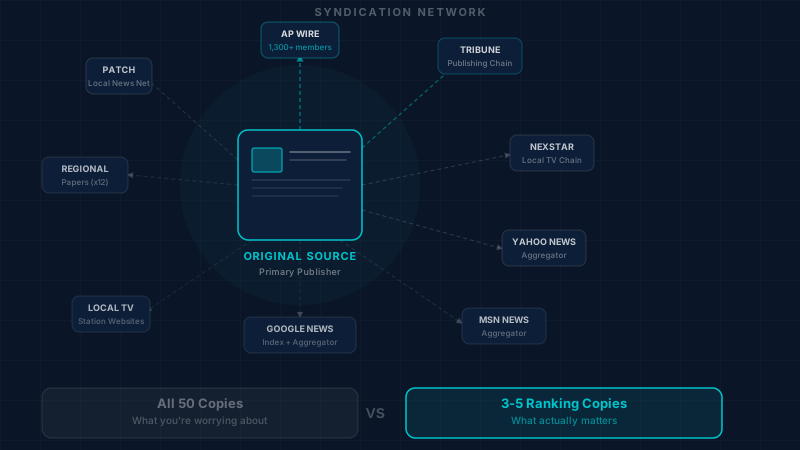
One Article. Fifty Sites. Here's How to Actually Remove It. (2026 Guide)
Discovering that a negative article has been republished across dozens of news websites is one of the most discouraging moments in reputation management. Most people assume they need to contact every outlet individually, which is both impossible and the wrong strategy. Understanding how syndication works -- and targeting the source rather than the copies -- is the only approach that produces results at scale.
By Anthony WillFounder & CEO, Reputation Resolutions · Removing articles since 2013
Updated June 30, 2026Published May 12, 2026 · 9 min read
Key Takeaways
Most syndicated copies are published automatically. AP wire, Nexstar, and Tribune Publishing properties republish stories without additional editorial review, which means the copies can often be addressed by targeting the source.
The original publisher controls the canonical URL. Removing or de-indexing the source article removes the SEO authority that copies inherit, even when the copies themselves remain live.
Yahoo News, MSN News, and Google News are aggregators, not publishers. They index and display content from source outlets, and removing from the source eventually removes from the aggregators.
Google's URL removal tool can target individual syndicated copies for de-indexing even when the original remains live -- useful for copies that rank for your name while the original does not.
When a news story gets published, it rarely stays on one website. The modern news distribution system is built around syndication networks that were designed to spread stories quickly and broadly. Understanding the mechanics of each type of syndication is essential before deciding where to direct your energy.
AP Wire and Newswire Syndication
A local paper or TV station publishes a story. If it is submitted to or picked up by the Associated Press wire, every AP member outlet can publish it verbatim. The AP has over 1,300 member newspapers in the United States alone. Member outlets do not edit the story -- they republish it with an AP byline. This means there is a primary publisher (the outlet that filed the story), an originating wire version (AP's canonical copy), and potentially hundreds of member publications that ran it.
This is the most challenging syndication scenario because the AP copy becomes its own canonical source that propagates independently. Removing the story from the original local outlet may not affect the AP wire version or the member publications that pulled it from AP.
Tribune Publishing, Nexstar, and Gray Television Chains
Large media companies that own dozens of local TV and newspaper properties often republish stories from within their own network automatically. A story published by one Tribune property -- the Chicago Tribune, Baltimore Sun, or another chain outlet -- may appear on all Tribune properties within hours, often without any additional editorial decision. The same pattern applies to Nexstar and Gray Television, which together own hundreds of local TV station websites across the country.
This is actually somewhat favorable for removal: because these are corporate siblings rather than independent publishers, getting a removal from the corporate editorial team can propagate down through the chain the same way the original story did.
Patch
Patch is a network of local news sites covering thousands of communities across the United States. Patch frequently republishes content from regional AP feeds and local wire services. It is a significant syndication destination for crime, court, and local government stories -- which means it often appears in search results for individuals dealing with arrest records, court proceedings, or regulatory matters that received local coverage.
Yahoo News and MSN News
These are news aggregators, not publishers. Yahoo News pulls content via RSS feed and licensing agreements from source publishers. MSN News operates similarly through partnerships with media companies. Neither outlet independently hosts the content in the way a newspaper does -- they display content sourced from others. This is why removing from the source typically removes from Yahoo and MSN within days to weeks; the feed simply stops serving the article once it is gone from the source.
Google News
Google News is a news aggregator and index. It does not host content; it indexes it from publisher websites. De-indexing the source article removes it from Google News. However, Google News and Google Search are separate systems -- de-indexing from one does not automatically de-index from the other. Both require separate action.
We remove negative news articles — you only pay after it’s gone.
No upfront payment No retainer A+ BBB Rated 5,000+ clients helped In business since 2013 Only Pay For Results True Removal Experts
Discovering that a negative article has been republished across dozens of news websites is one of the most discouraging moments in reputation management.
Section 02
Why Contacting Every Outlet Is the Wrong Strategy
The instinct to contact every outlet that ran a story is understandable. The problem is that it does not work at scale and often makes the situation worse.
Each AP member publication that republished a story has its own editorial staff, its own email addresses, and its own policies for handling removal requests. Contacting fifty outlets individually takes weeks. The responses are inconsistent -- some will ignore the request, some will decline, and some will forward the request internally without any result. Worse, a mass outreach campaign can draw attention to itself. Editors at outlets that had not noticed the original story may take a second look when a removal request arrives, and some will publish follow-up stories about the subject of the article requesting removal.
The correct framework is to understand which copies are actually harming you and which are ghost traffic. Most syndicated versions of a story are not independently ranking in Google. They exist in indexes and archives that Google has crawled, but they are not appearing in the search results that people actually see when they search your name.
To identify your actual target list: open an incognito browser window (so your search history does not influence the results) and search your full name. Look through the first three pages of results -- approximately thirty results -- and note every URL that contains the story. In our experience, this is typically three to five URLs for a syndicated story, not fifty. The other forty-five copies are indexed somewhere, but they are not the ones causing the daily reputational harm. Targeting those three to five is tractable. A mass outreach to all fifty is not.
This distinction also matters for prioritizing removal grounds. The original publisher and one or two high-authority pickup sites are the URLs worth pursuing for editorial removal. The remainder can often be handled with Google URL de-indexing requests, which is a faster and more reliable process than editorial outreach for low-authority or unmaintained archive copies.
For more on building a removal request that works with editorial teams, see our guide on how to write a news article removal request. If you're also dealing with a correction or retraction request to the original publisher, that guide covers the specific language and grounds that produce results. For broader context on removing articles across all platforms once syndicated copies are addressed, see our complete guide on how to remove negative articles from the internet.
From Practice
In our experience, 80% of the harm from a syndicated story comes from 3-5 URLs -- usually the original publisher, the AP wire version, and 1-2 high-authority pickup sites. The other 45 copies are indexed but not ranking. Fix the 3-5 that are showing up and you have solved most of the problem.
Section 03
The Source-First Strategy
Once you have identified the three to five URLs that are actually ranking for your name, the sequence of action matters. Working the source first creates downstream benefits that make the rest of the cleanup faster.
1
Identify the original publisher -- the outlet that first reported the story, not the AP wire version. This is the outlet with editorial authority over the underlying content. Their decision to remove or update the story has the broadest downstream effect on the syndication network.
2
Pursue removal or de-indexing with the original publisher first. This is where editorial arguments have the most traction. Factual errors, a resolved legal matter, outdated information, or a story that no longer serves the public interest are all grounds that editorial desks will at least consider. The original reporter and their editor have a relationship with the underlying facts that AP member publications do not.
3
If the AP wire version is the canonical source, contact AP's editorial team. AP does issue corrections and, in rare cases, kill notices. The bar is high -- AP only acts on editorial grounds, not reputation concerns -- but documented factual errors give you a viable path. The AP Standards Center is the appropriate point of contact.
4
For high-authority pickup sites that are ranking independently, contact those editorial desks directly, referencing the original publisher's removal or any errors you have identified. A Tribune property or major regional paper is more likely to act on a removal request that cites a precedent from the original publisher than one that arrives cold.
5
Use Google's URL removal tool to de-index specific syndicated copies that are ranking. This is especially effective for copies on sites that no longer actively maintain the content -- regional papers with outdated CMS systems, Patch archives, or aggregator pages. Even if the copy remains live on the site, Google de-indexing removes it from search results.
Section 04
The AP Wire -- Can You Actually Get a Wire Story Removed?
This is a question almost every client with a widely syndicated story asks. The answer is: sometimes, on narrow grounds, through a slow process.
AP can issue corrections to wire stories, and those corrections propagate to member outlets that ran the original. If you have identified specific factual errors in an AP wire story -- a wrong date, an inaccurate characterization of a charge, a factual claim that can be documented as false -- contacting AP's Standards Center with that documentation is the appropriate first step. AP takes editorial accuracy seriously and will investigate factual error claims.
AP can, in rare cases, issue a kill notice that instructs member outlets to remove a story. This typically happens when AP editorial acknowledges that a story has substantive factual errors that cannot be corrected in place, or when there are legal issues with the story that AP's legal team determines require retraction. Kill notices are not common and are not issued based on the subject's preference or reputation concerns.
AP does not process removal requests based on subject preference or reputation concerns alone. If the wire story accurately describes events that occurred, AP will not remove it because the subject finds the coverage damaging. This is standard editorial policy across all major news organizations and is not unique to AP.
The practical path: document every specific factual error in the AP wire story. Present each error with supporting documentation -- court records, official statements, contemporaneous evidence -- to AP's Standards Center. The SPJ Ethics Code, which requires journalists to "correct errors promptly and prominently," provides a useful framework when arguing that a wire story contains factual inaccuracies that need correction. If errors exist and are documentable, AP will investigate and may issue a correction or, in substantive cases, a kill notice. If the wire story is accurate, the AP path is not viable. Concentrate instead on the original publisher and on the Google outdated content removal tool for de-indexing the ranking copies once source content has been removed or updated.
Important Limitation
A kill notice from AP does not delete stories from member publications that already ran them -- it only prevents future distribution. Member outlets that ran the story before the kill notice was issued will still have it in their archive unless they independently remove it. A kill notice reduces the reach of future syndication but does not retroactively clean up existing copies.
Section 05
Yahoo News, MSN News, and Google News -- Aggregators Are Not Publishers
One of the most common misunderstandings in syndicated article removal is treating Yahoo News and MSN News as publishers with editorial teams you can negotiate with. They are not. Understanding the distinction changes how you approach them.
Yahoo News does not have an editorial process for individual story removal requests in the way a newspaper does. Content appears on Yahoo News because Yahoo has a licensing or feed agreement with the source publisher. If you contact Yahoo through their content reporting form, the request typically goes to an automated system or a small content operations team with limited authority to remove individual stories. The primary and most reliable path is removing or de-indexing the source article, which causes Yahoo's feed to update within two to four weeks. For faster resolution on a specific Yahoo URL that is ranking for your name in Google, submit a Google URL removal request targeting that Yahoo URL directly -- this de-indexes the Yahoo page from Google Search without requiring Yahoo's cooperation.
MSN News operates similarly to Yahoo. MSN aggregates from licensed partners, and its own content team rarely removes individual stories on request. The source removal path is the same. MSN URLs can also be targeted directly through Google's URL removal process once the source has been removed or changed.
Google News is a separate concern. To remove a URL from Google News, submit a removal request through Google's Search Console or the outdated content removal tool. This is distinct from Google Search removal -- a URL can be removed from Google News and still appear in regular Google Search results. If you want a URL removed from both systems, submit requests to both separately. For publishers, Search Console provides direct control. For individuals who are subjects of the coverage rather than publishers, the Outdated Content Removal tool and the Legal Removal Request form are the available paths.
Contact local editorial desk + reference original removal
Moderate
Yahoo News copy
Medium
Source removal + Google URL de-indexing
Moderate
MSN News copy
Medium
Source removal + Google URL de-indexing
Moderate
Patch copy
Low-Medium
Editorial request to Patch local editor
Moderate
Small regional paper copy
Low
De-indexing request (often unmaintained)
Moderate
Google News listing
Medium
Google Search Console removal
Moderate
Section 07
Using Google's URL Removal Tool on Syndicated Copies
Google provides a set of tools for requesting de-indexing of URLs. Understanding which tool applies to which situation -- and which tools are available to non-publishers -- is essential for using them effectively on syndicated copies.
Google's Outdated Content Removal tool allows anyone to request removal of a URL that previously showed content that has since changed or been removed. This is primarily useful after source removal -- once a syndicated copy has been taken down or substantially changed at the source, you can submit the URL to this tool and Google will typically clear it from its index within days to weeks. The tool does not require site ownership.
The Temporary Removals tool in Google Search Console requires ownership of the site. It is not available to the subject of an article appearing on someone else's site. It is useful if you own the domain where the content appeared -- for example, if the story appeared on your own website -- but it is not an option for third-party coverage.
For non-owner de-indexing of content that has not yet been removed: use Google's Legal Removal Request form for content that violates law or Google's policies -- this includes defamatory content in applicable jurisdictions, content that violates privacy laws, or content that meets other legal removal standards. This path requires a legal basis and is not a general-purpose reputation management tool.
Best practice for syndicated removal campaigns: after getting even one syndicated copy removed or de-indexed, document the result. When approaching other copies from the same publication network -- other Tribune properties, other Patch markets, other AP member outlets -- you can reference the precedent removal as supporting context. Publication networks with shared editorial governance often apply consistent decisions across their properties once a precedent is established.
If the original publisher or AP has declined removal but a specific syndicated copy at a smaller outlet is ranking for your name, use the Google URL removal tool to target that specific URL. You do not need the outlet's cooperation. You need only to show that the content at that URL has been removed or substantially changed, which gives you grounds to request de-indexing.
Which syndicated copies are actually ranking for your name? Paste any one URL to identify the ranking copies and get a recommended action for each one.
Run a full Google audit. Search your name in an incognito browser. Identify every URL appearing in the first three pages that contains the story. This is your actual target list -- not every site that ran the story, only the ones that are actively ranking and being seen by people who search your name.
2
Identify the original publisher and the AP or wire source, if applicable. Determine which outlet filed the story first and whether it entered an AP or newswire feed. These are your highest-priority targets because they control the canonical content that everything downstream derives authority from.
3
Assess removal grounds for the original. Are there specific factual errors with documentation to support them? Has the underlying legal matter been resolved? Is the information outdated in a material way? Pursue editorial removal with the original publisher first, using whatever grounds apply. A well-documented request to the original reporter and their editor is more effective than a general complaint.
4
For high-authority syndicated copies that are ranking independently, contact those editorial desks referencing the original removal request and any errors identified. Tribune properties, major regional papers, and high-DA local TV station websites deserve direct editorial outreach rather than relying solely on Google de-indexing.
5
Submit de-indexing requests to Google for ranking syndicated copies -- especially copies on unmaintained archives, aggregators, or sites where the original has already been removed. Use the Outdated Content Removal tool after source removal. Use the Legal Removal Request form where legal grounds exist. Document each submission and track the status.
6
Monitor over 60 to 90 days. Once the original is removed or de-indexed, aggregator copies typically fall out of Google within four to eight weeks without additional action. Run fresh incognito searches at 30-day intervals to track which URLs have cleared and which require follow-up. Adjust your approach based on what remains.
One Story. Multiple Sites. One Solution.
Syndicated article removal requires a coordinated strategy across the original publisher, wire services, chain publications, and aggregators. Our specialists have worked these campaigns for over a decade.
Tell us about your situation and a removal specialist will personally review it and respond within one business day. No pressure, no obligation.
No upfront payment -- you only pay if we succeed
A+ BBB Rated · 5,000+ Clients Helped · Since 2013
100% Confidential · Response within 1 business day
Frequently Asked Questions
Common Questions About Syndicated Article Removal
If I get the original article removed, will the syndicated copies disappear too?
Not immediately, and not automatically in every case. Removing the original article removes the canonical source that syndicated copies derive their authority from, which causes most copies to lose search ranking over time. Aggregators like Yahoo News and MSN News typically clear their feed copies within two to four weeks of the source being removed. However, copies hosted on member publications that published and archived the story independently -- Tribune properties, regional newspapers -- will remain live in their archives unless independently removed. Google's URL removal tool can be used to de-index individual ranking copies even while the broader cleanup process continues.
Can I contact Yahoo News or MSN News to remove a story about me?
You can submit a request, but direct editorial removal from Yahoo News or MSN News is rarely effective on its own. Both are aggregators, not publishers. They display content sourced from partner outlets and do not have editorial teams that review individual removal requests the way a newspaper would. The most reliable path is removing or de-indexing the source article, which causes Yahoo and MSN feeds to update within weeks. For faster results on specific Yahoo or MSN URLs that are ranking for your name, submit a Google URL removal request targeting those specific URLs directly.
How do I get an AP wire story corrected or removed?
Contact AP's Standards Center with documented evidence of specific factual errors in the wire story. AP issues corrections to wire stories when errors are substantiated, and those corrections propagate to member outlets. In cases involving serious factual error or legal issues, AP can issue a kill notice -- though this does not retroactively remove copies that member outlets already published and archived. AP does not process removal requests based on subject preference or reputation concerns; only documented factual errors or legal grounds are considered.
Does removing from Google News remove the article from Google Search?
No. Google News and Google Search are separate systems with separate indexes. Removing a URL from Google News does not remove it from Google Search results, and vice versa. If you want a URL removed from both, you need to submit separate requests for each. Google's Search Console removal tools (for site owners) and the Outdated Content Removal tool (for non-owners, after source removal) address Google Search indexing. Google News removal is handled through a separate process in Search Console.
How many syndicated copies do I actually need to address?
Far fewer than you think. Run an incognito Google search for your name and identify every URL containing the story that appears in the first three pages of results. In most cases involving a syndicated story, this is three to five URLs, not fifty. The remaining copies exist in indexes and archives but are not ranking for your name and are not being seen by people searching for you. Concentrate your efforts on the original publisher, any AP or wire canonical version, and the two or three high-authority pickup sites that are independently ranking. Addressing those five targets typically resolves the vast majority of the visibility problem.
How long does it take for syndicated copies to drop from Google after the original is removed?
Typically four to eight weeks for most aggregator and low-authority copies to lose ranking or fall out of Google's index once the source is removed or de-indexed. High-authority pickup sites that have independently indexed the story and acquired their own inbound links may take longer -- sometimes three to six months -- to lose ranking even after the source is gone. Using Google's URL removal tool to target specific ranking copies can accelerate the process for individual URLs.
CEO & Co-Founder, RemoveNews.ai · Reputation Resolutions
Anthony has spent 13+ years studying what makes negative news content stick — and how to remove it. He co-founded Reputation Resolutions and has helped 5,000+ clients remove and suppress damaging press coverage. He holds Corporate & Crisis Communications and Brand Management certifications from Cornell, a Digital Marketing certificate from NYU, and is a member of the Forbes Agency Council and Fast Company Executive Board.