Your Name Is Fine. Someone Else's Isn't. Google Doesn't Know the Difference. (2026 Guide)
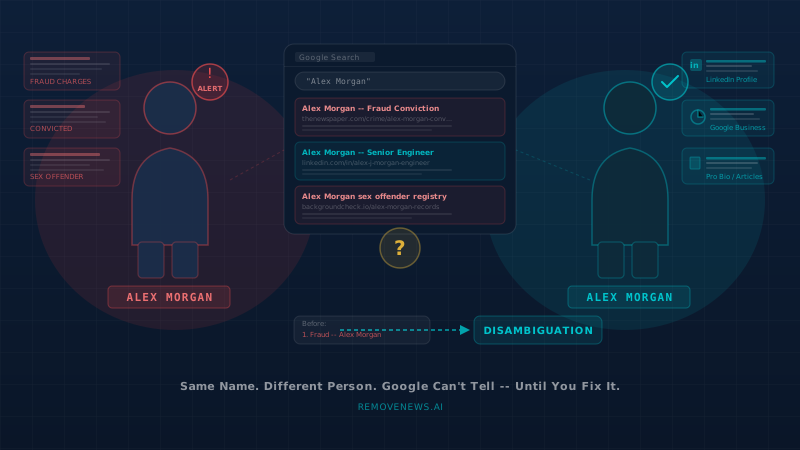
Sharing a name with someone who has significant negative news coverage is one of the most frustrating reputation problems to solve, because no mistake was made and no content is technically wrong. The news articles are about a real person with your name -- they are accurate -- which eliminates most standard removal arguments. The solution is not about removing the articles; it is about making it unmistakably clear to Google, and to anyone who finds you, that you are a different person.
By Anthony WillFounder & CEO, Reputation Resolutions · Removing articles since 2013
Updated June 30, 2026Published May 12, 2026 · 9 min read
Key Takeaways
If the articles are about a different person with the same name, standard editorial removal requests will not work. The articles are accurate about their subject and publishers have no obligation to remove them on your behalf.
The primary strategy is disambiguation -- building a strong, authoritative, differentiated digital presence that makes it clear to Google and to searchers that you are a distinct individual.
In some cases, Google's personal information removal tools can help if search results for your name are returning information that does not apply to you -- such as mugshot or background check entries that incorrectly associate you with the other person.
Middle name, professional title, location, and employer differentiation are the fastest ways to separate your identity in search results.
Why This Situation Is Different From Standard Article Removal
When most people discover that a negative article is appearing in Google search results for their name, the instinct is to contact the publisher and request removal. That approach works -- sometimes -- when the article contains factual errors, when the underlying matter has been resolved and the article has not been updated, or when the publication's editorial policy supports removal under specific circumstances.
Name confusion is fundamentally different. The articles are about another person. They are factually accurate. The publisher has done nothing wrong. Standard removal arguments -- factual errors, outdated information, a resolved case -- do not apply because none of those conditions exist. The article accurately describes a real person who happens to share your name. The publisher has no incentive and no editorial obligation to remove accurate coverage simply because a third party finds it inconvenient to share that name.
This is important to understand before taking any action, because many people in this situation spend months pursuing removal requests that will never succeed. They write letters, hire lawyers, and escalate to editors -- all for articles that will not be removed because the publisher has done nothing wrong. The correct approach is entirely different: it is about disambiguation and identity separation, not content removal. Use Google's outdated content removal tool if search results are returning cached pages that incorrectly associate you with the other person's coverage, and use Google's legal removal tool if any results contain your actual personal information in connection with the other person's records.
Once you accept that the articles are staying, the strategic question becomes: how do you make it unmistakably clear -- to Google's algorithm, to searchers, and to anyone who finds you -- that you are a different person from the subject of those articles?
The Two Versions of This Problem
Version A: Same name, you are not mentioned in the articles. When someone Googles your name, they see that person's articles -- but you are not in them. The confusion exists entirely in the searcher's mind, and in the outputs of background check engines and pre-screening tools that aggregate results for everyone with a given name without clearly distinguishing between them.
Version B: Your name appears in records incorrectly associated with the other person. This is the more damaging version. Background check databases, public record aggregators, and mugshot sites have, through automated matching errors, linked the other person's records to your identity profile. This means the incorrect association is in data, not just in a searcher's interpretation. Version B has additional remedies beyond pure disambiguation.
Identifying which version applies to you -- or whether you are dealing with elements of both -- is the essential first step. The strategies differ, and applying the wrong approach wastes time. We cover each version in the sections below. For a broader understanding of how Google handles requests related to negative articles, that resource covers the general framework within which both scenarios operate.
We remove negative news articles — you only pay after it’s gone.
No upfront payment No retainer A+ BBB Rated 5,000+ clients helped In business since 2013 Only Pay For Results True Removal Experts
Sharing a name with someone who has significant negative news coverage is one of the most frustrating reputation problems to solve, because no mistake was made and no content is technically wrong.
Section 02
Version A -- Same Name, You're Not in the Articles
In Version A, the articles are entirely about a different person. Your name does not appear in the text. But the problem is real and damaging nonetheless, because the systems that employers, clients, and landlords rely on do not always distinguish clearly between two people with the same name.
Background check services, employer pre-screening tools, and consumer platforms often return results for all people with a given name, presenting them in ways that do not make individual attribution clear. A hiring manager who sees "[Name] -- convicted of fraud" in a background check interface that is not cleanly disambiguated may assume the worst, especially if the position requires a background investigation or the employer lacks the resources to investigate further. The result is quiet, invisible rejection: you never know why the offer did not come through.
The same dynamic plays out with prospective clients, professional referral sources, and anyone who types your name into Google and sees the other person's results dominating the first page.
What Works in Version A
The core strategy is building a strong, authoritative digital presence that ranks for your name -- ideally for your name combined with differentiators like your profession, city, employer, or credentials. Here is what produces results:
1
Claim and fully populate your major profiles. LinkedIn, Google Business Profile (if applicable), About.me, and any relevant professional directory listings. These pages are indexed by Google, carry domain authority, and rank reliably for individual name searches when they are fully built out. An incomplete LinkedIn profile with a stock photo and three connections does not rank. A complete profile with a detailed work history, endorsements, a published article, and a professional headshot does.
2
Publish content under your name. This includes authored articles on LinkedIn, a personal professional website or bio page, press mentions, speaking event listings, and any other indexed content where your name appears in a clearly professional context. The goal is to give Google a body of content that it can associate with you as a distinct, credible entity.
3
Use your middle name or initial consistently. "[First] [Middle Initial] [Last]" is a meaningfully different Google identity than "[First] [Last]." If you have a middle name, begin using it professionally everywhere -- email signature, LinkedIn URL, byline, business cards. Over time, this creates a distinct indexed identity that is much harder for Google to confuse with the other person.
4
Optimize for "[Your Name] [Differentiator]" searches. Build content that naturally includes combinations like your name plus your profession, your name plus your city, or your name plus your employer. Prospective employers and clients often search these combinations, and ranking strongly for them shifts results away from the other person's articles.
For a thorough walkthrough of the underlying process, our guide to removing or suppressing negative articles from the internet covers the search suppression framework in full -- the same content strategy that works for suppression applies equally well to disambiguation. The EFF's digital rights resources also explain the legal tools available to private individuals who are harmed by inaccurate online associations. A content suppression campaign is the most reliable way to push the other person's results off your first page while your disambiguation content builds authority.
From Our Specialists
"The fastest way to separate yourself in Google's index is to give Google something to rank instead. A fully built LinkedIn profile at linkedin.com/in/firstname-middleinitial-lastname, a professional bio on your employer's website, and one or two published articles with your byline will often push a name-confusion result off the first page within 60 to 90 days."
Section 03
Version B -- Your Name Is Incorrectly Associated in Databases or Records
Version B is more serious. Background check databases, public record aggregators, and mugshot sites sometimes incorrectly link a person's criminal records, arrest records, or court history to someone who shares only their name. This is not a searcher's interpretation error -- it is a data error, embedded in systems that employers and landlords actually rely on to make decisions about you.
When a background check report incorrectly lists a criminal conviction under your name, you may face rejections from jobs, housing, and financial services -- and never know the reason. The FCRA and other regulatory frameworks give you specific rights in this situation that go beyond what disambiguation content alone can address. See our dedicated guides on, handling news articles that appear in background checks, andfor detailed strategies on each of these related problems.
What Works in Version B
The FCRA dispute process. Background check companies are regulated by the Fair Credit Reporting Act when their reports are used for employment, housing, or credit purposes. If a background check incorrectly includes another person's criminal record under your name, you have the right to dispute it. Submit a formal written dispute to the background check company, clearly identifying that the criminal record belongs to a different person with the same name and providing documentation of your identity (government-issued ID, proof of address, Social Security number confirmation). The company must investigate and correct the record within 30 days. Failure to do so is a FCRA violation with a private right of action -- meaning you can sue, and many consumer protection attorneys take these cases on contingency.
Google's personal information removal tool. If Google search results for your name are returning a mugshot, arrest record, or background check entry that is factually about a different person, you can submit a request to Google to remove that specific URL from results for your name query. Google reviews these requests individually and focuses on cases where personal information appearing in search results does not apply to the person searching -- which is precisely the situation in Version B. This is a meaningful tool that is underused in name-confusion cases.
Direct suppression requests to data aggregators. Background check sites and data brokers -- Spokeo, BeenVerified, Whitepages, Intelius, and others -- have suppression and opt-out request processes. Submitting your own correct information alongside a formal dispute often accelerates the correction. Some of these services also have dedicated processes for identity confusion cases that are separate from their standard opt-out flows. Contacting their data quality or compliance teams directly, in writing, with supporting identity documentation typically produces faster results than the standard consumer interface.
Important Caution
Do not attempt to contact the news publisher about articles that are accurately written about a different person with your name. Publishers will not remove accurate articles about their actual subject because that subject happens to share your name. Attempting this may backfire -- some journalists will cover the story of the mistaken identity attempt itself, generating new articles that explicitly name you in relation to the other person's case. This is the opposite of what you want. Contact publishers only if you are specifically and falsely identified as the subject of the article.
Section 04
The Google Knowledge Panel -- Your Most Powerful Disambiguation Tool
Google's Knowledge Panel is the information box that appears on the right side of search results for individuals. It typically shows a photo, a brief description, key facts, and links to related profiles. If the other person is a public figure, an executive, or anyone with significant coverage, they may already have a Knowledge Panel. When someone searches a name that both of you share, that person's panel may appear in the results -- further cementing the association in the searcher's mind.
If you can build a separate Knowledge Panel for yourself, Google will surface both entries when the shared name is searched, helping searchers clearly distinguish between you. A Knowledge Panel is Google's strongest signal that it recognizes you as a distinct, independent entity in its Knowledge Graph -- separate from anyone else with the same name.
Building a Knowledge Panel requires a sustained, multi-source effort. The single strongest signal is a Wikipedia article about you as a notable individual. Not everyone qualifies for Wikipedia -- its notability standards require significant coverage in reliable, independent sources -- but for professionals with published work, speaking histories, or significant industry recognition, it may be achievable. Supporting signals include:
1
A Wikidata entry. Wikidata is the structured data repository that feeds many of Google's Knowledge Graph entries. Creating a Wikidata record for yourself with accurate name, profession, employer, and affiliation data is a concrete, achievable step that does not require Wikipedia notability.
2
Consistent NAP data across high-authority sources. NAP stands for Name, Affiliation, Position. Google's entity recognition depends on seeing consistent information about the same person across multiple trusted sources. LinkedIn, your employer's website, a Google Business Profile, professional association directories, and press mentions should all reference you with the same name, title, and affiliation.
3
Schema markup on your personal or professional website. If you have a website, adding Person schema markup with your name, job title, employer, and links to your social profiles explicitly tells Google's crawler how to identify you as an entity. This is a technical step but a high-value one.
Building a full Knowledge Panel is a medium-term project typically requiring 3 to 6 months from when the supporting sources are in place. The payoff is significant: a Knowledge Panel definitively separates your digital identity from the other person's in Google's own interface, visible to every searcher.
Section 05
When Legal Action Is Appropriate
Most name-confusion situations do not require legal action, and in many cases legal action is not available because no one has done anything unlawful. However, there are specific circumstances where legal remedies exist and are worth pursuing.
Defamation: when a specific website explicitly and falsely identifies you as the subject of a criminal or negative story. This is distinct from the standard name-confusion scenario. If a website has published content that specifically names you -- not just someone with your name -- as the person convicted, arrested, or accused, and that identification is false, that is potentially actionable as defamation in most states. The key distinction: the article must be about you specifically, not about someone who shares your name. If a journalist has written "John Smith of 123 Main Street, Chicago, IL -- the person convicted of fraud -- is the same John Smith who works at Acme Corporation," that is a different legal situation than an article accurately describing a different John Smith's conviction.
FCRA violations: when a background check company refuses to correct a record after a formal dispute. If you have submitted a proper FCRA dispute with documentation and the background check company has failed to investigate and correct within the required timeframe, the FCRA provides a private right of action. Damages can include actual damages, statutory damages of up to $1,000 per violation, punitive damages, and attorney's fees. Many consumer protection attorneys handle FCRA cases on contingency, meaning no upfront cost to you.
Right of publicity and identity: when a mugshot site is using your photo in association with the other person's story. If your actual photograph has been incorrectly attached to a mugshot or arrest record that belongs to a different person, this is a distinct issue involving misuse of your likeness. Many states have right of publicity statutes that cover this type of misidentification. An attorney experienced in privacy law can assess whether you have a viable claim against the site.
For most people in name-confusion situations, the practical path is the combination of disambiguation strategy, FCRA disputes where applicable, and Google removal requests -- not litigation. But knowing when legal remedies exist is important, particularly if you have already tried the standard approaches and the incorrect association is persisting in ways that are causing concrete harm. For a full overview of who to contact and in what order when dealing with damaging news coverage, that guide covers the publisher, platform, and legal contact sequence in detail.
Section 06
Name Confusion Situations at a Glance
Situation
Best Approach
Timeframe
Difficulty
Same name, no association in articles
Disambiguation / counter-content strategy
60-120 days
Moderate
Background check incorrectly linking records
FCRA dispute to background check company
30-60 days
Moderate
Mugshot site incorrectly using your name
Direct suppression request + Google removal
4-8 weeks
Moderate
Google autocomplete suggesting association
Counter-content + Google feedback tool
60-180 days
Hard
Knowledge Panel showing other person in your search
Build your own Knowledge Panel (Wikipedia + Wikidata)
90-180 days
Hard
Publisher explicitly misidentifying you in article
Defamation claim or correction demand
Varies
Very Hard
Section 07
The 6-Step Disambiguation Plan
This is the structured approach we recommend for anyone dealing with a name-confusion reputation problem. Follow the steps in order -- each one builds on the previous and informs which subsequent actions are highest priority for your specific situation.
1
Run a full audit. Open an incognito browser window and search your full name, your name plus your city, your name plus your profession, and your name plus your employer. Document exactly what is appearing -- what sites, what content, whether you appear anywhere in the content, and whether there is any incorrect association between your name and the other person's records. This audit tells you whether you are in Version A, Version B, or a combination of both. Screenshot everything.
2
Check background check databases directly. Use AnnualCreditReport.com for credit-based background reports, and visit consumer background check sites -- Spokeo, BeenVerified, Whitepages, Intelius -- to search your own name and see what data is attached to your profile. If you find criminal records, mugshots, or arrest history that belongs to the other person appearing under your name entry, you have a Version B problem. Document what you find and initiate FCRA disputes immediately for any employment-related reports.
3
Claim and fully build your digital profiles. LinkedIn must be complete and fully populated -- professional headshot, full work history, summary, skills, endorsements, and a published article or two. Claim your Google Business Profile if you are a professional or small business owner. Build out About.me and your employer's team page bio. Use your full name with any middle initial or professional credential that differentiates you, and ensure the URL for your LinkedIn profile includes that differentiator.
4
Publish differentiated content. A professional bio page, a LinkedIn article on a topic in your field, any press mention that uses your full name in a positive professional context. Target 5 to 10 indexed pages that are clearly and unambiguously about you -- not just your name, but your name combined with your location, title, and professional context. This content is what displaces the name-confusion results from page one.
5
Address the Knowledge Graph. Check whether the other person has a Wikipedia page. If they do, ensure Wikidata has you listed as a separate person with distinct attributes. If they do not have a Wikipedia page, consider whether you qualify for one -- notability standards require significant coverage in reliable, independent sources, but professionals with published work or speaking histories may meet the threshold. Create a Wikidata entry for yourself regardless of Wikipedia status.
6
Monitor quarterly. Once disambiguation content is indexed, search results typically improve within 90 days. Set a Google Alert for your name -- in quotes, to match exactly -- to catch any new coverage of the other person that might resurface the confusion. Review your background check profiles every 90 days to ensure no new incorrect associations have appeared. The disambiguation work compounds over time, but so can new coverage of the other person if they remain in the news.
Same name, different person -- and you're the one losing opportunities. We know how to fix this. Start with a name audit.
Tell us about your situation and a removal specialist will personally review it and respond within one business day. No pressure, no obligation.
No upfront payment -- you only pay if we succeed
A+ BBB Rated · 5,000+ Clients Helped · Since 2013
100% Confidential · Response within 1 business day
Frequently Asked Questions
Common Questions About Name Confusion and Search Results
Can I make a news publisher remove an article about someone with my same name?
Almost certainly not. News publishers have no obligation to remove accurate articles about their actual subject simply because another person shares that person's name. The articles are factually correct -- they are about the other person, not you. Standard removal arguments (factual error, outdated information, resolved case) do not apply when the article is accurately written about someone else. Pursuing publisher removal in this scenario is almost always unsuccessful and can occasionally backfire. The correct approach is disambiguation: building your own strong digital identity that separates you in search results, not attempting to remove accurate articles about a different person.
A background check is showing someone else's criminal record under my name. What do I do?
This is a Fair Credit Reporting Act (FCRA) violation if the background check report is being used for employment, housing, or credit decisions. Background check companies regulated by the FCRA are legally required to maintain accurate records. File a formal dispute directly with the background check company, clearly identifying that the criminal record belongs to a different person with the same name and providing documentation of your own identity. The company must investigate and correct the record within 30 days. If they fail to do so, the FCRA provides a private right of action. You should also consult a consumer protection attorney who handles FCRA cases, as many work on contingency for these disputes.
How do I build a Google Knowledge Panel to separate my identity?
Google Knowledge Panels are generated by Google's Knowledge Graph and are not directly applied for -- they are earned through authoritative, consistent information across multiple trusted sources. The strongest signal is a Wikipedia article about you as a notable individual. Supporting signals include a Wikidata entry, consistent name and affiliation data across LinkedIn, your employer's website, professional association directories, and any press mentions. The process typically takes 3 to 6 months from when you begin building these sources. Once you have a Knowledge Panel, Google is able to distinguish your entity from others with the same name, which significantly helps disambiguation in search results.
How long does it take to separate your search results from someone with the same name?
The timeline depends on the strength of the other person's existing coverage, how common your name is, and how aggressively you build disambiguation content. In most cases, actively building a strong professional digital presence -- fully populated LinkedIn, employer bio, a few published articles or press mentions under your name -- produces visible search result improvement within 60 to 90 days. More challenging situations involving a highly prominent other person, a very common name, or incorrect database associations can take 3 to 6 months of sustained effort. Incorrect background check entries resolved through FCRA disputes typically correct within 30 days of the dispute.
What if my name is very common -- is disambiguation even possible?
Yes, even common names can be effectively disambiguated, though the effort required is greater. The key is adding differentiators that become part of your consistent digital identity: your middle name or initial, your professional title, your city, your employer, or your credentials. A LinkedIn profile at linkedin.com/in/firstname-middleinitial-lastname immediately creates a distinct URL identity. Publishing professional content where your full name with differentiators appears consistently gives Google a clear, distinct entity to index. Very common names may require more robust content and a longer timeline, but the strategy works because Google indexes you as an entity with attributes, not just a string of words.
Can Google remove search results that confuse me with another person?
In some cases, yes. Google has a personal information removal tool that allows people to request removal of specific URLs from search results for their name query. This tool is most effective when a search result for your name is returning content that does not apply to you -- for example, a mugshot or background check entry that incorrectly associates you with the other person's records. Google reviews these requests individually and does not guarantee removal, but incorrect personal information associations have a reasonable success rate. The tool is available through Google's support pages under "Remove outdated content" and "Personal information removal."
Your Name Deserves Its Own Search Results.
Name confusion is one of the most unfair reputation problems an innocent person can face. Our specialists know exactly how to separate your digital identity and push your professional presence where it belongs -- above everything else.
CEO & Co-Founder, RemoveNews.ai · Reputation Resolutions
Anthony has spent 13+ years studying what makes negative news content stick — and how to remove it. He co-founded Reputation Resolutions and has helped 5,000+ clients remove and suppress damaging press coverage. He holds Corporate & Crisis Communications and Brand Management certifications from Cornell, a Digital Marketing certificate from NYU, and is a member of the Forbes Agency Council and Fast Company Executive Board.