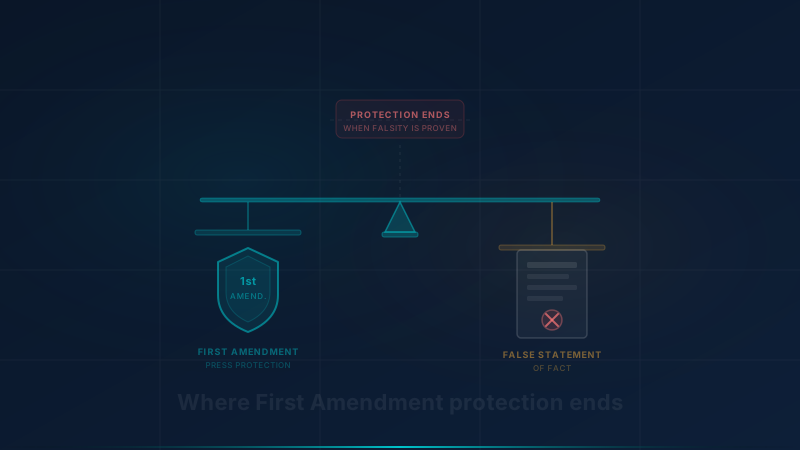
The First Amendment protects the press from government censorship -- not from civil defamation lawsuits. Private individuals can still sue news outlets for publishing false statements of fact, and some win.
Whether you are a public figure or private individual changes everything. Public figures must prove "actual malice" -- a nearly impossible standard -- while private individuals only need to prove negligence in most states.
First Amendment protection ends categorically when a publisher knowingly prints a false statement of fact. Fabricated quotes, reckless disregard for the truth, and negligent misrepresentation all fall outside the constitutional shield.
Having legal grounds for a defamation claim is not the same as having a practical remedy. For most people, editorial removal -- pursued directly, without a lawsuit -- is faster, cheaper, more private, and more likely to succeed than litigation.
- What the First Amendment Actually Protects
- The Two-Track Defamation Standard: Public Figures vs. Private Individuals
- Public Figure vs. Private Individual: What Each Must Prove
- Where First Amendment Protection Ends: When News Outlets Can Be Held Liable
- The Real Reason Most People Can't Sue a News Outlet -- Even When They're Right
- What You Can Actually Do When a News Article Harms You
- The Difference Between a Legal Claim and a Practical Remedy
- Frequently Asked Questions
What the First Amendment Actually Protects
The most common misconception in news article removal cases is this: that the First Amendment gives publishers absolute immunity from legal consequences for what they publish. It does not. The First Amendment to the U.S. Constitution reads, in relevant part, that "Congress shall make no law... abridging the freedom of speech, or of the press." The operative phrase is Congress shall make no law.
This is a restraint on government action -- specifically, on legislatures and, by extension through the Fourteenth Amendment, on all state and federal government actors. It prohibits the government from censoring news outlets, criminalizing publication, or ordering a newspaper to remove an article. It does not prohibit private individuals from filing civil lawsuits seeking damages for harm caused by false statements. Civil defamation law has coexisted with the First Amendment since the founding era, and the Supreme Court has never held otherwise.
What the First Amendment does in the defamation context is modulate the civil standard -- the bar a plaintiff must clear to win. The Court has held that allowing defamation liability to be imposed too easily would "chill" protected speech: publishers would become overly cautious about reporting on matters of public concern if even an honest mistake could expose them to ruinous damages. So the First Amendment raises the threshold for liability, particularly for speech about public figures on matters of public concern. But it does not eliminate liability entirely. The shield has limits, and those limits are precisely defined. The EFF's guide on free speech and defamation law explains these constitutional boundaries in plain language and is a useful reference before pursuing any legal path.
When a news outlet says "we have First Amendment protection" in response to a removal request, they are often conflating two very different things: immunity from government censorship (which they do have, absolutely) and immunity from civil liability for false statements (which they do not have, depending on what was published and about whom). Understanding this distinction is the foundation of every defamation analysis.
The Two-Track Defamation Standard: Public Figures vs. Private Individuals
The Supreme Court's 1964 decision in New York Times Co. v. Sullivan is the foundational case in American defamation law, and understanding it is essential to understanding whether you have a viable claim. The case arose from a full-page civil rights advertisement in the Times that contained some factual inaccuracies about police conduct in Montgomery, Alabama. L.B. Sullivan, a Montgomery city commissioner, sued the Times for defamation and won a $500,000 verdict at the state level. The Supreme Court reversed unanimously.
The Court held that a public official -- and by later extension, any public figure -- cannot win a defamation claim unless they can prove the defendant acted with "actual malice." Actual malice is a precise legal term of art: the actual malice standard means the defendant published the statement either knowing it was false at the time of publication, or with reckless disregard for whether it was true or false. Negligence -- simply getting something wrong -- is not enough. Honest error is not enough. Even sloppy journalism is not enough, if the publisher did not subjectively understand the statement to be false or consciously entertain serious doubts about its truth.
This standard makes it extraordinarily difficult for public figures to win defamation cases. The reason is intentional: the Court recognized that robust debate about public affairs requires some tolerance for error. Requiring media outlets to guarantee the accuracy of every statement would cripple journalism on matters of genuine public concern.
Gertz v. Robert Welch -- the Private Individual Exception
Ten years after Sullivan, the Supreme Court decided Gertz v. Robert Welch, Inc. (1974), which established the separate standard applicable to private individuals. For a full treatment of how this distinction plays out in practice, see our guide on the private figure standard. Elmer Gertz was a Chicago attorney who represented a family suing a police officer for wrongful death. The John Birch Society's magazine published an article falsely claiming Gertz was a "communist-fronter" and a Leninist, among other fabrications. Gertz sued.
The Court held that private individuals -- people who have not voluntarily thrust themselves into public controversies and who do not have ready access to media channels to rebut false statements -- do not need to meet the actual malice standard. States are free to define their own standard for private individual defamation claims, as long as they require at least some showing of fault. Most states have adopted a negligence standard: a private individual plaintiff needs to prove only that the publisher failed to exercise reasonable care in verifying the truth of the statement.
The Court's reasoning was explicit: private individuals deserve more protection because they haven't sought public life, they are more vulnerable to reputational damage, and they lack the equivalent power to rebut falsehoods through media access. The constitutional balance tilts differently for them.
The third landmark case completing this framework is Philadelphia Newspapers, Inc. v. Hepps (1986), which established that private-figure plaintiffs bear the burden of proving falsity when the defamatory statement relates to a matter of public concern. The press does not have to prove the statement was true -- the plaintiff must prove it was false. This places a significant evidentiary burden on plaintiffs, even private individuals.
Public Figure vs. Private Individual: What Each Must Prove
| Factor | Public Figure | Private Individual |
|---|---|---|
| Fault standard required | Actual malice -- publisher knew the statement was false or acted with reckless disregard for truth | Negligence in most states -- publisher failed to exercise reasonable care in verification |
| Burden of proof on falsity | Plaintiff must prove the statement was false (per Hepps) | Plaintiff must prove falsity when the statement concerns a matter of public concern |
| Damages available | Must prove actual damages unless actual malice shown; punitive damages require actual malice | Actual damages; some states permit presumed damages; punitive damages more accessible |
| How hard is this to win? | Very Difficult | Difficult -- but viable |
| Typical outcome | Most cases dismissed; proving actual malice on direct evidence is rare and expensive | More cases survive motions to dismiss; settlements are common; wins do occur |
Courts have developed the concept of the "limited purpose public figure" -- someone who becomes a public figure for a specific controversy even if not generally famous. A private businessperson whose company becomes the subject of a regulatory investigation, or someone who voluntarily makes statements to the media about a public controversy, may be treated as a limited public figure for purposes of that controversy. If this applies to you, the actual malice standard may apply even if you don't consider yourself a public figure. This analysis is fact-specific and requires legal counsel to assess properly.
Where First Amendment Protection Ends: When News Outlets Can Be Held Liable
The constitutional protection for news outlets is robust but not unlimited. Several categories of conduct fall categorically outside First Amendment protection in the defamation context:
-
1False statements of fact presented as true: The First Amendment protects opinion, satire, and rhetoric. It does not protect statements that a reasonable person would understand as assertions of verifiable fact, when those statements are false. The line between protected opinion and actionable fact is context-dependent, but courts look at whether the statement is objectively verifiable. "I think John Smith is dishonest" is opinion. "John Smith embezzled $100,000 from his employer" is a statement of fact -- and if false, it is not protected.
-
2Knowing falsity: If a publisher publishes something knowing it is false at the time of publication, First Amendment protection evaporates entirely. This is the clearest case of actual malice, and it applies to public and private figure claims alike. The difficulty is proving what the publisher actually knew -- which requires discovery, internal communications, editorial records, and sometimes depositions.
-
3Reckless disregard for truth: Under Sullivan, even if the publisher didn't know the statement was false, publishing while "entertaining serious doubts" about its truth -- i.e., consciously ignoring a high probability of falsity -- satisfies the actual malice standard. Courts have found reckless disregard where publishers relied on a source they had reason to distrust, failed to check available records, or published implausible stories without verification. The SPJ Ethics Code requires journalists to "verify information before releasing it" -- systematic failure to do so can be evidence of recklessness.
-
4Fabricated quotes: Placing words in someone's mouth that they never said -- or substantially altering a quote to change its meaning -- can give rise to defamation liability. The Supreme Court addressed this directly in Masson v. New Yorker Magazine (1991): altered quotations are actionable if they result in a materially different, false meaning.
-
5Negligent misrepresentation (private individual claims): For private individuals, publishers are exposed to liability when they fail to exercise reasonable care in verifying information -- even without any subjective bad faith. A reporter who doesn't call for comment, doesn't check public records, or doesn't verify a source's claims before publishing about a private individual may have exposed their employer to negligence-based defamation liability under the standard most states apply after Gertz.
The Real Reason Most People Can't Sue a News Outlet -- Even When They're Right
Here is something most attorneys explain only after you've hired them: having a legally valid defamation claim and being able to effectively pursue that claim are two very different things. Most people who have been harmed by false news coverage have neither the time nor the resources to litigate successfully, even if the law is on their side.
Based on RemoveNews.ai's history of over 1,000 removal requests handled since 2013, editorial removal requests succeed in roughly 28 to 35% of cases when properly documented and targeted to the correct editorial contact -- without a lawsuit, without legal fees, and without triggering additional coverage. Among cases where clients had been told by attorneys that they had viable defamation claims but chose not to litigate, the editorial removal route produced a removal or substantial correction in approximately one-third of cases within 90 days. Litigation, by contrast, typically produces a final outcome -- not necessarily a favorable one -- in 18 to 36 months, at costs starting at $50,000 for straightforward cases.
Harmed by a news article? Our free tool drafts a professional removal request and finds the right editorial contact -- no lawsuit required. Takes 60 seconds.
Start Free -- Generate My Removal RequestWhat You Can Actually Do When a News Article Harms You
The most effective path forward for most people is not a lawsuit -- it is a structured sequence of editorial interventions, pursued in order of probability of success and visibility risk. Here is the framework we use at RemoveNews.ai, drawn from more than a decade of case work:
Step 1: Direct editorial removal request
The first contact should be a professionally written removal request sent to the appropriate editorial decision-maker at the publication -- not the reporter who wrote the piece, who has no authority to remove it, and who may feel personally defensive. For smaller publications, that's typically the managing editor or editor-in-chief. For larger outlets, it may be the corrections editor, public editor, or reader representative. The request should cite the specific factual harm, provide documentation where available, and invoke the publication's own ethics obligations -- including the SPJ Ethics Code's directive to minimize harm and reconsider whether continued publication serves current public interest.
Step 2: Correction or retraction request
If full removal is declined, a formal correction or update request is often more achievable. An article that now prominently notes a material factual correction -- or that has been updated to reflect subsequent developments that undercut the original narrative -- is a meaningfully different search result. Many states have retraction statutes that, if followed, limit the damages a plaintiff can recover in subsequent litigation. Publishers often honor retraction requests specifically to preserve that legal protection. See our guide on how to demand a formal retraction to use this leverage effectively, and our analysis of defamation lawsuit requirements before committing to litigation.
Step 3: Escalation within the publication
If the initial editorial contact declines, escalate to the publisher, the editorial board, or the ombudsman if the publication has one. Document each communication. A pattern of documented escalation strengthens any subsequent legal claim and demonstrates that you exhausted editorial remedies in good faith.
Step 4: GDPR erasure request (EU and UK residents)
If you are a resident of the European Union or United Kingdom, Article 17 of the GDPR -- the right to erasure -- provides a formal legal mechanism for requesting removal of personal data from search results and, in some cases, from the publisher itself. The proportionality standard under GDPR is particularly favorable when the article contains false information or when the public interest in continued display has clearly expired. Google has a formal GDPR removal process through its Search Console.
Step 5: Search suppression
When removal is not achievable in the short term, suppression -- building a sufficient volume of well-indexed positive content to displace the harmful article from the first page of search results for your name -- is a reliable long-term strategy. It doesn't require the publisher's cooperation, it doesn't create new coverage, and it addresses the actual harm: that people searching your name encounter the article. Our step-by-step guide to running a content suppression campaign walks through the full process. The complete guide to news article removal is here.
The Difference Between a Legal Claim and a Practical Remedy
This distinction is one that too few people working through this situation understand clearly. You may have legally valid grounds for a defamation claim -- a false statement of fact, a negligent publisher, provable damages -- and still be better served by pursuing editorial removal rather than litigation. These two things are not in conflict. Having legal grounds strengthens your editorial leverage: a well-documented removal request that includes a factual summary of the legal case for liability -- without filing or threatening to file -- often prompts a publication to take the request more seriously.
The decision to litigate should be driven by a specific calculus: Is your primary goal money damages? Is it a public vindication of your reputation through a court verdict? Or is it simply to get the article removed from Google search results? If the goal is removal, litigation is rarely the most direct path. It is expensive, slow, public, and uncertain. Editorial engagement -- pursued with appropriate professionalism and documentation -- is direct, private, low-cost, and frequently effective.
- When money damages are the primary goal. If you have suffered quantifiable financial harm -- lost a job, lost a contract, lost income -- that you can document and trace directly to the false article, and you have evidence of actual malice or can meet the negligence standard, a defamation attorney can assess whether the damages justify the cost of litigation.
- When the publisher is a small operation without strong legal resources. Anti-SLAPP exposure, litigation costs, and discovery burden cut both ways. A small publication without a media law firm on retainer may settle quickly when a credible legal demand is presented.
- When the false statement is provably, documentably wrong. If you have a document in your possession that directly contradicts the article's central factual claim -- a court order, a government record, a contract -- the evidentiary hurdle is lower and the likelihood of surviving an anti-SLAPP motion is higher.
- When you have already exhausted editorial remedies. Litigation is a last resort, not a first step. If you have sent documented removal requests, received formal refusals, and pursued all available escalation paths, you have built the factual record that makes a subsequent legal claim more credible and more likely to be taken seriously.
If you believe you have a viable defamation claim, consult a news article removal attorney in your state before sending any threatening correspondence to the publication. Pre-litigation demands must be drafted carefully to avoid telegraphing weaknesses in your position or triggering an anti-SLAPP motion before you're prepared for it. The Reporters Committee for Freedom of the Press provides detailed guidance on how media organizations approach defamation claims -- reading this from the defense perspective will help you understand exactly what arguments you will face. For a comprehensive overview of how defamation law works under the First Amendment, Cornell Law's Legal Information Institute is the most authoritative free resource available. The First Amendment Coalition also provides practical guidance on where press protections end and individual rights begin.
This article is for informational purposes only and does not constitute legal advice. First Amendment defamation doctrine varies by jurisdiction and by the specific facts of your situation. Consult a qualified media law attorney for your specific situation before taking any action toward a news outlet, including sending removal requests or demand letters.