The CPA Discipline Is Resolved. The Google Results Aren't.
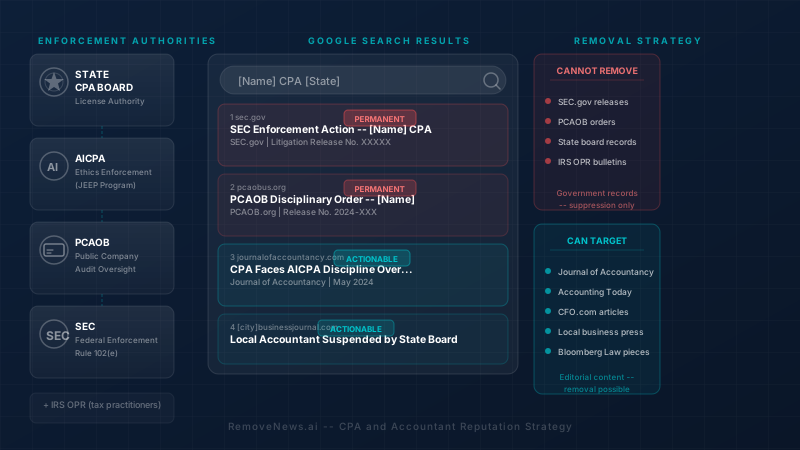
CPAs and accountants face one of the most complex professional reputation problems in any licensed field: discipline can come from multiple overlapping authorities simultaneously -- state CPA board, AICPA, PCAOB, SEC, or IRS Office of Professional Responsibility -- each of which publishes enforcement records in different places, and accounting trade press (Accounting Today, Journal of Accountancy) and financial press (WSJ, Bloomberg) both actively cover enforcement actions as a regular beat. The result is multiple permanent public records plus multiple independent news articles -- all ranking for a practitioner's name. This guide explains what each authority publishes, where the editorial layer sits on top of the official records, and which removal strategies are actually viable for each category of content.
By Anthony WillFounder & CEO, Reputation Resolutions · Removing articles since 2013
Updated June 30, 2026Published May 12, 2026 · 12 min read
Key Takeaways
CPA discipline can come from four separate authorities at once -- state CPA board, AICPA, PCAOB, and SEC -- each publishing its own permanent public enforcement record with separate Google footprints that compound the search result problem exponentially compared to professions with a single enforcement body.
PCAOB and SEC enforcement actions are permanent federal records with extremely high Google authority; they are among the hardest professional discipline records to suppress in search and cannot be removed through any standard mechanism.
News articles covering accounting enforcement are a separate editorial target fro
m the enforcement records themselves -- Accounting Today, Journal of Accountancy, and general financial press all cover CPA discipline as a regular beat, and these editorial publications can sometimes be updated or removed.
State CPA board discipline and AICPA ethics violations are often more actionable for editorial removal than PCAOB or SEC matters, because state-level and professional association publications have more editorial discretion over outdated or resolved content than the federal government does.
The Four Enforcement Authorities -- and Why They Create Different Problems
Most licensed professionals face a single regulatory body. Doctors have state medical boards. Lawyers have state bar associations. Financial advisors have FINRA and the SEC. Accountants face a fundamentally different architecture: up to five separate enforcement authorities, each with its own publication infrastructure, each capable of generating independent Google results for the same underlying event. Understanding each authority is the first step toward understanding the scope of the problem.
State CPA Board
Each state's board of accountancy is the primary licensing authority for CPAs practicing in that state. When a state board takes disciplinary action -- license suspension, revocation, censure, probation, or conditions on practice -- it publishes that action on the board's official website, which is a state .gov domain. These pages rank highly for searches combining the practitioner's name with "CPA" and the state name.
State board disciplinary records cannot be removed. They are official government records maintained by a government agency under state law. The records persist on the state board website even after a license is reinstated. For most CPAs who face discipline, this is the base layer of the Google footprint problem -- the first entry that appears for a name search and the one that no amount of outreach will alter.
AICPA -- American Institute of CPAs
The AICPA's professional standards are enforced through the Joint Ethics Enforcement Program (JEEP) -- the AICPA's Joint Ethics Enforcement Program (JEEP) handles ethics violations for AICPA members and state CPA society members. AICPA disciplines members for violations of its Code of Professional Conduct and publishes disciplinary actions in the Journal of Accountancy and on the AICPA website.
AICPA discipline is legally and operationally separate from state board action. A CPA can face both simultaneously for the same underlying conduct -- the state board acting on the license and the AICPA acting on membership. Because AICPA membership is voluntary, an AICPA ethics sanction does not automatically affect a CPA's license to practice. Conversely, a state board suspension does not automatically affect AICPA membership, though AICPA may initiate its own inquiry based on state board action. This separation creates two enforcement publications for one event.
PCAOB -- Public Company Accounting Oversight Board
The PCAOB was created by the Sarbanes-Oxley Act of 2002 to oversee auditors of public companies. PCAOB sanctions auditors -- both firms and individual practitioners -- who audit SEC registrants. Disciplinary orders are published on the PCAOB website and are permanent federal records.
PCAOB.org carries very high domain authority in Google's index. An individual named in a PCAOB disciplinary order will typically find that order ranking in the top three search results for their name combined with any accounting-related term. PCAOB sanctions are generally career-defining for auditors who work with public companies, but they apply only to practitioners involved in audits of SEC registrants -- a significant but not universal portion of the CPA population.
SEC Enforcement -- Division of Enforcement and Rule 102(e)
The Securities and Exchange Commission pursues CPAs and auditors under Rule 102(e) of the Rules of Practice, which governs who may practice before the Commission. When the SEC bars or suspends a CPA from practice before the Commission, it issues a formal order published on SEC.gov. These are catalogued in the SEC enforcement actions database. Litigation Releases covering accounting enforcement are also published on SEC.gov and syndicated through the SEC's news distribution system.
SEC.gov has domain authority comparable to the largest news organizations in the world. An SEC enforcement release naming an individual accountant or auditor typically ranks first or second in Google results for that person's name -- often above their own professional website, their firm's page, and their LinkedIn profile. It is one of the highest-ranking and most persistent types of professional discipline records in any field. Unlike PCAOB sanctions, SEC enforcement under Rule 102(e) can reach any CPA or accountant who participates in SEC filings, not only those who audit public companies.
IRS Office of Professional Responsibility
The IRS Office of Professional Responsibility (OPR) regulates CPAs, enrolled agents, and other practitioners who practice before the IRS under Treasury Department Circular 230. OPR disciplinary actions -- censure, suspension, disbarment from practice before the IRS -- are published in the Internal Revenue Bulletin. OPR publications are less prominently indexed in Google than PCAOB or SEC records, but they are publicly available and relevant for tax practitioners. For CPAs who focus primarily on tax practice, an OPR action is a significant addition to the Google footprint problem.
We remove damaging professional coverage — you only pay after it’s gone.
No upfront payment No retainer A+ BBB Rated 5,000+ clients helped In business since 2013 Only Pay For Results True Removal Experts
CPAs and accountants face one of the most complex professional reputation problems in any licensed field: discipline can come from multiple overlapping authorities simultaneously -- state CPA board, A
Section 02
How News Coverage Layers on Top of Enforcement Records
Each of the enforcement authorities above does not simply publish a record and stop. Each authority's actions generate press coverage that exists entirely separately from the enforcement record itself -- in different publications, indexed by different URLs, and often outlasting the original enforcement publication in Google rankings as the article accumulates inbound links over time.
The PCAOB publishes a press release when it sanctions an auditor. That press release is picked up and reported on by Bloomberg Law, Accounting Today, CFO.com, and the Journal of Accountancy -- each publication writing its own article with its own URL, its own headline, and its own Google ranking. The PCAOB press release itself ranks on PCAOB.org. The Bloomberg Law article ranks on Bloomberg.com. The Accounting Today article ranks on AccountingToday.com. Four separate indexed results from a single enforcement action.
The pattern is even more pronounced for SEC enforcement. The SEC issues a Litigation Release that ranks prominently on SEC.gov. The Wall Street Journal, Bloomberg, Reuters, and the Financial Times all cover significant SEC accounting enforcement actions in their own articles. Regional business press covers local practitioners. Legal blogs and law firm client alerts aggregate and analyze the enforcement action, creating additional indexed content.
The practical result: a CPA who has faced simultaneous PCAOB sanction and state board action may find 6 to 10 separate indexed items appearing in the first two pages of Google results for their name -- a combination of enforcement records and news articles that collectively tell a one-sided story of the event without any balancing context about resolution, reinstatement, or the practitioner's subsequent career.
Strategic Distinction
"The distinction that matters for removal strategy: SEC.gov and PCAOB.org enforcement records are permanent federal publications that cannot be altered or removed. But the Journal of Accountancy article covering the same enforcement action is editorial content -- the publisher made a decision to cover it, and the publisher can make a decision to update it. Conflating the two leads to wasted effort. Every hour spent trying to remove a government enforcement page is an hour not spent on the editorial removal strategy that can actually produce results."
Section 03
The Google Footprint of a CPA Enforcement Action
Understanding how Google actually ranks enforcement records is essential for calibrating expectations and designing a realistic strategy. The ranking hierarchy is driven primarily by domain authority -- a measure of a website's overall credibility and link profile that Google uses as a major ranking signal.
SEC.gov has PageRank comparable to the largest news organizations in the United States. An SEC Litigation Release or enforcement order naming a specific CPA will almost always rank first or second for a search on that person's name combined with any professional term. PCAOB.org similarly carries high authority, placing PCAOB disciplinary orders in the top three results in the vast majority of cases. State CPA board websites rank highly for localized searches -- "[name] CPA [state]" -- because of their .gov status and topical relevance.
Accounting Today and the Journal of Accountancy both rank well within Google's general index, particularly for searches that combine a practitioner's name with accounting or audit terminology. Articles in these publications can persist in search results for years, accumulating links from other sites that reinforce their ranking.
Suppression versus removal: these are two distinct strategies that serve different purposes. Suppression means creating enough high-quality content about the practitioner -- LinkedIn profiles, speaking engagement pages, authored articles, firm bios, professional directory listings -- that enforcement records and news articles are displaced from the top five search results for the practitioner's name. Suppression does not delete the enforcement record; it changes what a casual searcher sees first. Removal, by contrast, means that the news article (not the enforcement record) is taken down from the publisher's website or de-indexed from Google, so it no longer appears in search results at all. Removal is a binary outcome -- the article either disappears or it does not. Suppression is a probabilistic outcome measured by how far down the search results the negative content moves.
For SEC.gov and PCAOB.org records, only suppression is viable. For accounting trade press and general financial news articles, both suppression and removal are potential strategies, with the right approach depending on the publication, the article's age, the resolution status of the underlying matter, and the specific grounds available.
Section 04
What Grounds Work for Editorial Removal Requests
Editorial removal requests succeed or fail based on the quality of the grounds offered to the publisher. Publications have no legal obligation to remove accurate, timely reporting. Requests that do not identify specific, legitimate grounds for removal are ignored or, worse, draw renewed attention to the article. The following are the grounds that actually move accounting trade press editors:
Discipline completed, license reinstated, and CPA is actively practicing. This is the strongest available argument for removal from accounting trade press. An article reporting a license suspension that was written when the suspension was current becomes factually incomplete -- and arguably misleading -- once the license is reinstated and the CPA is back in practice. The "no longer current" argument is most compelling when the article has no contextual reference to the possibility of reinstatement and reads as a permanent characterization of the practitioner's status. Once an article is removed at the source, Google's legal removal tools can accelerate de-indexing.
Charges or investigation resulted in no action or lesser sanction than originally reported. If an article reported that a CPA was "under investigation" or "facing charges" and the matter closed without action or with a significantly lesser outcome than the original reporting suggested, factual grounds for correction or removal exist. The original article created an impression of severity that the record does not support.
Factual errors in the original coverage. Accounting enforcement articles sometimes contain errors in dollar amounts, timeline, firm affiliation, or the specific nature of the alleged conduct. Even a single documented factual error -- a client engagement amount stated incorrectly, a date wrong by a year, a firm name that was not the practitioner's firm at the time -- can open a correction request that may lead to broader editorial reconsideration. Document every error with specific citations before approaching the publication.
AICPA membership reinstated after ethics sanction. An article describing a CPA's expulsion from the AICPA is factually incomplete after reinstatement is granted. The Journal of Accountancy and similar AICPA-affiliated publications have editorial reason to update articles when the underlying membership status has changed. This argument is particularly strong when the reinstatement is itself documented in an AICPA publication -- the later record directly contradicts the current framing of the earlier article.
Small regional outlet that no longer maintains its archive. Many regional business journals have gone through ownership changes, platform migrations, or editorial cutbacks that have left older archives in a state of benign neglect. Editors at these outlets are often more receptive to removal requests for older content precisely because they have limited bandwidth to manage archival articles and may prefer a clean removal over an ongoing content liability.
Article identifies clients or engagement details that may implicate confidentiality. Some enforcement articles include details about specific client engagements, audit subjects, or business relationships that were disclosed during the enforcement process. Where those details raise confidentiality concerns under applicable professional standards, there may be grounds to request redaction or removal of specific content -- even if the core enforcement narrative is accurate and remains in the article.
Important Limitation
CPAs have no legal right to force removal of accurate news coverage. Requests citing rights to privacy or professional reputation without factual or recency grounds will be ignored or escalate scrutiny. Some publications have policies of publishing follow-up articles when practitioners attempt to suppress coverage -- a "Streisand Effect" dynamic that makes the original article rank even higher. All editorial removal requests must be grounded in accuracy or changed circumstances, never in personal preference. Involving a reputation specialist who knows how to frame these requests without triggering defensive responses is strongly advisable.
Section 05
Google De-Indexing for Accounting Enforcement Coverage
Google's URL removal tools offer a secondary pathway for addressing news articles that are not responsive to direct editorial requests. De-indexing is the process of requesting that Google remove a specific URL from its search index, meaning the page will no longer appear in search results even if the publisher has not taken the article down from their website.
Outdated content removal is the most applicable Google tool for accounting enforcement articles. Google's Search Console includes an outdated content removal tool that allows a requestor to flag a URL as showing information that is no longer accurate or current. For accounting articles that describe a suspension that has since been lifted, a sanction that has been reversed on appeal, or a disciplinary status that has materially changed, the outdated content tool provides a mechanism for requesting de-indexing based on factual obsolescence. This tool does not guarantee removal -- Google evaluates each request -- but for genuinely outdated content with clear documentation of the changed circumstances, it can be effective.
Sensitive personal information is a second available ground under Google's search removal policies. If the article includes the practitioner's home address, personal financial details beyond the scope of the enforcement action, or similar PII that was not central to the enforcement matter, Google's sensitive information removal policy may apply to request de-indexing of those specific details -- and in some cases, the entire URL if the personal information is sufficiently embedded in the content.
Two critical limitations apply specifically to accounting enforcement content. First, SEC.gov and PCAOB.org pages cannot be de-indexed via standard Google removal tools. Google does not process de-indexing requests for government websites. These records remain in Google's index regardless of any request submitted through Search Console or the URL removal tool. Second, de-indexing an Accounting Today or Journal of Accountancy article from Google requires working with the publisher first, because those publications control their own robots.txt and noindex directives. Google will not de-index a page that the publisher is actively serving without restrictions; the publisher must either remove the article or add a noindex directive before Google's index reflects the change. The editorial removal request and the Google de-indexing request are therefore sequential, not parallel, for trade press articles.
For context on how this process works across different types of news content, see our broader guide on government press release removal which covers the specific limitations that apply to government domain content and how to work around them through suppression strategies.
Section 06
Removal Difficulty by Source
Source
Removal Difficulty
Timeframe
Notes
SEC.gov enforcement release
Impossible
N/A -- permanent federal record
Cannot be removed; suppression only strategy applies
PCAOB.org disciplinary order
Impossible
N/A -- permanent federal record
Cannot be removed; suppression only strategy applies
State CPA board website
Impossible
N/A -- permanent government record
Record stays even after license reinstatement; suppression only
Journal of Accountancy / AICPA publications
Moderate
6 to 14 weeks
AICPA has editorial discretion; reinstatement of membership significantly strengthens request
Accounting Today / CFO.com
Moderate
6 to 12 weeks
Trade press is responsive to "case is closed" arguments when properly documented
Bloomberg Law / Wall Street Journal
Very Hard
12 to 24+ weeks
Major outlets rarely remove; an update or correction notice is the more realistic outcome
Local business journal
Moderate
4 to 10 weeks
Smaller outlets more receptive to removal for older, resolved matters
Google (standard search de-index)
Hard
8 to 20 weeks
Requires publisher cooperation first; SEC and PCAOB pages are completely unaffected by Google removal tools
Section 07
The 6-Step Plan for CPAs and Accountants
1
Map every enforcement record across all relevant authorities. Check the state board website, AICPA disciplinary publications, PCAOB.org, SEC.gov and EDGAR, and the IRS Internal Revenue Bulletin. Run an incognito Google search for "[your name] CPA," "[your name] accountant [firm name]," "[your name] auditor," and "[your name] PCAOB" to see exactly what is currently ranking and from which sources.
2
Separate enforcement records from editorial publications. Go through every search result and classify it: is this a government enforcement record (SEC.gov, PCAOB.org, state board .gov), or is this editorial content (trade press article, financial news article, legal blog)? Allocate removal effort only to the editorial layer. Do not waste resources on government records that cannot be changed.
3
Confirm the current status of all proceedings. Pull your current license status from the state board, confirm your AICPA membership status, and identify any reinstatement orders, appeal decisions, or consent orders that modify the original enforcement action. These documents are the factual foundation of your editorial arguments -- without them, removal requests have no evidentiary basis.
4
Build a tailored removal request for each editorial article. For each news article, identify the specific grounds that apply -- factual errors, resolved case, outdated status, changed circumstances. Paste the article URL into RemoveNews.ai to generate a tailored removal request with the correct editorial contact identified. Generic removal requests addressed to the wrong editor fail most of the time; targeted, specific, documented requests succeed at a meaningfully higher rate.
5
Pursue Google de-indexing for articles where publishers are unresponsive. For older articles -- generally three or more years old -- where the underlying action is fully resolved and the publisher has not responded to a removal request, submit an outdated content removal request through Google Search Console. Document the changed circumstances thoroughly in the request. This is a secondary option, not a substitute for publisher engagement, but it can succeed where direct outreach has failed.
6
Build positive counter-content to drive suppression of immovable records. A strong LinkedIn presence, speaking engagements at accounting conferences (AICPA ENGAGE, state society events), published articles in accounting publications under your own byline, updated professional directory profiles on CPA.com and state society directories, and a professional website that clearly conveys current practice status all give Google positive, authoritative material to surface for your name. This is the only viable strategy for SEC.gov and PCAOB.org records -- and it complements, rather than replaces, the editorial removal effort for trade press articles.
Multiple enforcement records and multiple news articles are different problems. We handle both. Start with your article URL and we will identify what is actionable and what is not.
AICPA membership can be reinstated after an ethics sanction, following a period of suspension or expulsion as determined by the AICPA's Professional Ethics Division. The reinstatement process typically involves demonstrating that the circumstances underlying the original ethics violation have been addressed and that the member meets AICPA's current membership standards.
The period immediately following reinstatement is the strongest window for requesting editorial updates or removal from AICPA-affiliated publications. The Journal of Accountancy has published follow-up notices of reinstatement in documented cases -- this is the best-case editorial outcome when full removal of the original article is not achievable. A reinstatement notice does not erase the original article, but it creates a second indexed URL that provides context and, in many cases, ranks alongside the original enforcement article, giving searchers the complete picture.
The practical recommendation is to act within 12 to 18 months of reinstatement for the best editorial results. The longer the gap between reinstatement and the removal request, the more the original article has settled into Google's index as historical record rather than current information -- and the weaker the "no longer current" argument becomes. Publishers are most receptive to recency arguments when the change in status is genuinely recent.
For CPAs dealing with news coverage that extends beyond the accounting trade press into general financial media, the strategic framework described in our guide on financial advisor news article and FINRA reputation management covers the broader editorial removal landscape for financial professionals facing major press coverage of regulatory events.
Additionally, if accounting enforcement coverage is surfacing in AI-generated search results and chatbot responses, see our dedicated guide on removing content from ChatGPT and AI search for strategies specific to that emerging channel.
CPAs who need a structured path forward may benefit from working with a news article removal attorney who understands professional licensing contexts. For a realistic sense of what intervention costs, see our breakdown of the cost of professional removal. If the enforcement article is also surfacing during employment background checks, our guide on an article affecting your background check covers that specific problem. CPAs still weighing whether to act can review our guide on whether to respond publicly before engaging any publisher.
Free Consultation
Is your article removable? Find out -- free.
Tell us about your situation and a removal specialist will personally review it and respond within one business day. No pressure, no obligation.
No upfront payment -- you only pay if we succeed
A+ BBB Rated · 5,000+ Clients Helped · Since 2013
100% Confidential · Response within 1 business day
Frequently Asked Questions
CPA Discipline, News Coverage, and Google: Common Questions
Can a CPA force removal of an SEC enforcement release or PCAOB sanction from Google?
No. SEC.gov and PCAOB.org are government domains that publish permanent federal records. These pages cannot be removed from Google through any standard de-indexing tool -- Google does not accept removal requests for government enforcement records, and the agencies themselves are not permitted to delete enforcement publications. The only strategy available for SEC and PCAOB records is search suppression: building enough high-ranking positive content that the enforcement records are displaced from the top positions for your name. This is achievable in many cases but requires sustained effort over 12 to 24 months and a robust content strategy that gives Google positive, authoritative material to prioritize.
How long do CPA disciplinary actions stay in Google search results?
State CPA board records, SEC enforcement releases, and PCAOB disciplinary orders are permanent and will remain in Google indefinitely. There is no expiration date and no removal mechanism for these government pages. News articles covering those enforcement actions may become less prominent over time as content ages and accumulates fewer recent inbound links, but without active suppression or editorial removal efforts, they can continue to rank for a practitioner's name for years or even decades after the underlying matter is resolved. The practical experience of most practitioners is that articles covering major enforcement actions remain highly visible for five to ten years without active intervention.
What is the difference between AICPA discipline and state CPA board discipline?
State CPA board discipline is a government action that affects your CPA license -- it can result in suspension, revocation, censure, probation, or conditions on your practice. AICPA discipline is a professional association action that affects your membership in a voluntary organization and is handled through the Joint Ethics Enforcement Program. The two can arise from the same underlying conduct simultaneously, but they are legally and operationally separate. An AICPA ethics sanction does not automatically affect your license, and a state board action does not automatically affect your AICPA membership. Each publishes its own enforcement record in a different location, and each generates its own potential press coverage -- meaning two articles for one event, published in different outlets with different editorial contacts, requiring separate removal approaches.
If my CPA license was reinstated, can I get the news articles about my suspension removed?
License reinstatement significantly strengthens your editorial removal argument and is often the pivotal fact that moves a trade press editor from "no" to "yes." The strongest grounds for requesting removal from accounting trade press are that the matter is fully resolved, the license is active, and the article no longer reflects current facts. Journal of Accountancy and Accounting Today have both updated or removed articles following reinstatement in documented cases. The window of greatest leverage is approximately 12 to 18 months following reinstatement. Acting promptly matters: the more time passes, the more the article becomes an archived historical record rather than actionable current content, and the weaker the recency argument becomes with editors.
Does a PCAOB sanction show up in Google for my name?
Yes, almost always and near the top. PCAOB.org is a high-authority website, and the PCAOB publishes press releases for each disciplinary order alongside the formal order itself. These press releases are typically indexed by Google within 24 to 48 hours of publication. Because PCAOB.org carries strong domain authority and the releases are keyword-rich with the practitioner's full name, firm, and audit-related terms, they typically rank in the top three results for a search combining the practitioner's name with "CPA," "auditor," or "accountant." Bloomberg Law, Accounting Today, and in significant cases the Wall Street Journal frequently pick up PCAOB sanctions and publish their own coverage, adding additional indexed results on top of the PCAOB's own publication.
How do I address accounting enforcement coverage in AI search results like ChatGPT?
AI search tools including ChatGPT, Google's AI Overviews, and Perplexity draw from indexed web content, which means SEC.gov enforcement releases, PCAOB.org disciplinary orders, and accounting trade press articles about an enforcement action may appear in AI-generated summaries when someone queries a practitioner's professional background. Addressing this requires a two-track approach: editorial removal of news articles where possible -- which reduces the source material that AI models can cite -- and active creation of positive professional content that gives AI systems a more complete and current picture of your career and standing. Our dedicated guide on removing content from AI search results covers the specific mechanisms and limitations involved in this emerging channel.
Your Enforcement Record Is Fixed. Your Search Results Don't Have to Be.
We work with CPAs, auditors, and accounting firm partners to address the news coverage and editorial content that layers on top of government enforcement records -- the only part of this problem that is actually actionable.
CEO & Co-Founder, RemoveNews.ai · Reputation Resolutions
Anthony has spent 13+ years studying what makes negative news content stick — and how to remove it. He co-founded Reputation Resolutions and has helped 5,000+ clients remove and suppress damaging press coverage. He holds Corporate & Crisis Communications and Brand Management certifications from Cornell, a Digital Marketing certificate from NYU, and is a member of the Forbes Agency Council and Fast Company Executive Board.